
Senetic offers a business IT purchasing route for Microsoft software and hardware, making it a relevant benchmark when you compare suppliers. The ceiling is a purchasing decision that stops at the licence rather than defining installation, administration and support responsibilities. The best Senetic alternative in 2026 is VOLL if you need Microsoft 365 alongside Portuguese business IT support; Microsoft direct if your team can own deployment and administration.
- For senetic alternatives, choose VOLL for Microsoft 365 purchasing alongside Portuguese business IT support.
- Choose Microsoft direct when your internal team owns deployment, administration and support coordination.
- Microsoft 365 subscriptions and volume licensing agreements are different purchasing decisions; compare the exact entitlement.
- Keep Senetic when its proposal already meets your licensing, service and renewal requirements.
Why this matters
A Microsoft licence identifies what you can use. It does not, by itself, define who will configure your environment, move your data or resolve an operational problem. You need both the software entitlement and a clear division of responsibilities.
For a Portuguese company, that decision also sits beside invoicing, ERP, point-of-sale systems and network infrastructure. Buying each component separately is an option, but someone still needs to coordinate the work. Compare suppliers on the tasks your business needs completed, not just the product names on an order.
For your 2026 shortlist, separate the licence decision from the service decision. A suitable Microsoft subscription with an unsuitable implementation arrangement is still an unsuitable purchase.
Senetic alternatives at a glance
This comparison separates a local business IT supplier from buying directly through the software publisher. Senetic remains in the table because staying with your current supplier is a valid outcome.
| Purchasing option | Best for | Standout characteristic | Difference from Senetic |
|---|---|---|---|
| VOLL | Portuguese businesses buying Microsoft 365 alongside broader IT requirements | B2B catalogue covering Microsoft 365, WINTOUCH POS/ERP and professional equipment, with installation, ERP integration and local support as areas of focus | A Portuguese business IT option centred on specialised implementation needs |
| Microsoft direct | Businesses with an internal Microsoft administration capability | Subscription purchasing through the software publisher | Removes the reseller from the purchasing relationship; your team must separately assign implementation responsibilities |
| Senetic | Businesses whose existing supplier arrangement meets their requirements | Business IT purchasing across Microsoft software and hardware | The benchmark: compare its actual proposal before changing supplier |
Do not treat these routes as interchangeable. A supplier proposal can combine licences and services, while a direct software purchase requires you to organise the surrounding work. Compare equivalent deliverables before choosing.
1. VOLL: best for Portuguese business IT requirements
VOLL is a Portuguese B2B online IT store whose core catalogue includes Microsoft 365 and more than 200 WINTOUCH POS/ERP products. Its stated focus is specialised requirements involving installation, integration with Primavera/Cegid and local support, rather than competing on commodity hardware alone.
That makes VOLL a Microsoft 365 alternative to consider when the subscription is part of a wider business IT purchase. Define the required work in your enquiry; a broad catalogue is not a promise that every service is included with every licence.
Where VOLL shines
- Business software context: Microsoft 365 sits alongside management software and professional IT equipment.
- Portuguese support focus: Local support is part of the stated business positioning.
- Implementation focus: Installation and ERP integration are explicit areas of specialisation.
- Purchasing choice: Business buyers can request a quotation or purchase online directly.
Where VOLL falls short
- Not a commodity-first proposition: It is not the strongest fit when your only selection criterion is a hardware transaction without implementation needs.
- A licence order needs a separate scope: Specify migration, configuration and support responsibilities rather than assuming they accompany the subscription.
- Specialist fit still needs checking: A Microsoft 365 requirement does not automatically establish that a particular volume licensing agreement or enterprise procurement arrangement is suitable.
Best for: Portuguese SMEs that want to discuss Microsoft 365 alongside business software, installation and local IT support.
Before you accept a proposal, ask for the exact Microsoft subscription, commitment terms, administrative responsibilities and service deliverables. Keep ERP integration requirements separate from Microsoft 365 requirements so neither disappears into a general description of IT support.
Verdict: Buy when the written scope matches your licensing and implementation needs.
2. Microsoft direct: best for internally managed subscriptions
Microsoft direct is the alternative for a business that wants to purchase its subscription from the publisher and manage the environment internally. It changes the purchasing relationship, not the need for administration.
This route fits a team that can choose licences, maintain access controls, manage users and coordinate any migration. Buying directly is not a substitute for assigning those responsibilities.
Where Microsoft direct shines
- Publisher relationship: You purchase the subscription directly from Microsoft.
- Internal ownership: Your own team can manage purchasing decisions and administration together.
- Separate supplier choices: You can procure implementation assistance independently of the subscription purchase.
Where Microsoft direct falls short
- No single broader IT purchase: A Microsoft subscription purchase does not combine your ERP, POS and network procurement into one supplier arrangement.
- Coordination stays with you: Your team must organise implementation and any external specialists.
- Direct purchase does not solve licence selection: You still need to map subscriptions to actual user requirements.
Best for: Businesses with a named internal administrator and a separate plan for deployment, migration and operational support.
For a 2026 purchase, document who controls the tenant, who can approve subscription changes and who handles staff departures. Those decisions matter whether you buy directly or through a reseller.
Verdict: Buy when your internal team can own the complete subscription lifecycle.
Microsoft 365 is not the same as volume licensing
Microsoft 365 is a subscription product family. Volume licensing describes purchasing arrangements for organisations; it is not a single interchangeable licence that replaces every Microsoft subscription or software entitlement.
A larger order does not establish which licensing agreement your business needs. Start with the software, users, devices and deployment requirements, then identify the applicable purchasing route.
Separate these decisions
| Decision | What you need to establish | What not to assume |
|---|---|---|
| Microsoft 365 subscription | Required applications, services and user eligibility | Every subscription includes the same applications or security capabilities |
| Perpetual software purchase | Exact edition, permitted use and deployment rights | A product key alone explains the full licence entitlement |
| Organisational licensing arrangement | Applicable agreement, eligibility and management requirements | Buying several licences automatically creates a volume licensing agreement |
| Implementation services | Configuration, migration, acceptance criteria and support ownership | Software purchasing includes all project work |
Microsoft publishes a maximum of 300 users for its Microsoft 365 Business plans. Use that boundary when assessing plan families, but do not use headcount as the only criterion: application requirements, identity controls and security needs also affect selection.
The product name Microsoft 365 is not sufficient for comparing proposals. Record the full subscription name and included services so you are comparing the same entitlement. For smaller organisations, the guide to the best Microsoft 365 plan for small businesses provides a relevant starting point.
How to compare supplier proposals in 2026
Use the same brief for every supplier. Otherwise, a licence-only proposal and an implementation proposal look like competing answers when they actually cover different work.
1. Licence scope
List the applications and services each staff role needs. Distinguish desktop application requirements from browser-based work, and record any existing subscriptions before requesting replacements.
Ask each supplier to identify the exact entitlement. Avoid a proposal that describes the purchase only as business software or Microsoft licences.
2. Tenant control
Record the organisation that owns the tenant and the people authorised to administer it. Keep purchasing authority and technical access explicit.
Changing supplier should not become an excuse to surrender administrative visibility. Decide which external access is necessary, who approves it and how it will be removed when the relationship ends.
3. Migration scope
Separate a supplier change from a data migration. Buying subscriptions through a different route does not, by itself, establish that email and files need to move to a new environment.
If migration work is required, specify the source systems, destination, validation tasks and acceptance criteria. Avoid accepting a general promise to move everything without defining what everything includes.
4. Support ownership
Name the first contact for an operational issue and the party responsible for escalation. Distinguish subscription administration from support for devices, networks and business applications.
Local support is useful only when the agreed scope matches the problem you expect it to cover. Write those boundaries into the proposal.
5. Renewal terms
Read the commitment and renewal conditions before signing. Record who can approve changes and how your business will track renewal decisions.
Do not infer flexibility from the way an invoice is issued. Ask the supplier to explain the applicable subscription terms in writing.
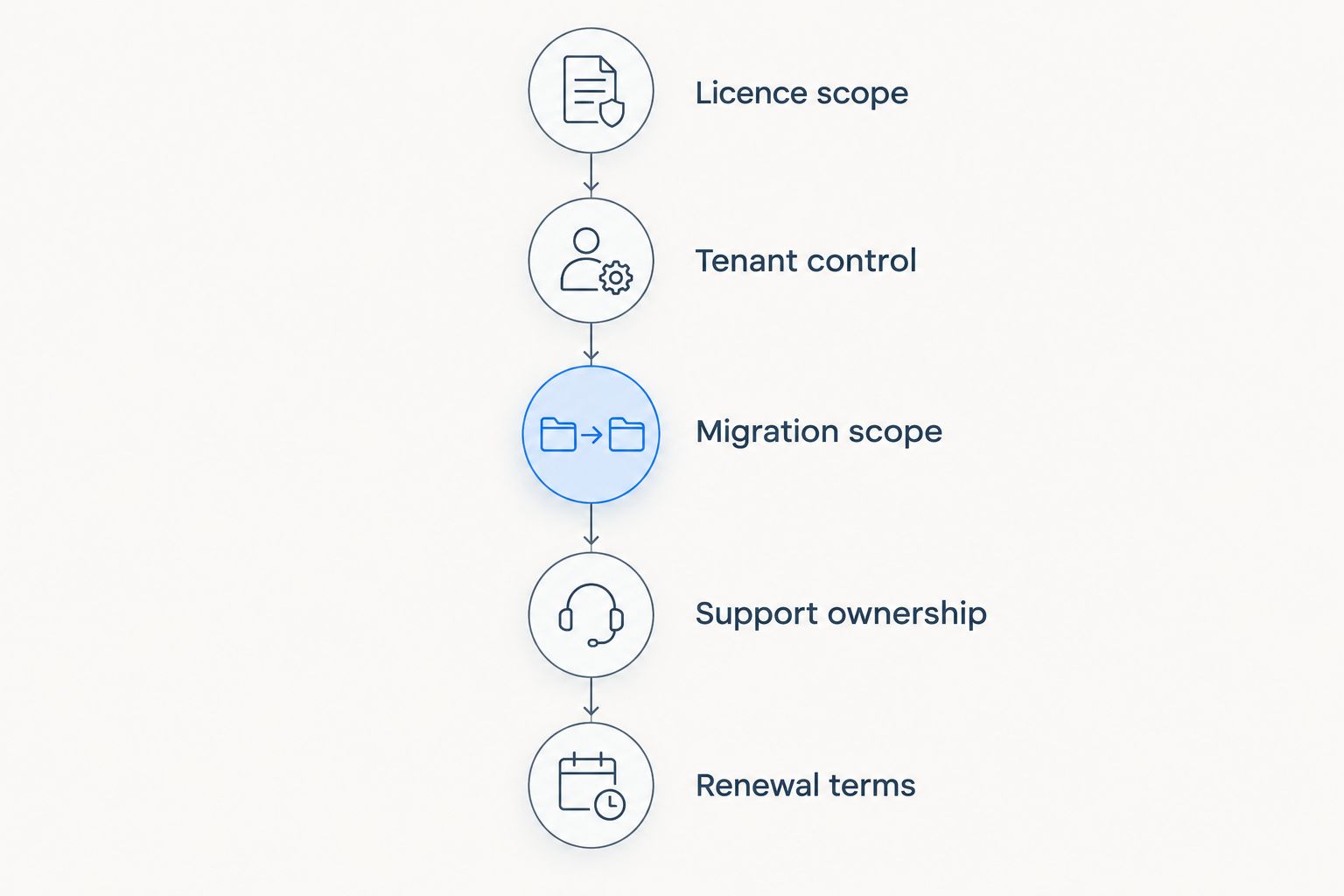
Keep these checks in a shared decision document. The result should identify the software you are buying, the work being delivered and the responsibilities your own team retains.
Define your Microsoft licensing requirements
Discuss Microsoft 365 and wider business IT requirements with a Portuguese B2B supplier.
Why people switch from Senetic
A sound reason to switch is a change in your requirements. The decision does not need an allegation about Senetic's service, renewals or reliability.
Consider alternatives when your purchase now requires:
- A Portuguese implementation focus: You want local support and installation requirements explicitly covered in the supplier brief.
- Business application coordination: The project includes POS or ERP work as well as Microsoft subscriptions.
- Internal purchasing ownership: Your IT team wants a direct Microsoft subscription relationship and can manage the surrounding work.
- A clearer scope: Your current arrangement no longer matches the responsibilities your business needs assigned.
These are selection criteria, not evidence that Senetic cannot meet them. Give the current supplier the same brief as the alternatives and compare the written responses.
Switch for a better fit, not merely for a different invoice. If an alternative proposal leaves the same responsibilities unresolved, the supplier change has not addressed the underlying problem.
When staying with Senetic is the right call
Keep Senetic if its proposal provides the exact licences, service scope and purchasing terms your business needs. Familiarity alone is not a reason to stay, but a working arrangement that meets your requirements is.
Your 2026 review should include the current supplier rather than assuming a new supplier wins. Ask Senetic to clarify any unclear responsibilities before deciding that replacement is necessary.
Best for: Businesses whose existing Senetic arrangement already matches their technical and procurement requirements.
Where staying shines
- You retain an established purchasing relationship.
- You avoid changing supplier without a defined business benefit.
- You can request clearer responsibilities within the current arrangement.
Where staying falls short
- An unchanged agreement does not resolve an unclear implementation scope.
- Familiarity does not establish that the selected subscriptions still match staff needs.
Verdict: Hold when the current arrangement meets the same brief used to assess alternatives.
FAQ
What's the best Senetic alternative for Microsoft 365 in Portugal?
VOLL is the strongest fit in this shortlist for Portuguese businesses seeking Microsoft 365 alongside local business IT support. Specify installation, integration and support deliverables in the proposal rather than assuming they accompany every licence.
Is buying Microsoft 365 directly better than using a reseller?
Microsoft direct is better suited to businesses that can own subscription administration and coordinate implementation internally. A reseller is a different purchasing route, not proof that migration or support services are included.
Are Microsoft 365 subscriptions the same as volume licensing?
No, Microsoft 365 subscriptions and organisational volume licensing arrangements are not interchangeable terms. Compare the exact product entitlement and applicable purchasing agreement before placing an order.
Do I need to migrate email when changing Microsoft suppliers?
Changing suppliers does not automatically require an email migration. Establish whether the purchase keeps the existing tenant and subscriptions before agreeing to any data movement.
How many users can Microsoft 365 Business plans support?
Microsoft publishes a maximum of 300 users for Microsoft 365 Business plans. Review other plan families when your requirements exceed that boundary, and assess application and security needs separately.
What should I compare in Microsoft licensing proposals in 2026?
Compare the exact licence scope, tenant control, migration work, support ownership and renewal terms. Give every supplier the same brief so the proposals cover equivalent responsibilities.
When should I stay with Senetic instead of switching?
Stay with Senetic when its proposal already meets your licensing, implementation and procurement requirements. Request clarification where the scope is unclear before changing an otherwise suitable purchasing relationship.
One last thing
Before choosing a supplier, ask your administrator to document the existing tenant and subscriptions. Then ask each bidder to explain what changes and what stays in place.
The useful comparison is not who sells Microsoft 365; it is who owns each task after you buy it. Make that ownership visible before you approve the order.


