Office Wi-Fi decisions for Portuguese small businesses come down to one question: can the network survive a busy Friday afternoon without your POS terminals timing out or your team getting bounced off Microsoft 365 mid-invoice.
- Multi-access-point setups with VLAN segmentation win for retail and hospitality floors running WINTOUCH POS in 2026 — buy.
- Consumer mesh kits stall past 15-20 concurrent devices; skip them once POS or ERP traffic joins the network.
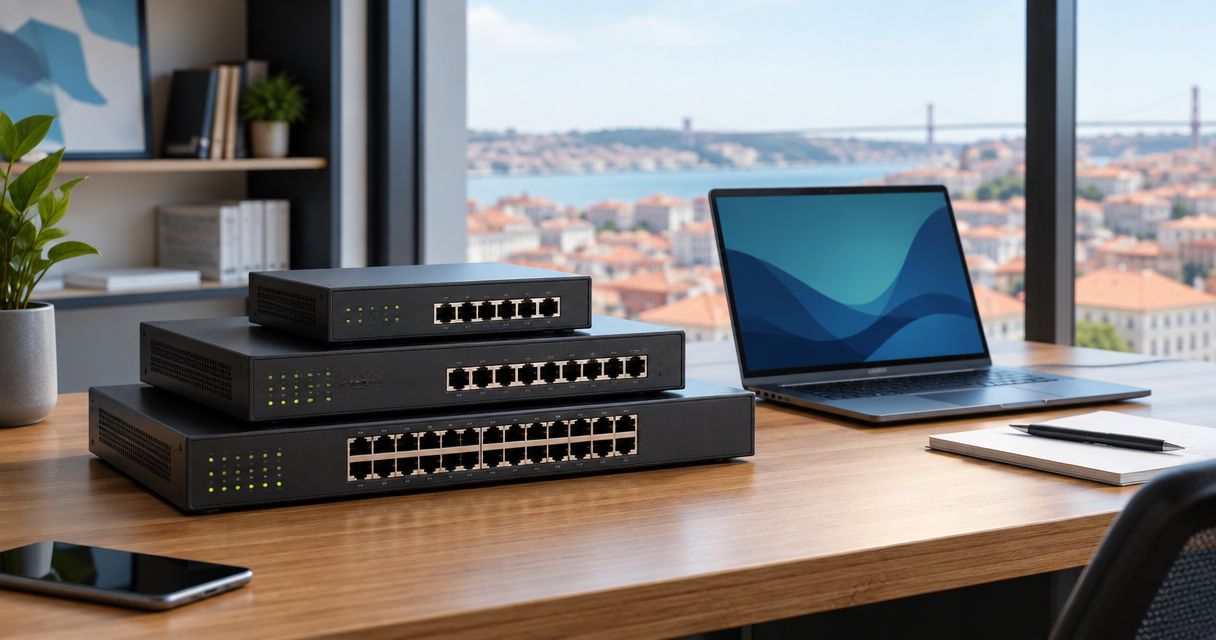
- PoE+ switches at 30W per port run access points and IP cameras from one cable — no separate power adapters needed.
- Dual-WAN failover matters more than extra bandwidth for keeping cloud ERP and Microsoft 365 sessions alive.
- Most wifi para escritórios searches skip VLAN segmentation, which is the actual failure point in PCI-style audits.
Why this matters
A weak office network doesn't just mean buffering video calls. It means a WINTOUCH POS terminal that loses connection mid-transaction, a Primavera ERP session that times out during month-end closing, or a Microsoft 365 file that won't sync before a client meeting.
Small businesses in Portugal running cloud-first software stacks — POS, ERP, Microsoft 365 — are more exposed to network gaps than a home office ever was. One dropped connection during checkout costs more than a slow Netflix stream. The network is now infrastructure, not convenience.
Who this is for
This guide is for owners and IT-responsible staff at businesses with 3 to 50 employees across one or more locations — retail counters, restaurant floors, clinics, law offices, and back-office teams running Primavera, Cegid, or Microsoft 365 daily. If your team depends on a POS terminal, a cloud ERP login, or shared drives to close a sale, this is your buyer profile.
What to look for in office Wi-Fi for small businesses
Coverage and access point density
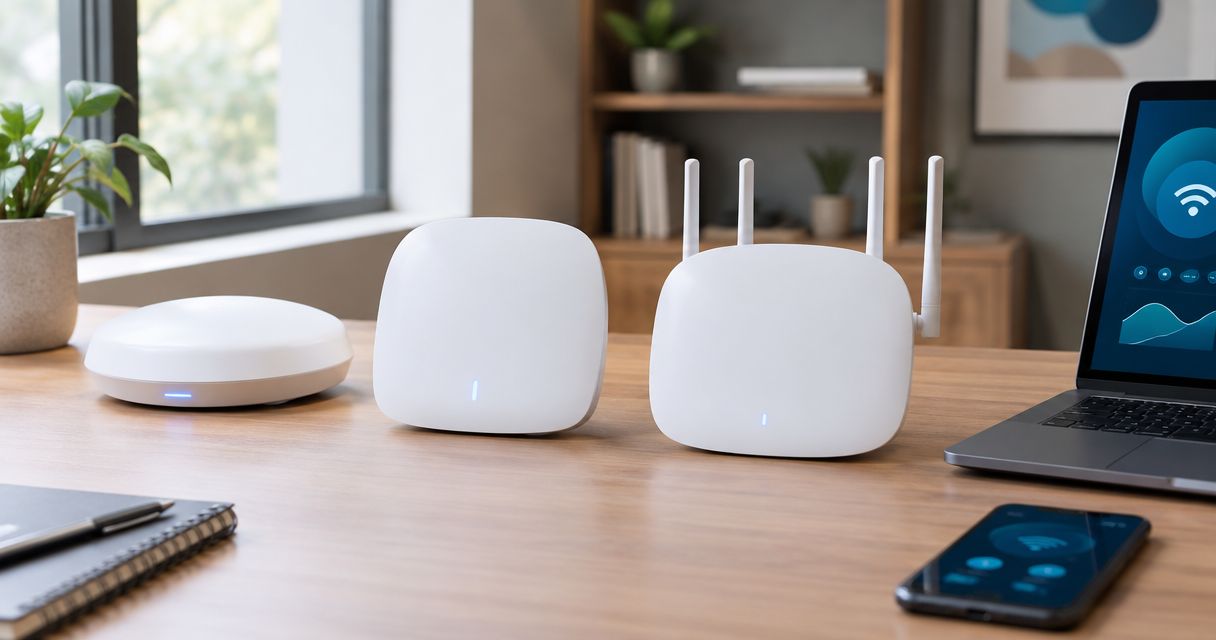
A single consumer router rarely covers more than 80-100 m² reliably through walls and shelving. Wi-Fi 6 access points designed for commercial use typically cover 150-200 m² indoors per unit, which is why most retail floors need two or three units, not one router pushed to its limit.
Network segmentation
Guest Wi-Fi, staff devices, and POS terminals belong on separate VLANs. Mixing a customer's phone with the terminal processing card payments is the single most common finding in small-business network audits — and the easiest one to fix before it becomes a compliance problem.
PoE switching and cabling
Power-over-Ethernet switches delivering 30W per port run access points, IP cameras, and even some POS hardware from a single cable. Skimping on PoE budget means access points that reboot randomly when a camera pulls too much power from the same switch.
Redundancy and failover
A single fiber line with no backup means a full outage the day the ISP has a fault. A secondary connection — mobile data failover through a router built for business use — keeps card payments and cloud ERP logins alive during an outage instead of sending staff home.
Central management
Businesses with more than one location need one dashboard to see every access point, push firmware updates, and isolate a problem site without a technician driving there. This matters far more at three locations than at one.
Integration reliability with POS and ERP
A network that looks fine on a speed test can still choke a POS terminal talking to Primavera over API in real time. Latency and packet loss under load matter more than raw megabits for these workloads.
Plan Your Office Network
Get a tailored access point, switch and installation quote for your business.
Top picks by business profile
The safe pick — single-location office or small professional practice. A two-access-point setup with one managed switch covers most 150-250 m² offices without overbuilding. Verdict: Buy for teams under 15 people running Microsoft 365 and light cloud ERP. Browse the full network and IT equipment catalog before specifying hardware.
The practical pick — retail counters and restaurant floors. Wi-Fi built around the POS terminal, not around general browsing, keeps checkout traffic isolated from guest devices. Stores already running WINTOUCH POS software for restaurants and retail need a network that prioritizes that terminal's traffic over a customer streaming video on guest Wi-Fi. Verdict: Buy.
The scale pick — multi-location retail chains. Once you're past two or three sites, a centrally managed controller becomes the difference between one IT afternoon and a technician visiting every store. Chains running WINTOUCH Cloud for multi-location retail should treat network standardization across sites as part of the same rollout. Verdict: Consider once you cross three active locations — overkill below that.
The busy-floor pick — restaurant and hospitality groups. High device density from staff tablets, kitchen display systems, and guest Wi-Fi at once means access point count matters more than raw speed here. Verdict: Consider, and size access points by seat count, not square meters alone.
The cloud-heavy pick — remote-capable professional services teams. Firms leaning on Microsoft 365 for file sync, Teams calls, and document collaboration need consistent upload speed more than download speed. Verdict: Buy if your team is on video calls more than two hours a day; skip the upgrade if usage is mostly email.
What to avoid
- Consumer mesh kits marketed for homes. They cap out around 15-20 concurrent devices before throughput visibly drops — fine for a household, not for a lunch-rush retail floor.
- Oversized enterprise controllers for a 3-person office. A cloud controller built for 50 access points adds licensing complexity nobody at a small office needs to manage.
- Skipping VLAN segmentation to save setup time. It's the single change that separates a compliant small-business network from one that fails a PCI-style review the first time someone checks.
Budgeting for a Wi-Fi refresh often overlaps with refreshing other office hardware at the same time. If your 2026 IT budget covers laptops alongside network gear, checking equipamentos para pequenas empresas ahead of a full hardware cycle can stretch what you allocate to the network build itself.
Verdict comparison
| Profile | Best for | Access points needed | Verdict |
|---|---|---|---|
| Single-location office | Under 15 staff, cloud apps | 2 | Buy |
| Retail counter / POS floor | Checkout-heavy traffic | 2-3 | Buy |
| Multi-location chain | 3+ sites, central management | 2-3 per site | Consider |
| Restaurant / hospitality | High device density | 3-4 | Consider |
| Remote-heavy services team | Video calls, file sync | 2 | Buy |
FAQ
What's the best Wi-Fi setup for a small office in 2026?
Two to three commercial-grade Wi-Fi 6 access points on separate VLANs for staff, guests, and POS traffic covers most small offices in 2026. A single consumer router rarely holds up once POS or ERP traffic joins the network.
Is Wi-Fi 6 worth it for a 5-person office?
Yes, mainly for device density and stability rather than raw speed. A 5-person office with phones, laptops, and a POS terminal easily reaches 15-20 connected devices, which is where older standards start dropping packets.
How many access points does a 200m2 store need?
Roughly two access points, since commercial Wi-Fi 6 units typically cover 150-200 m2 indoors through shelving and walls. Layout and material density can push that number to three.
Should POS terminals share Wi-Fi with guest network?
No — POS and guest traffic should sit on separate VLANs. This is the most common finding in small-business network reviews and the easiest fix to avoid.
How much does professional office Wi-Fi cost in Portugal?
Cost depends on access point count, switching, and cabling scope, so it varies site to site. Requesting a tailored quote based on floor plan and device count gives an accurate number faster than a generic estimate.
Does a backup internet connection matter for a small office?
Yes, especially for businesses running cloud ERP or card payments. A router with mobile-data failover keeps checkout and cloud logins alive during a fiber outage instead of sending staff home.
Does Microsoft 365 performance depend on office Wi-Fi quality?
Yes — Teams calls and file sync are sensitive to latency and packet loss, not just raw bandwidth. A network with weak coverage in one corner of the office shows up as dropped calls before it shows up on a speed test.
Can one access point cover a two-floor office?
Rarely reliably. Floors and ceilings cut Wi-Fi range more than open walls, so a two-floor office almost always needs at least one access point per floor.
One last thing
The network problem small businesses actually hit in 2026 isn't weak signal — it's PCI-style audit findings from POS terminals sitting on the same network as customer Wi-Fi. Fix the segmentation before you fix the coverage; it costs less and solves the problem that actually gets flagged.