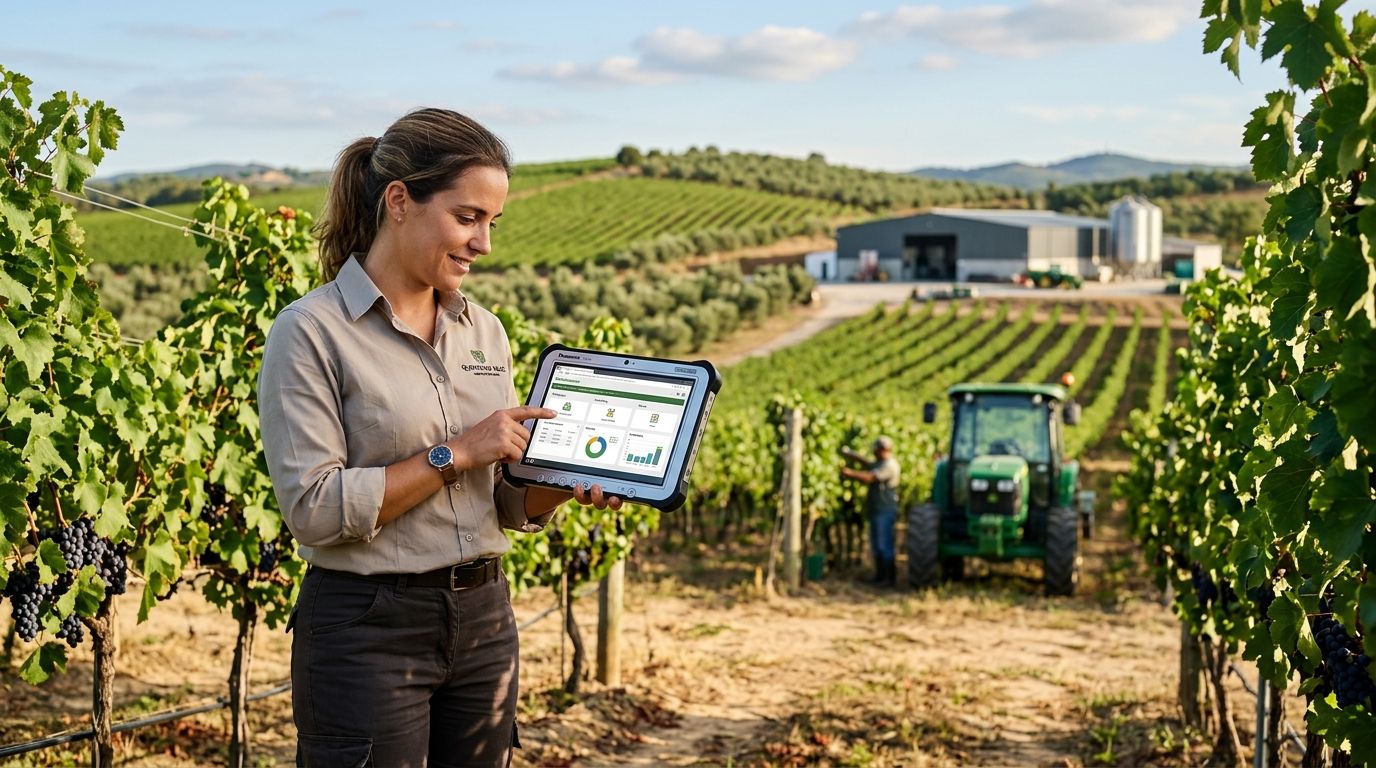
ERP Primavera for agricultural and farming businesses is management software that ties crop cycles, livestock records, land parcels, and seasonal invoicing into one licensed system, so stock counts, VAT filing, and subsidy paperwork stop living in three unrelated spreadsheets. Farms need something a generic retail ERP handles badly: production runs that stretch across months instead of days, multiple legal entities tied to the same land, and tax rules written specifically for agricultural producers.
- erp primavera para agricultura works when it's configured around parcels, crops, and livestock lots — not just SKUs and generic invoices.
- Farms running separate companies for CAP subsidy purposes need per-company setup inside one Primavera Cegid license, not three separate systems.
- SAF-T invoicing rules for agricultural producers differ from retail VAT exemptions — get this mapped before the first 2026 harvest invoice.
- WINTOUCH POS integration only matters if you sell direct from the farm; otherwise the core Primavera license covers stock and accounting alone.
Why ERP Primavera matters for agricultural businesses
A farm with three parcels registered under three different ownership structures for subsidy purposes can't run that setup inside one flat company code. It needs ERP Primavera configured as linked companies, each with independent reporting, sharing a single license structure through Voll, which handles the Primavera/Cegid integration and local configuration rather than shipping a generic install.
Agricultural VAT treatment in Portugal is not the same as retail. Producers filing SAF-T invoices in 2026 still follow the same core reporting deadlines as any business, but the exemption codes applied to primary agricultural sales are different, and a system configured for a shop or a services firm will misfile them by default.
Stock in farming isn't a fixed catalog either. A crop moves from seed to harvested lot to sold batch, and a herd changes head count weekly. ERP Primavera for agriculture needs stock modules that track lots and movements, not just static SKUs with a reorder point.
The how-to spine
Map your parcels and legal entities before choosing a license
Do this before anyone touches invoicing settings. Getting the company structure wrong here means re-doing every report later.
- List every parcel by ownership name, not just farm name
- Note which parcels file separately for CAP subsidy purposes
- Confirm whether any parcel is leased versus owned — this changes VAT treatment
- Decide if seasonal partnerships (co-ops, shared harvests) need their own company code
- Write down which parcels share equipment or labor costs, since that affects cost allocation later
Set up seasonal stock categories for crops and inputs
A spreadsheet can track one harvest. It falls apart the moment you're running two crops on rotation with different input schedules.
- Separate stock categories for seed, fertilizer, and crop protection inputs
- A lot-tracking structure for harvested product, not a flat quantity field
- Reorder points tied to planting calendar, not a fixed monthly cycle
- Waste and shrinkage categories for perishable produce
- A link between input consumption and the parcel it was applied to
Configure automatic invoicing for buyers and subsidy declarations
Manual invoicing works until harvest season hits and you're issuing forty invoices in a week to the same three cooperative buyers.
- Standing invoice templates per recurring buyer (cooperatives, processors, distributors)
- VAT exemption codes mapped correctly for agricultural producer status before the first 2026 sale
- SAF-T export configured and tested before the filing deadline, not the week of it
- Automatic numbering sequences that match what your accountant already expects
This is where a SAF-T compliant invoicing setup matters more for farms than for most other sectors, because the exemption logic is producer-specific and easy to misconfigure.
Track livestock and produce lots for traceability
Buyers and inspectors both want to know where a batch came from. A generic ERP stock module won't give you that trail without configuration.
- Batch or lot numbers assigned at harvest or at birth for livestock
- A movement log tied to parcel, not just a warehouse location
- Expiry or shelf-life fields for perishable product categories
- A traceability report you can hand to a buyer or an inspector without manual compilation
Add users and companies as the farm grows
Family farms often start with one person managing everything, then add seasonal staff, a bookkeeper, and a second company code as land is inherited or leased.
- Role-based permissions so seasonal staff can't touch invoicing or payroll
- Separate company access for each subsidy-linked entity
- An audit trail on who changed stock counts or pricing
- A process for adding users and companies to the license as the operation expands, instead of cramming everyone into one shared login
“If your farm operates under three company names for subsidy purposes, configure three linked companies inside one Primavera license — never split it into three separate systems.”
Connect point-of-sale for direct farm sales
Skip this step if you sell exclusively through a cooperative or distributor. It matters the moment you open a farm shop, run a market stall, or take agritourism payments on-site.
- POS hardware that posts sales straight into the same Primavera stock ledger
- Cash and card reconciliation that matches your daily harvest output
- A shared product catalog so farm-shop pricing and wholesale pricing don't drift apart
- Offline capability for rural connectivity gaps during peak season
Plan license renewal around your harvest calendar
A lapsed license mid-harvest means no invoicing access at the exact moment you're issuing the most invoices of the year.
- Set renewal reminders 60-90 days before expiry, timed against planting season not the calendar year
- Confirm user counts before renewal if staff numbers changed since last season
- Check that any custom configuration (VAT codes, lot tracking) carries over on renewal
Get your farm's ERP Primavera set up right
Configuration, Primavera/Cegid integration, and local support for agricultural licenses.
Comparison: management options for farms in 2026
| Option | Best for | Key limitation |
|---|---|---|
| Spreadsheet or paper bookkeeping | Single-parcel farms with one crop and no staff | No automatic invoicing, no stock reconciliation, breaks past one harvest cycle |
| Standalone accounting software | Farms needing VAT filing only, no stock or land tracking | Can't track parcels, crops, or livestock lots at all |
| ERP Primavera core license | Multi-parcel or mixed farms needing integrated stock, invoicing, and per-company reporting | Needs a proper configuration pass before first use, not plug-and-play |
| ERP Primavera with POS integration | Farms selling direct — farm shop, market stall, agritourism | Adds a second system to license, though it feeds the same stock ledger |
Verdict: for anything beyond one parcel and one crop, spreadsheets and standalone accounting apps stop scaling by the second season — ERP Primavera configured for agriculture is the option that holds up once subsidies, multiple parcels, or direct sales enter the picture.
Common mistakes agricultural businesses make
- Registering every parcel under one company code. This breaks apart the moment a subsidy audit asks for ownership-separated reporting.
- Running retail-style monthly reports on a harvest calendar. Matching your reporting periods to planting and harvest cycles, not the calendar month, gives numbers that actually mean something.
- Delaying SAF-T invoicing setup until after the first sale of the season. Re-entering paper receipts in July because the exemption codes weren't mapped in April costs more time than the setup would have.
- Skipping per-company user permissions. Seasonal staff and family members end up with access to invoicing or payroll they never needed.
- Renewing the license reactively. Waiting until it's close to expiry risks losing invoicing access mid-harvest, which is the worst possible week for that to happen.
FAQ
What's the best ERP Primavera for agriculture in 2026?
For farms with more than one parcel, mixed crops, or livestock, ERP Primavera configured with lot tracking and per-company setup is the option that scales; single-parcel operations with one crop can often get by on standalone accounting software instead.
Is ERP Primavera better than standalone accounting software for a farm?
Yes, once you have more than one parcel or need stock tracking on crops and livestock — standalone accounting software only handles VAT filing, not parcel, crop, or lot-level tracking.
How much does ERP Primavera for agriculture cost in 2026?
Pricing depends on the number of companies, users, and modules configured for your operation, so request a quote based on your parcel and staff count rather than expecting a flat number.
Can ERP Primavera track livestock separately from crops?
Yes, with lot and movement tracking configured per stock category — livestock and crops use separate lot structures within the same license.
Do I need one Primavera license per farm company?
No, a single license can host multiple linked companies, which is the correct setup for family farms with parcels registered under different ownership for subsidy purposes.
Does ERP Primavera integrate with a POS system for farm shop sales?
Yes, POS integration posts direct sales straight into the same stock ledger used for wholesale and cooperative sales, which matters for farms running a shop or market stall.
What happens if I don't renew my Primavera Cegid license before harvest season?
Invoicing access lapses, which typically hits at the worst possible time — during peak harvest when invoice volume is highest — so renewal should be timed 60-90 days ahead of expiry, not against the calendar year.
Is SAF-T invoicing mandatory for agricultural producers in Portugal?
Yes, the core SAF-T filing requirement applies to agricultural producers the same as any other business in 2026, though the VAT exemption codes applied to primary agricultural sales differ from retail.
One last thing
Most farm ERP failures in 2026 aren't caused by choosing the wrong software — they're caused by registering multiple family-owned parcels under a single company code, which then can't be split apart when a CAP subsidy audit asks for ownership-separated numbers. Fix the company structure before touching invoicing configuration, and the rest of the setup gets far simpler.


