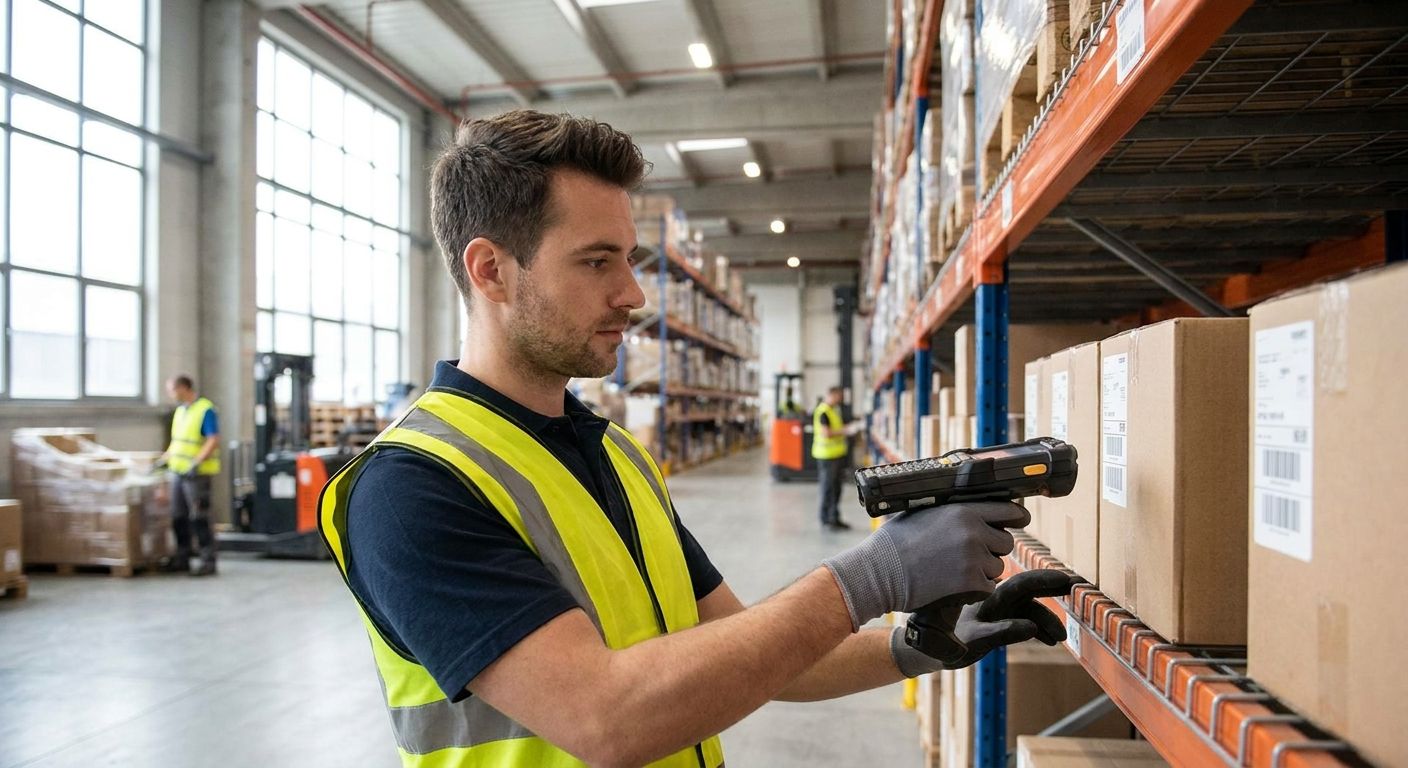
Warehouse teams that still count stock with a phone camera or a beat-up scanner from a previous decade lose hours every week to re-scans and mis-picks. This guide breaks down what actually matters when you buy handheld barcode scanners for warehouse inventory in 2026, and which device class fits which operation.
- 2D imager scanners beat 1D laser units on damaged or curved labels — buy 2D for mixed-condition warehouse stock in 2026.
- Look for IP54 or higher and a 1.2m drop rating before anything else on a warehouse floor.
- A scanner that doesn't talk to your ERP is a data-entry problem wearing a barcode scanner costume.
- Rugged inventory tablets replace a scanner entirely for teams doing cycle counts and putaway in the same device.
Why this matters
A warehouse inventory error rate that looks small on paper — a handful of mis-scans per shift — compounds into stockouts, double-picks, and reconciliation headaches at month-end. The scanner is the cheapest link in that chain to fix and the one most businesses buy on price alone.
VOLL sells professional-grade handheld barcode scanners for warehouse and retail environments alongside the WINTOUCH POS/ERP software many Portuguese distributors already run, which matters more than it sounds: a scanner that pairs cleanly with your existing stock system removes an entire manual step from every count. The barcode scanner range at VOLL covers both 1D and 2D imager models built for that kind of integration.
Who this is for
This guide is for warehouse managers, 3PL operations leads, and wholesale distributors in Portugal running receiving, putaway, picking, or cycle counts on paper labels or barcoded totes. If you're outfitting a checkout counter instead of a stockroom, the criteria shift — retail scanners prioritize speed at a fixed station, not battery life and drop resistance across a 10,000 m² floor.
What to look for in handheld barcode scanners for warehouse use
Scan engine type
1D laser scanners read standard linear barcodes fast and cheap, but they choke on torn, wrinkled, or shrink-wrapped labels — common on pallets that have traveled through two or three handling points. 2D imager engines read damaged, curved, and even screen-displayed barcodes, which matters the moment a label gets scuffed on a forklift tine.
Connectivity range and battery life
Bluetooth Class 2 radios give you roughly 10 meters of range from the base or host device, enough for most aisle work but tight in a wide-span warehouse. Wi-Fi-enabled scanners that roam across access points hold a connection down the length of a large facility — pair them with proper coverage like warehouse Wi-Fi access points rather than relying on a single router in the office.
Ruggedness rating
An IP54 rating covers dust and light splashes; IP65 handles hose-down conditions and heavier dust exposure common in loading bays. Rugged handhelds built for warehouse floors typically carry a 1.2-meter drop-to-concrete rating — a spec worth checking against your actual floor height, not the marketing photo of the device sitting on a desk.
Batch mode and offline memory
Warehouses with dead zones — mezzanines, deep racking, basement storage — need a scanner that stores scans locally and syncs once back in range. Without batch mode, every dead zone becomes a manual re-entry task at the end of the shift.
ERP and POS integration
A scanner is only as useful as the system it feeds. If your stock data lives in Primavera or Cegid, confirm the scanner talks to it through your POS layer rather than dumping a flat file you reconcile by hand. Distributors running Primavera ERP for wholesale distributors get the most value when receiving and picking scans post directly to stock levels in real time.
Total cost of ownership
Cheap import scanners without local support turn into dead weight the first time a trigger fails or a battery won't hold charge. Factor in warranty terms and whether replacement stock or repairs are available within days, not weeks.
Top picks for warehouse inventory
The safe pick — 1D laser handheld. Entry-level 1D scanners cover clean, printed labels reliably and cost the least to deploy across a large team. They fall short the moment labels get damaged or printed on curved surfaces like drums or rolls. Verdict: Buy for small, controlled stockrooms with consistent label quality; Skip if your inbound freight arrives with inconsistent labeling.
The workhorse — 2D imager wireless scanner. These read 1D and 2D codes, damaged labels, and even barcodes on a phone screen for supplier returns processing. Pair one with a Wi-Fi-covered floor and IP54-or-better housing and it handles receiving through shipping without a change of device. Verdict: Buy for any operation running mixed inbound freight in 2026.
The wildcard — rugged inventory tablet with built-in scanner. Instead of a separate handheld, a rugged tablet combines the scan engine with a screen for picking lists, stock adjustments, and putaway confirmation in one device. It costs more upfront but removes a second piece of hardware from the workflow entirely — worth checking against rugged inventory tablets built for field and warehouse use. Verdict: Consider for teams doing cycle counts with digital checklists rather than simple scan-and-go picking.
Skip this one — consumer-grade Bluetooth scanners sold for retail POS. They're built for a fixed checkout counter, not eight hours of walking a warehouse floor, and most carry no IP rating at all. Verdict: Skip for any warehouse floor role.
Get a quote for warehouse scanners
Business pricing without IVA, delivery nationwide in 24-48h.
What to avoid
- Scanners with no batch mode — fine for a small shop, a liability the moment your warehouse has a dead zone in racking or a basement.
- Devices with no local repair or warranty support — a scanner with a dead battery and a six-week import turnaround stalls a shift.
- 1D-only scanners on damaged-label freight — the failure shows up as re-scans, not as an obvious spec mismatch, so it's easy to miss until volume climbs.
Verdict comparison
| Criteria | 1D Laser Handheld | 2D Imager Wireless | Rugged Inventory Tablet |
|---|---|---|---|
| Reads damaged/curved labels | No | Yes | Yes |
| Typical IP rating | IP54 | IP54-IP65 | IP65 |
| Battery/offline batch mode | Limited | Yes | Yes |
| ERP/POS integration | Basic | Full | Full |
| Best for | Clean-label stockrooms | Mixed inbound freight | Cycle counts + picking lists |
| Verdict | Buy (small ops) | Buy | Consider |
FAQ
What's the best handheld barcode scanner for warehouse inventory in 2026?
A 2D imager wireless scanner is the best fit for most warehouse inventory work in 2026 because it reads damaged, curved, and screen-displayed barcodes that a 1D laser scanner misses. Confirm it integrates with your ERP or POS before buying.
Is a 2D scanner better than a 1D scanner for warehouses?
Yes, for most warehouses. 2D imagers read both linear and 2D codes plus damaged labels, while 1D laser scanners only read clean, undamaged linear barcodes.
How much does a handheld barcode scanner cost for warehouse use?
Pricing varies by scan engine, connectivity, and ruggedness rating. Business buyers get pricing without VAT on request, with delivery across Portugal in 24-48 hours.
Do warehouse barcode scanners need Wi-Fi or Bluetooth?
Wi-Fi-enabled scanners hold connection across a large facility with proper access point coverage, while Bluetooth Class 2 covers roughly 10 meters from the paired device. Large warehouses generally need Wi-Fi coverage to avoid dropped connections.
Can a handheld barcode scanner connect to Primavera or Cegid ERP?
Scanners that pair with a compatible POS layer can post stock movements directly into Primavera or Cegid without manual re-entry, provided the integration is confirmed before purchase.
What IP rating do I need for a warehouse barcode scanner?
IP54 covers dust and light splashes, which suits most indoor warehouse floors. IP65 is worth the upgrade for loading bays, outdoor yards, or hose-down cleaning routines.
Should I buy a scanner or a rugged tablet for inventory counts?
A rugged tablet with a built-in scanner works well when staff also need a screen for picking lists and stock adjustments. A dedicated 2D scanner is lighter and cheaper when scanning is the only task.
How long do warehouse barcode scanner batteries last?
Rugged handhelds are generally built to cover a full working shift, but battery performance drops with age and cold storage use, so confirm expected run time against your shift length before buying.
One last thing
The scanner rarely fails a warehouse — the Wi-Fi coverage behind it does. A 2D imager with full battery and a perfect IP rating still drops connection and forces offline batch mode the moment it walks past the third rack aisle without an access point in range, so budget for coverage before you budget for the device.


