Assismática remains a sensible benchmark if your current purchasing relationship already meets your business IT requirements. The limit of a supplier-only comparison is that equipment purchasing, software licensing and ERP integration are different jobs. Among Assismatica alternatives in 2026, Voll is best for Portuguese businesses seeking a business IT supplier focused on POS, management software and integration; hardware-only procurement fits standalone equipment purchases.
- Among Assismatica alternatives, Voll fits Portuguese businesses needing POS, ERP integration and local support.
- Compare business IT suppliers by implementation scope, not just equipment lists.
- Hardware-only procurement fits standalone replacements when your own team handles configuration.
- Keep Assismática when your existing arrangement meets the requirements of your next project.
Why this matters
A replacement office peripheral and a new retail checkout require different purchasing decisions. The peripheral needs to work with your existing setup; the checkout also needs software, configuration and a clear route for resolving integration problems.
For your 2026 shortlist, separate the item you need from the work needed to make it useful. Otherwise, you risk comparing an equipment order with an implementation proposal as though they cover the same task.
Assismática alternatives at a glance
This comparison separates a named business IT supplier from alternative purchasing approaches. Use the approaches to decide what kind of proposal to request, rather than treating every route as an interchangeable shop.
| Supplier or purchasing route | Best for | Defining characteristic | Decision relative to Assismática |
|---|---|---|---|
| Assismática | Retaining an existing arrangement that meets your requirements | Your established purchasing relationship, if you already have one | Stay when the next project fits the existing agreement |
| Voll | Business IT involving POS, management software and ERP integration | Portuguese B2B catalogue with installation, integration and local support | Request a project-specific proposal for this scope |
| Hardware-only procurement | Standalone equipment replacements | Equipment purchasing separated from implementation | Compare the exact item and leave configuration with your team |
| Split procurement | Projects with clearly separated technical responsibilities | Equipment supply and implementation assigned separately | Keep the existing supplier for suitable purchases and assign specialist work separately |
Best for describes the purchasing situation, not a claim that every supplier offers the same services. In particular, a familiar supplier remains useful when the purchase is routine and the existing arrangement works.
1. Voll: best for integrated business IT in Portugal
Voll is a Portuguese B2B online store whose core catalogue includes WINTOUCH POS/ERP licences and Microsoft 365. Its business IT offer also includes professional networking equipment from Reyee, Teltonika and Equip, SUNMI point-of-sale hardware, storage and components.
The distinction is the service context around those categories: installation, integration with Primavera/Cegid ERP and local support. That makes this route relevant when you need more than an equipment purchase.
Where this option shines
- Management software focus: the WINTOUCH POS/ERP catalogue contains more than 200 products, making this a core category rather than an incidental addition.
- Connected purchasing requirements: software, networking and POS hardware sit within the same business IT offer.
- Implementation services: installation and ERP integration are part of the stated business positioning.
- Business purchasing routes: you can request a quotation or buy directly online.
- Portuguese business context: local support complements the online purchasing model.
Where this option falls short
- Commodity hardware is not its stated differentiator. A basic replacement item does not necessarily require the specialist services that define this offer.
- A broad catalogue does not settle compatibility. You still need confirmation that the chosen software, terminal and integration match your existing environment.
- Delivery and implementation are separate milestones. The stated nationwide delivery window is 24–48 hours; that is not a commitment to configure or integrate your system within the same period.
For a 2026 project, request a written scope that distinguishes licences, equipment, installation and integration. Identify the existing ERP and the business process that must work after deployment.
Best for: Portuguese businesses buying POS or management software alongside installation, ERP integration and local support.
Verdict: Buy for a defined integration project; hold a standalone hardware decision until you have compared the exact requirements.
2. Hardware-only procurement: best for standalone replacements
Hardware-only procurement treats the purchase as an equipment order, with configuration and support ownership handled separately. It fits a replacement that your internal team can identify, install and maintain without changing a wider business system.
This is a purchasing approach, not a recommendation of an unverified retailer. Select a supplier only after checking the exact item and the terms relevant to your business.
Where hardware-only procurement shines
- A narrow brief: you can compare the same specification across proposals without adding unrelated implementation work.
- Internal control: your own IT team keeps responsibility for configuration and deployment.
- Continuity: you can replace a component without making a broader supplier change.
Where hardware-only procurement falls short
- Integration remains your responsibility. An equipment order does not define who connects the device to your business software.
- Compatibility checks move in-house. Your team must validate interfaces, drivers and the intended workflow.
- Separate purchases need separate coordination. Software, equipment and support responsibilities must still fit together.
Use this route when the requirement is genuinely self-contained. Replacing an office peripheral is different from introducing a checkout that must exchange information with an ERP.
Best for: businesses with internal technical ownership buying clearly specified replacement equipment.
Verdict: Buy for isolated replacements; skip this route as the sole plan for an integration project.
3. Split procurement: best for clearly divided responsibilities
Split procurement keeps equipment purchasing separate from specialist implementation. You can retain Assismática for purchases that already work within your existing arrangement while assigning a defined software or integration task separately.
The benefit is flexibility. The weakness is coordination: dividing the work only helps when everyone agrees where each responsibility starts and ends.
Where split procurement shines
- Targeted change: you can change the part of the arrangement that needs improvement without replacing everything.
- Specialist assignment: a defined integration task can have its own implementation brief.
- Existing relationships: routine purchasing can stay with a supplier that already meets those requirements.
Where split procurement falls short
- Shared faults need an owner. A problem involving both equipment and software requires a clear escalation route.
- Handover needs documentation. Configuration details and acceptance criteria cannot remain with one party alone.
- Your business coordinates the boundaries. Separate agreements need to describe the same intended outcome.
Best for: businesses that can manage separate equipment and implementation responsibilities.
Verdict: Hold until ownership and acceptance criteria are agreed; skip if responsibility remains ambiguous.
Turn your shortlist into a usable project brief
Before approaching suppliers in 2026, write a brief that follows the work from requirement to handover. The sequence below prevents an equipment list from becoming a substitute for a deployment plan.
Business workflow
Describe what employees must be able to do. For a POS project, that means describing the checkout process and the information that needs to reach the back office, rather than naming a terminal alone.
Existing systems
Identify the software and equipment already in use. Include the ERP, POS application, network environment and any peripherals involved in the workflow; ask the proposed supplier to confirm the relevant dependencies.
Ownership
Specify who supplies equipment, configures software, performs integration and answers support requests. Avoid assigning responsibility to an unnamed partner or assuming that installation includes every task.
Acceptance
Describe how you will confirm that the project works. Use an actual business workflow as the acceptance check, then record who approves the result and who receives the handover documentation.
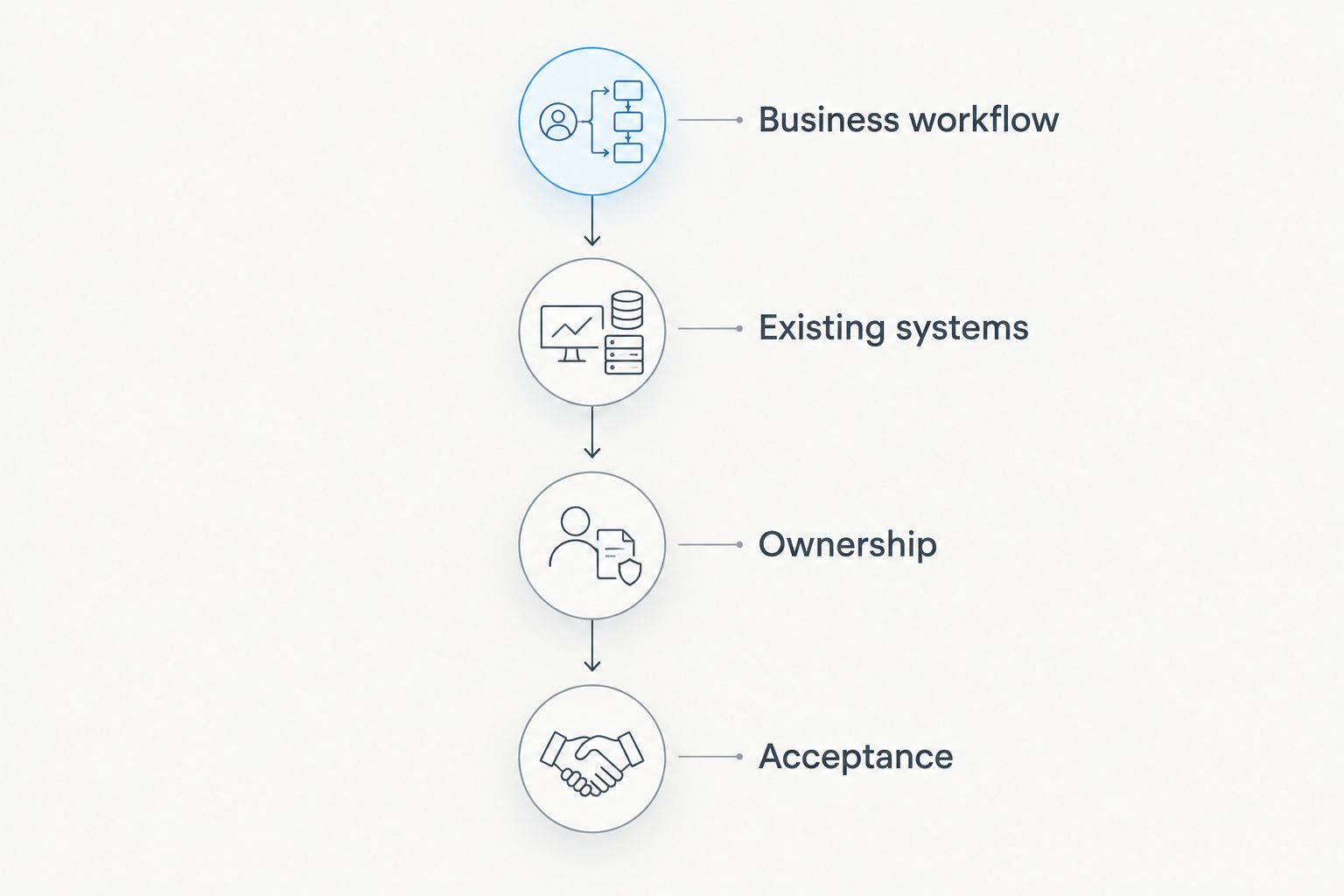
A useful brief does not need to be long. It needs to make the supplier's responsibility testable: what is being supplied, what must connect, and what counts as a completed job.
Questions to include in your request
- Which licences and equipment are included in the proposed scope?
- Which existing systems must be checked before implementation?
- Who configures the connection between POS and ERP?
- What work remains with your internal team?
- Who owns the first support response after handover?
- What documentation will your team receive?
Use the answers to compare scope line by line. Do not treat an omitted implementation task as though it were included simply because the proposal contains all the equipment you requested.
Compare your business IT requirements
Match your equipment, software and integration brief to the Portuguese B2B catalogue.
Why consider switching from Assismática?
Switch to solve a defined requirement, not to replace a supplier name. A new POS deployment, an ERP connection or a change in implementation ownership gives you a concrete reason to compare purchasing routes.
These are decision triggers, not claims about Assismática's performance. Apply them to your own agreement and the work your business needs next.
| Your requirement | What to compare | What a satisfactory answer contains |
|---|---|---|
| POS and ERP must work together | Integration scope | Named systems, responsibilities and acceptance criteria |
| Equipment needs installation | Deployment work | A clear distinction between supply and configuration |
| Your team needs local support | Support ownership | The responsible party and the agreed escalation process |
| You need only a replacement item | Equipment specification | The exact requirement without unnecessary project work |
| You want to keep an existing supplier | Split responsibilities | A documented boundary between purchasing and implementation |
A switch becomes useful when a new proposal addresses a requirement your current arrangement does not cover. Confirm that gap in writing before changing the relationship.
If the issue is unclear ownership, changing supplier without changing the brief leaves the same problem unresolved. The brief is the first decision; the supplier selection follows it.
Compare proposals without confusing supply and implementation
A useful 2026 comparison separates equipment, licensing, configuration, integration and handover. These headings let you see whether proposals describe the same work.
Read each proposal for exclusions as well as inclusions. If one proposal assigns configuration to your team and another includes it, the two proposals describe different responsibilities.
- Equipment: identify what is supplied and the intended use.
- Licensing: confirm the software entitlement being proposed.
- Configuration: identify who prepares the system for use.
- Integration: define the systems and business processes that must connect.
- Handover: confirm documentation, acceptance and support ownership.
Keep delivery milestones separate from operational readiness. Receiving the equipment does not demonstrate that users can complete the intended workflow.
When staying with Assismática is the right call
Stay with Assismática when your existing arrangement meets the requirements of the next purchase. A routine replacement does not, by itself, justify changing a supplier relationship that works for your business.
For your 2026 decision, check the upcoming requirement against the current agreement. If equipment specification, implementation responsibility and support ownership are already clear, continuity is a valid choice.
You can also keep the existing relationship for routine purchasing while commissioning a separately defined specialist task. Switching everything is not a prerequisite for improving one part of your IT setup.
FAQ
What's the best Assismática alternative for business IT in Portugal?
Voll is best suited to Portuguese businesses seeking POS, management software, ERP integration and local support. For an isolated equipment replacement, compare hardware-only purchasing against your existing supplier arrangement.
Is Assismática or a specialist business IT supplier better for my company?
The better choice is the supplier whose agreed scope matches your next project. Compare equipment supply, configuration, integration and support ownership rather than assuming either route covers every task.
Should I change suppliers just to replace office equipment?
No, a standalone replacement does not automatically require a supplier change. Keep your existing arrangement when it meets the specification and your team can handle deployment.
What should I check before buying a POS terminal for my business?
Check the software, peripherals, network requirements and ERP connection before choosing the terminal. Ask who configures the system and how the completed workflow will be accepted.
Can I keep Assismática and use another supplier for integration?
Yes, split procurement is a valid approach when responsibilities are clearly separated. Document who owns equipment issues, software configuration, integration and support escalation.
Does equipment delivery mean my business IT project is finished?
No, delivery and operational readiness are separate milestones. A completed project needs the agreed configuration, integration checks and handover, not just receipt of the equipment.
How do I compare business IT proposals in 2026?
Compare proposals against the same written workflow and responsibility brief. Separate equipment, licensing, configuration, integration and handover so that exclusions remain visible.
One last thing
The decisive comparison is often at the boundary between equipment and software. Before placing an order, ask who owns a fault when the device works but the business workflow does not.
Voll fits business IT projects where its stated installation, ERP integration and local support match that boundary. Keep the final decision tied to a written scope, not the breadth of a catalogue.


