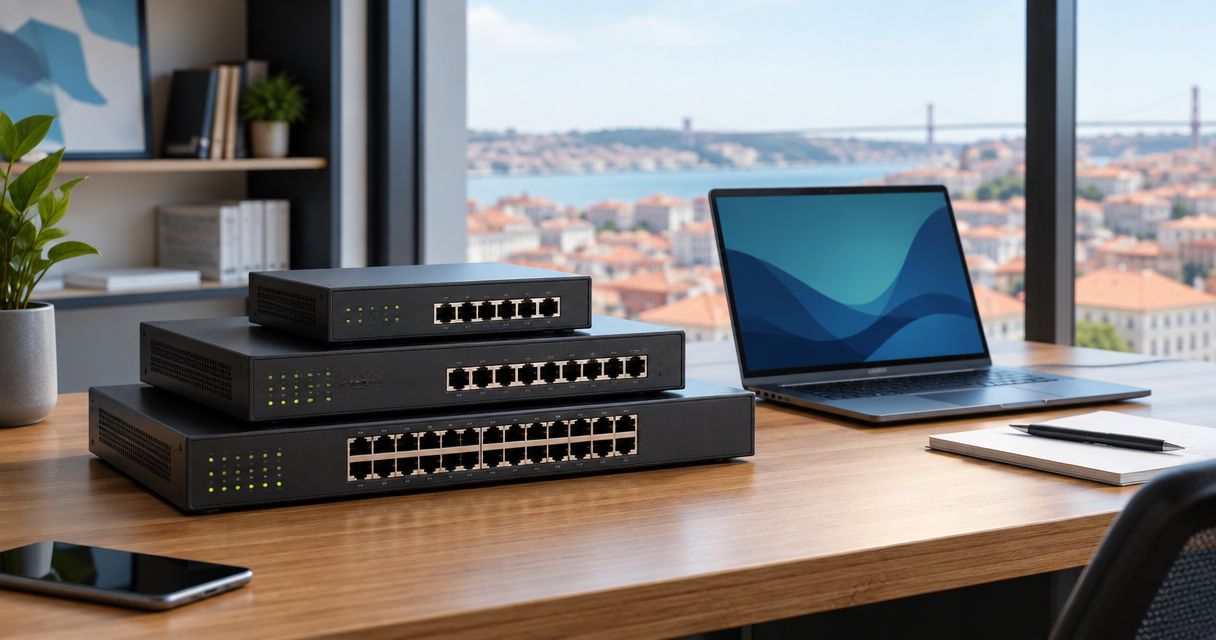
Growing past 15 desks means your consumer router and the unmanaged switch under the receptionist's desk stop being enough. This guide ranks the switch tiers that actually match office growth stages in 2026, from an 8-port plug-and-play box to a rugged unit built for a warehouse floor.
- For teams under 10 devices, an unmanaged 8-port switch from Equip is the safe, cheap start — Buy.
- Offices adding VoIP phones or IP cameras need a PoE switch with at least a 130W budget — Buy the Reyee PoE line.
- Past 20 employees, a managed L2 switch with VLAN support prevents the network chaos that kills productivity — Buy.
- Multi-site retail or hospitality groups need L3 routing between switches, not just more ports — Consider before you scale to a second location.
- Rugged Teltonika switches only make sense in warehouses or workshops — Skip them for a standard office and save the budget.
Why this matters
A switch is the one piece of office IT nobody budgets for until it fails mid-workday. Search "switches de rede para empresas" and you'll find hardware specs everywhere but almost nothing about which tier actually fits an office at 8 people versus 80.
Buy too small and every new hire, printer or Wi-Fi access point fights for the same eight ports. Buy too much managed switch too early and nobody on staff configures the VLANs anyway — the extra cost sits unused. The right call in 2026 depends on device count, whether you're running VoIP or POS hardware over Ethernet, and whether you'll open a second location within the next 18 months.
VOLL's network equipment catalog covers Reyee, Teltonika and Equip gear specifically for this kind of staged growth, with installation and ERP integration handled locally rather than shipped as a box with no support.
How this ranking works
The tiers below are ordered by growth stage, not by brand loyalty. Each one reflects what a switch actually needs to do at that headcount: port count, Power over Ethernet budget, whether VLANs and traffic prioritization matter yet, and whether the unit needs to survive dust, heat or vibration. Pricing in Portugal runs without IVA for business buyers, so treat any number you see elsewhere as pre-tax unless stated otherwise.
The ranked list
1. Unmanaged 8-port switch — the entry-level pick
An unmanaged 8-port desktop switch from Equip covers a single-room office running under 10 wired devices: a router, two or three desktops, a printer, an access point. No configuration, no login screen, no VLANs — it just passes traffic.
The catch is headroom. Once you add a fourth desk or a second printer, you're out of ports and buying a second switch to daisy-chain, which adds a hop and a failure point. Verdict: Buy if you're under 10 devices and don't plan to double headcount this year.
2. PoE switch for VoIP and cameras — the workhorse pick
The moment an office adds desk phones or IP cameras, an unmanaged switch stops being enough because those devices need power over the same Ethernet cable that carries data. A Reyee 8-port or 16-port PoE switch with a 130W to 150W power budget covers 6-10 PoE devices without tripping the budget mid-install.
This is the switch most growing offices actually need first, before VLANs or L3 routing matter. Check the office Wi-Fi network guide before buying — a PoE switch that can't also power your access points defeats the point. Verdict: Buy for any office adding VoIP, cameras or PoE access points in 2026.
3. Managed L2 switch — the growth pick
Past roughly 20 employees, an office usually runs enough distinct traffic types — guest Wi-Fi, POS terminals, staff data, security cameras — that segmentation stops being optional. A managed Layer 2 switch with VLAN support keeps a POS terminal running WINTOUCH from ever seeing guest Wi-Fi traffic, and it lets you prioritize VoIP packets so calls don't stutter during a big file transfer.
Managed switches take setup time — someone has to configure the VLANs and QoS rules, which is where local installation support pays for itself versus a drop-shipped box. If you're running WINTOUCH POS software alongside general office traffic, this is the tier where the two stop competing for bandwidth. Verdict: Buy once you're managing more than two distinct traffic types on one network.
4. L3 managed switch — the multi-location upgrade
A business opening a second location, or a retail chain syncing inventory between stores, needs routing between VLANs and sites, not just switching within one office. An L3 managed switch handles inter-VLAN routing locally instead of forcing every packet back through a router, which matters once you're running site-to-site VPNs for ERP data.
This tier costs more and demands real network administration knowledge, so it's a jump most single-location offices don't need yet. Verdict: Consider this only once a second site or a multi-VLAN setup is actually on the calendar for 2026, not hypothetically someday.
Not sure which switch tier fits your office?
Get a tailored network quote with installation, sized to your headcount.
5. Rugged industrial switch — the wildcard
A Teltonika rugged switch is built for temperature extremes, dust and vibration — warehouse floors, workshops, outdoor kiosks. It's the same switching logic as a standard managed unit wrapped in a hardened housing rated for conditions a normal office never sees.
Buying rugged for a climate-controlled office wastes money on protection you don't need. Verdict: Buy only if the switch lives somewhere dusty, hot, cold or exposed — Skip for a standard office floor.
Comparison table
| Tier | Port Count | PoE Budget | Managed | Best For | Verdict |
|---|---|---|---|---|---|
| Unmanaged (Equip) | 5-8 | None | No | Under 10 devices | Buy |
| PoE (Reyee) | 8-16 | 130-150W | No | VoIP, cameras, access points | Buy |
| Managed L2 (Reyee) | 24-48 | Varies | Yes | 20+ employees, VLANs | Buy |
| Managed L3 | 24-48 | Varies | Yes | Multi-site, inter-VLAN routing | Consider |
| Rugged (Teltonika) | 5-8 | Varies | Yes/No | Warehouses, harsh environments | Buy if harsh site, Skip if not |
Where to buy
- Buy from a supplier that quotes prices without IVA if you're a registered business — it changes the real comparison against consumer retail listings.
- Confirm installation and ERP integration are included before comparing sticker price alone; a cheaper switch with no configuration support costs more in support tickets later.
- Check delivery windows before ordering — 24-48h nationwide delivery matters when a switch failure takes down POS terminals mid-week.
FAQ
What is the best network switch for a growing office in 2026?
A managed L2 switch, such as the Reyee line, is the best fit once an office passes about 20 employees and runs more than one traffic type. Smaller offices under 10 devices do fine with an unmanaged switch, so match the tier to headcount rather than buying the top option by default.
Do I need a PoE switch or a regular switch?
You need a PoE switch if you're running VoIP desk phones, IP cameras or PoE-powered Wi-Fi access points over Ethernet. A regular unmanaged switch is fine if every device on the network has its own power source.
How many ports does a small office network switch need?
Count current wired devices, add 30% headroom for growth, then round up to the nearest standard size: 8, 16, 24 or 48 ports. An office with 12 devices today should buy a 16-port switch, not an 8-port one that's full on day one.
Is a managed switch worth it for a small business?
A managed switch is worth it once you're running more than two distinct traffic types, such as guest Wi-Fi plus POS terminals plus staff data. Below that, the VLAN and QoS features of a managed switch usually sit unused.
What PoE budget do I need for an office switch?
A 24-port switch typically ships with a 130W to 250W PoE budget, which covers roughly 6 to 12 PoE devices depending on their draw. IP cameras and access points usually pull less power than desk phones with screens.
Should a small retail store buy an industrial switch?
No, a rugged industrial switch is built for warehouses and harsh environments and costs more than a standard switch for no benefit in a climate-controlled retail space. Save that budget for a managed switch with VLAN support instead.
How does a network switch affect POS system speed?
A congested or unmanaged switch can slow POS terminal response time when guest Wi-Fi or file transfers share the same network without prioritization. A managed switch with QoS rules keeps POS and payment traffic responsive even under load.
What's the difference between L2 and L3 managed switches?
An L2 managed switch handles VLANs and traffic prioritization within one network segment, while an L3 switch adds routing between VLANs and sites. Single-location offices rarely need L3; multi-site businesses usually do.
One last thing
The single most common mistake in 2026 office network builds isn't buying the wrong switch — it's buying the right switch and skipping configuration. A managed switch left on factory defaults performs exactly like an unmanaged one, just with a bigger price tag and unused VLAN features sitting idle.