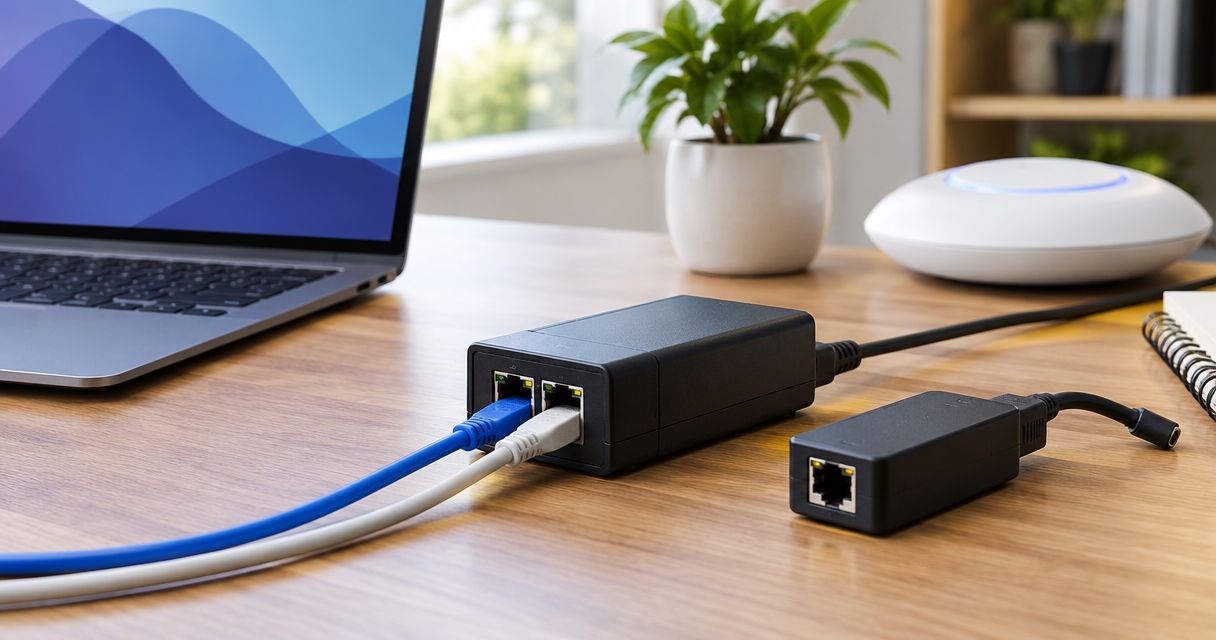
Best overall for a single compatible device in 2026: an IEEE 802.3at PoE injector. Best for a low-power endpoint: an IEEE 802.3af injector. Best for a higher-power endpoint: an IEEE 802.3bt Type 3 injector. If the device has no PoE input, you need a compatible PoE splitter instead of an injector alone.
- An IEEE 802.3at poe injector is the default choice for one compatible business-network device in 2026.
- Choose 802.3af only when the endpoint's stated power requirement fits its limit.
- Choose 802.3bt Type 3 when the device specifies higher-power PoE.
- A PoE splitter powers a non-PoE device only when its output matches the device's input.
Why this matters
A PoE injector adds power to an Ethernet connection for one device when the network switch does not provide PoE. That makes it useful for an access point, IP camera or other compatible endpoint without replacing an otherwise suitable switch. The device's specified PoE standard decides the purchase; its physical connector does not.
VOLL supplies professional network equipment to Portuguese businesses and offers installation and local support. For a single-device installation, start with the endpoint's power specification, then decide whether an injector solves the problem. Adding more devices changes the decision: a PoE switch gives you powered ports in one place, while separate injectors add a power supply and cable connection for each endpoint.
What makes the best PoE injector for one device?
- Standards match: Look for an explicit IEEE 802.3af, 802.3at or 802.3bt requirement on the endpoint. Match the injector to that requirement rather than relying on the word PoE alone.
- Power at the device: IEEE 802.3af permits up to 15.4 W at the power source and 12.95 W at the powered device. IEEE 802.3at raises those limits to 30 W and 25.5 W. IEEE 802.3bt Type 3 permits up to 60 W at the source and 51 W at the device.
- Output type: A standards-based injector negotiates power with a compatible powered device. A passive injector does not provide the same standards-based detection; use one only when the endpoint documentation explicitly calls for its voltage and wiring.
- Data connection: Confirm that the injector's Ethernet data capability meets the connection the device needs. Supplying enough power does not fix a data-speed mismatch.
- Installation fit: Account for the injector's mains connection, cable route and operating environment. A weather-exposed device does not make an indoor injector suitable for outdoor mounting.
The source-side and device-side wattages are different because the Ethernet cable consumes some power. Compare the endpoint's requirement with power available at the device, not just the largest number printed on an injector. In 2026, this check matters more than choosing the highest-rated option by default.
PoE injector options at a glance
| Option | Best for | Standout feature | Key limitation |
|---|---|---|---|
| IEEE 802.3at injector | One device specifying 802.3at | Up to 25.5 W at the powered device | Does not meet an 802.3bt power requirement |
| IEEE 802.3af injector | One low-power device specifying 802.3af | Up to 12.95 W at the powered device | Lower power limit than 802.3at |
| IEEE 802.3bt Type 3 injector | One device specifying higher-power PoE | Up to 51 W at the powered device | Unnecessary when the endpoint only needs 802.3af or 802.3at |
| Compatible PoE splitter | A device without a PoE input | Separates power and data at the endpoint | Requires a matching output and a PoE power source |
These are equipment types, not interchangeable models. Check the chosen unit's stated standard, output and data capability against the endpoint documentation before ordering. The splitter belongs in the comparison because it answers a common single-device problem, but a splitter is not a substitute for an injector at the source end.
1. IEEE 802.3at injector: best PoE injector for a single standard device
An IEEE 802.3at injector is the default when one endpoint specifies 802.3at and the existing switch has an ordinary Ethernet port. It combines data from that port with power from a mains-fed supply, sending both toward the compatible endpoint. The standard allows up to 30 W at the source and 25.5 W at the device.
IEEE 802.3at injector pros:
- Meets an endpoint's stated 802.3at requirement without changing a non-PoE switch.
- Provides more device-side power than IEEE 802.3af.
- Uses standards-based detection with a compatible powered device.
IEEE 802.3at injector cons:
- Does not meet a device's stated 802.3bt requirement.
- Needs its own power connection and a place in the cable run.
- Is a poor fit if several endpoints need power from the same switch location.
Best for: One 802.3at access point, camera or other compatible endpoint on an existing non-PoE network connection. Verdict: Buy when the device specifies 802.3at and one powered port is all you need in 2026. Do not treat the 802.3at label as permission to ignore the injector's stated Ethernet data capability.
2. IEEE 802.3af injector: best for a low-power endpoint
An IEEE 802.3af injector serves a device whose documentation specifies 802.3af and whose power requirement stays within that standard. It delivers up to 15.4 W at the source and 12.95 W at the powered device. Those limits are the deciding facts, not the device's size or whether it looks like other PoE equipment.
IEEE 802.3af injector pros:
- Directly matches an endpoint that specifies 802.3af.
- Adds one powered Ethernet connection without replacing the switch.
- Uses standards-based power detection with a compatible device.
IEEE 802.3af injector cons:
- Cannot satisfy an endpoint that requires 802.3at or 802.3bt power.
- Leaves no room for a device whose stated requirement exceeds the 802.3af limit.
- Still needs a separate mains connection.
Best for: A single endpoint explicitly rated for 802.3af. Verdict: Buy when the device's documentation confirms the match; skip it when the documentation calls for a higher PoE standard. An injector cannot compensate for an endpoint power requirement above its standard's device-side limit.
3. IEEE 802.3bt Type 3 injector: best for a higher-power device
An IEEE 802.3bt Type 3 injector addresses an endpoint that specifies Type 3 or an equivalent requirement within its supported power class. Type 3 permits up to 60 W at the source and 51 W at the powered device. Confirm the particular injector's supported classes and the endpoint's requirement; the broad 802.3bt label alone does not identify every unit's output.
IEEE 802.3bt Type 3 injector pros:
- Supports a higher device-side power limit than 802.3at.
- Lets one qualifying endpoint use an existing network data port.
- Keeps the choice tied to the device's documented PoE requirement.
IEEE 802.3bt Type 3 injector cons:
- Does not meet a requirement above its supported class or power output.
- Requires closer attention to cable condition and the complete power path.
- Adds another powered component when several devices might be better served by a suitable PoE switch.
Best for: One endpoint that specifies IEEE 802.3bt Type 3 and does not justify replacing the current switch. Verdict: Buy for that documented requirement; hold if the device simply says PoE without identifying the standard or power needed. VOLL network equipment procurement is most useful here when the endpoint, injector and cable specification are considered together rather than selected separately.
4. Compatible PoE splitter: best adapter for a non-PoE endpoint
A PoE splitter sits near a device that cannot accept power through its Ethernet port. It receives a compatible PoE connection and separates it into an Ethernet data connection and a power output for the device. It does not create power: the other end of the cable still needs a suitable PoE injector or PoE switch.
Compatible PoE splitter pros:
- Makes a suitable PoE cable run usable with a non-PoE endpoint.
- Separates data and power where the device needs them.
- Gives you a clear output specification to compare with the device's input requirement.
Compatible PoE splitter cons:
- An incorrect output voltage or connector can make it unsuitable for the endpoint.
- Its own power requirement reduces what remains available to the device.
- It does not remove the need for a compatible PoE source.
Best for: A device with separate Ethernet and power inputs when you need to carry power along the network cable. Verdict: Buy only after matching the splitter's output voltage, connector polarity and available power to the device's stated input. Skip the splitter for a device that already has a compatible PoE input: it adds a conversion step without solving a problem.
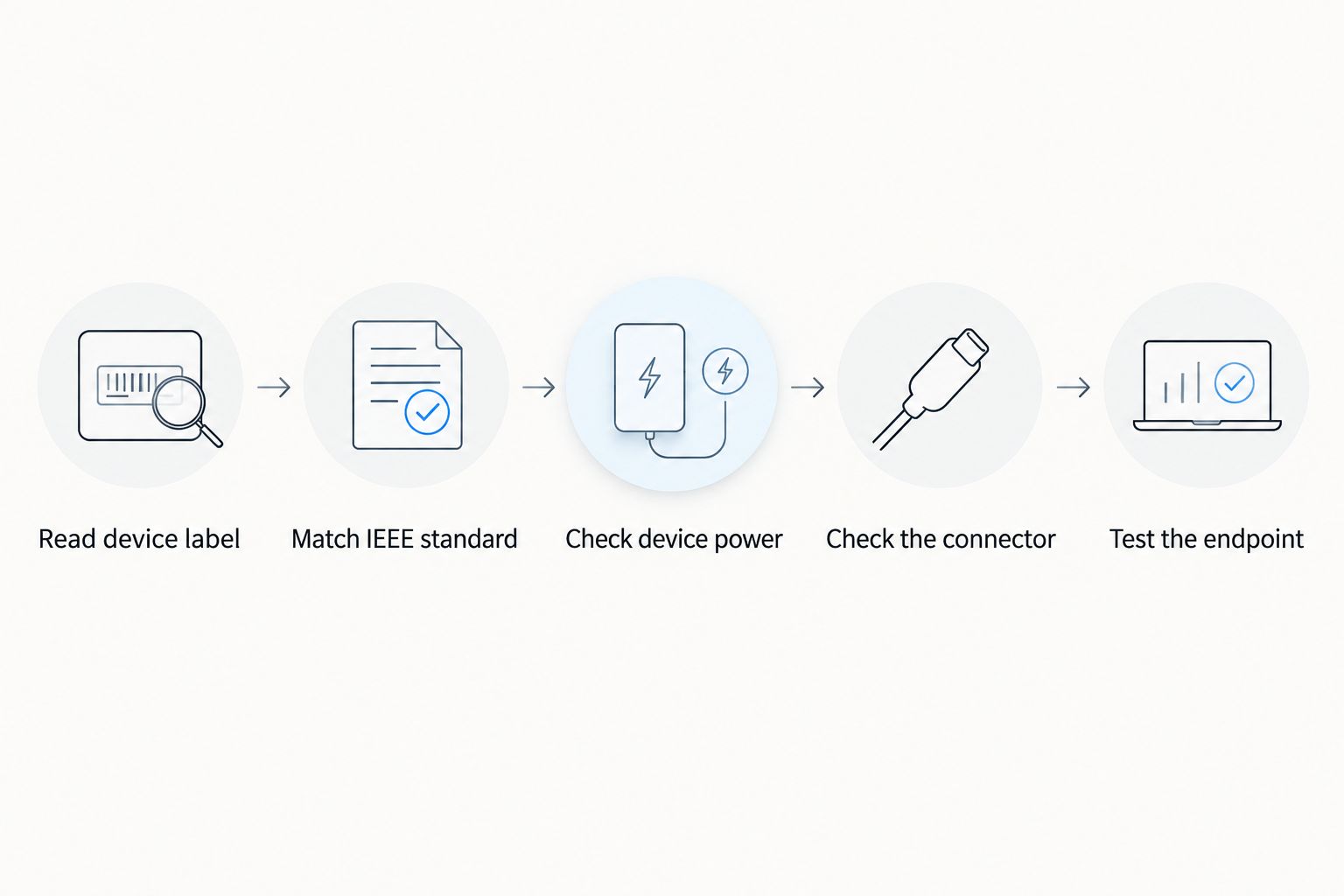
Match the device before placing the order
Use the endpoint specification as the first document, not an injector listing. A product described only as PoE-compatible has not yet told you enough to distinguish 802.3af from 802.3at, 802.3bt or a proprietary passive arrangement. Find the exact power requirement before choosing equipment.
- Read the device label: Record the stated PoE standard or, for a non-PoE device, its power-input requirements.
- Match the IEEE standard: Select an injector that states support for the endpoint's required standard and class.
- Check device power: Compare the device's stated need with power available at the endpoint, accounting for any splitter in the path.
- Check the connector: For a splitter, match output voltage, connector and polarity. For an injector, check the stated Ethernet data capability.
- Test the endpoint: Connect the complete cable path and verify that the device starts and its network connection works under its intended operating conditions.
Do not substitute a passive injector because its connector fits. Passive power arrangements depend on the endpoint's stated voltage and wiring; a familiar-looking Ethernet plug is not proof of compatibility. In 2026, that warning applies just as much to a replacement adapter as to a new installation.
How these options were ranked
The ranking starts with the most useful answer to the stated problem: powering one compatible endpoint from a non-PoE switch. IEEE 802.3at takes the default slot because it addresses a device that specifies 802.3at without requiring a switch replacement. IEEE 802.3af wins the narrower low-power slot, while IEEE 802.3bt Type 3 wins when the endpoint documents a higher-power requirement.
The splitter ranks separately because it solves a different problem: the endpoint lacks a PoE input. None of these options wins by offering the largest wattage alone. Standards compatibility, power at the device, data capability and installation fit determine the right choice. That is also why an undocumented passive injector does not earn a recommendation.
Which PoE injector should you choose in 2026?
Choose an IEEE 802.3at injector for one device that specifies 802.3at and an existing switch without PoE. Choose 802.3af when the endpoint explicitly specifies it; choose 802.3bt Type 3 when the endpoint requires that higher-power standard. Choose a compatible splitter only when the device has a separate power input and the complete PoE path meets its requirements.
If you are powering several endpoints from one location, stop treating the installation as a collection of single-device purchases. Compare a suitable PoE switch instead. VOLL network equipment choices should follow the planned number of powered ports and each endpoint's documented power requirement, not the injector that happens to be closest to hand.
FAQ
What is the best poe injector for one device in 2026?
An IEEE 802.3at injector is the default for one endpoint that specifies 802.3at. If the endpoint specifies 802.3af or 802.3bt, choose an injector that meets that documented requirement instead.
Can an IEEE 802.3af injector power an 802.3at device?
No, not when the device requires power beyond 802.3af limits. IEEE 802.3af permits up to 12.95 W at the powered device; check the endpoint's stated requirement before connecting it.
What is the difference between a PoE injector and a PoE splitter?
An injector adds power to an Ethernet connection at the source; a splitter separates power and data near a non-PoE endpoint. A splitter still needs a compatible PoE source on the other end of the cable.
Is a passive PoE injector the same as an IEEE PoE injector?
No. A passive injector does not use the same standards-based power detection; use it only when the endpoint documentation explicitly specifies the required voltage and wiring.
When should I choose an IEEE 802.3bt Type 3 injector?
Choose an IEEE 802.3bt Type 3 injector when one endpoint specifies that standard and its supported power class matches the device. Type 3 permits up to 51 W at the powered device.
Can a PoE injector replace a PoE switch?
A PoE injector can add power for one compatible device without replacing a non-PoE switch. For several powered devices, compare a switch with suitable PoE ports and a power budget that covers all endpoints.
What must match when using a PoE splitter?
The splitter's output voltage, connector, polarity and available power must match the device's stated input. The upstream injector or switch must also meet the splitter's PoE input requirement.
One last thing
A higher source-side wattage does not guarantee that the endpoint receives enough power. Check the device-side limit: 802.3at allows up to 25.5 W at the endpoint, while 802.3bt Type 3 allows up to 51 W. For a VOLL business-network installation in 2026, write down the endpoint requirement before choosing between an injector, a splitter and a switch.


