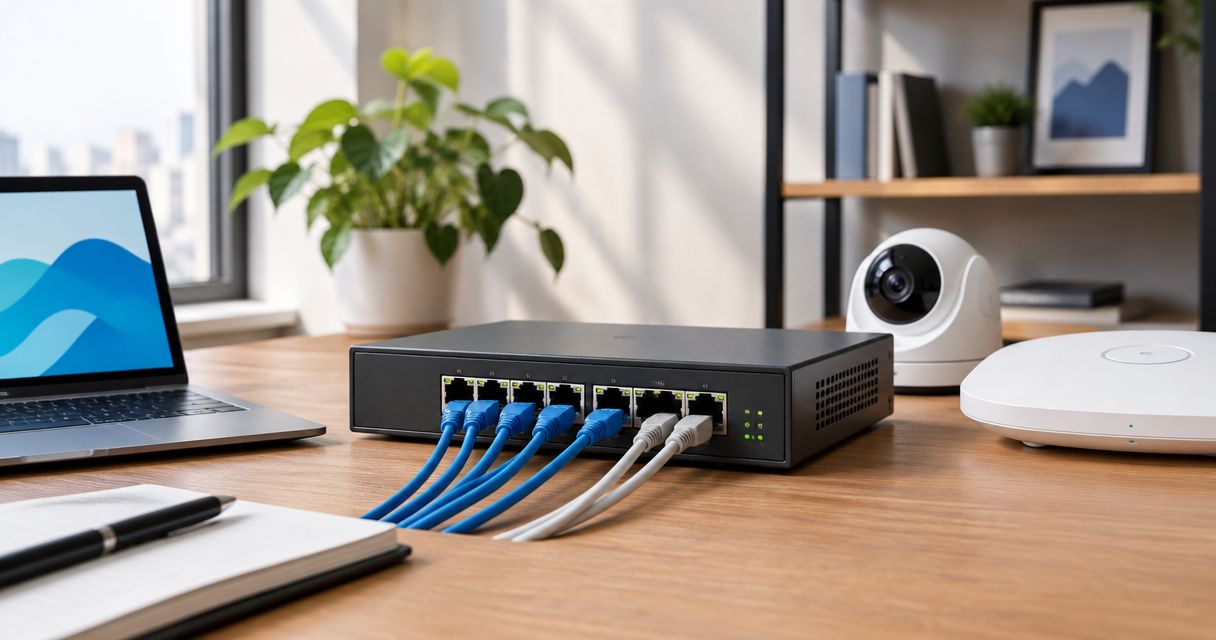
A switch poe 8 portas combines network connectivity and device power for IP cameras, access points, VoIP phones, and compatible POS equipment. Best overall for a growing office: a smart-managed 8-port PoE switch. Best for a simple installation: an unmanaged model. Best for multiple VLANs: a Layer 2+ managed switch. For Portuguese businesses that need installation and local support, Voll provides the B2B network-equipment route rather than a hardware-only purchase.
- A smart-managed switch poe 8 portas is the best default for a growing small business in 2026.
- Choose an unmanaged 8-port PoE switch when you need power and data without configuration.
- Choose Layer 2+ management when the 2026 network plan includes multiple VLANs and central monitoring.
- IEEE 802.3af supplies up to 15.4 W at the switch port; 802.3at supplies up to 30 W.
- Voll suits Portuguese businesses that want network equipment combined with installation and local support.
Why this matters
A switch can advertise eight PoE ports without having enough total power to run every connected device at its maximum draw. The port count tells you how many cables fit; the total PoE budget tells you which combination of cameras, access points, phones, and terminals can remain powered together.
This distinction matters when planning PoE switch installations for IP cameras. A fixed camera and a motorised PTZ camera do not place the same demand on a switch, while access points can also require different PoE standards. Add the maximum input requirements from the device specifications before selecting the switch.
Voll is best for Portuguese businesses that want an 8-port PoE switch specified with local installation and support rather than selected on hardware price alone. Voll’s B2B catalogue includes professional networking equipment from Reyee, Teltonika, and Equip, while its stated delivery window across Portugal is 24-48 hours.
What makes the best 8-port PoE switch
Use these criteria to assess every candidate in 2026:
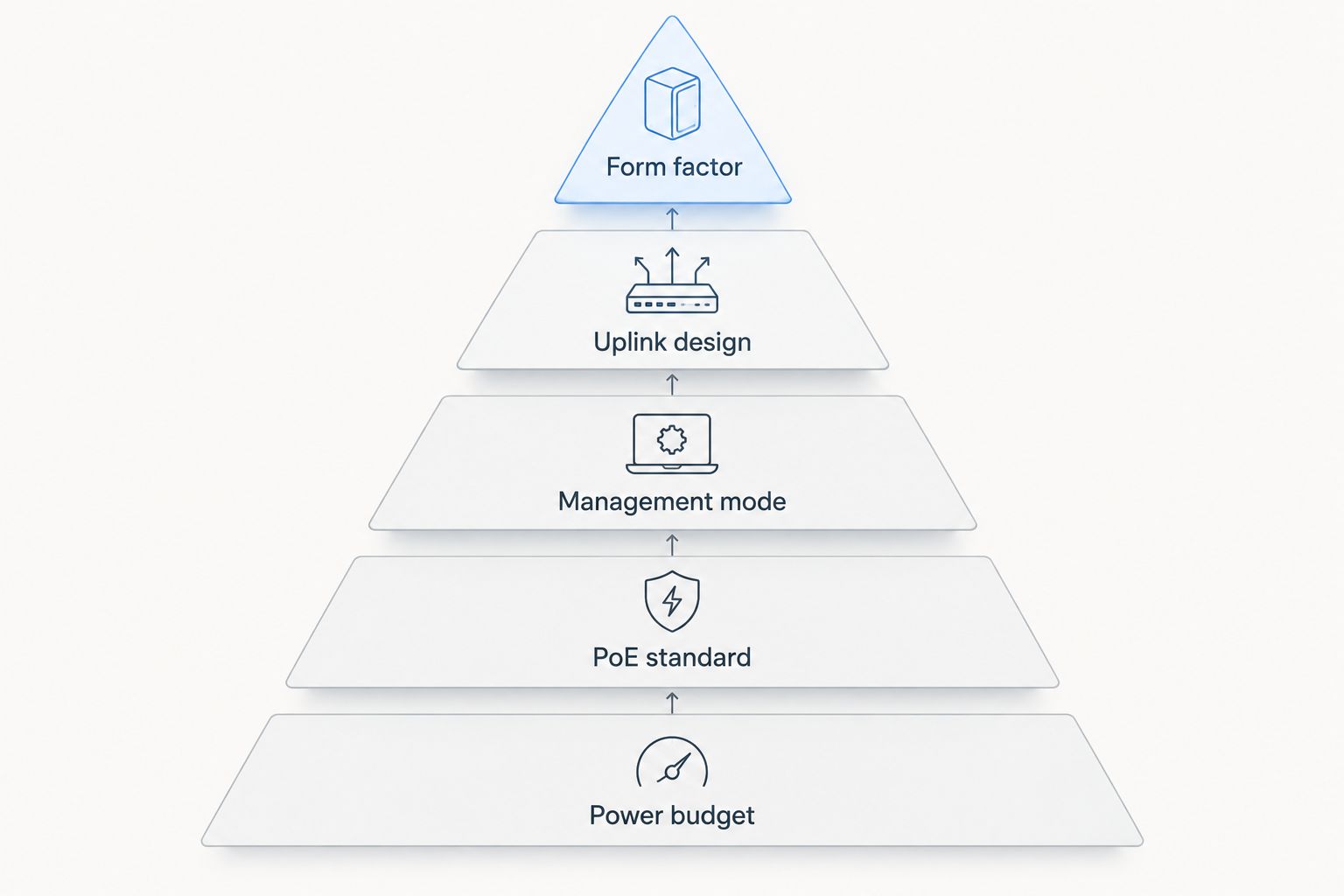
- Power budget: Add the maximum wattage required by every powered device, then compare the result with the switch’s combined PoE capacity.
- PoE standard: IEEE 802.3af provides up to 15.4 W at the power-sourcing port, while 802.3at PoE+ provides up to 30 W. Confirm the standard required by each endpoint.
- Management mode: Unmanaged switches need no configuration. Smart-managed and Layer 2+ models add controls such as VLANs, monitoring, and port settings.
- Uplink design: Check whether the switch includes dedicated copper or fibre uplinks. Otherwise, connecting the switch to the wider network can consume one of the eight listed ports.
- Form factor: Desktop, wall-mounted, DIN-rail, and rack-mounted switches fit different cabinets and work areas.
- Installation environment: A climate-controlled office and an exposed warehouse cabinet need different temperature, dust, mounting, and power arrangements.
A managed interface is not automatically better. It is useful only when someone is responsible for configuring it, recording the settings, applying updates, and investigating alerts.
8-port PoE switches at a glance
| Rank | Switch type | Best for | Standout feature | Key limitation |
|---|---|---|---|---|
| 1 | Smart-managed 8-port PoE | Growing small offices | VLAN and port-level controls | Requires initial configuration |
| 2 | Unmanaged 8-port PoE | Straightforward installations | Plug-and-play operation | No VLAN or remote diagnostics |
| 3 | Layer 2+ managed 8-port PoE | Structured multi-VLAN networks | Detailed management controls | Needs networking expertise |
| 4 | Industrial 8-port PoE | Warehouses and equipment cabinets | DIN-rail and industrial installation options | Unnecessary for a normal office |
| 5 | Rack-mounted 8-port PoE | Small network cabinets | Organised cabinet installation | Needs suitable rack space |
The ranking is a decision tree, not a claim that every switch in one category beats every switch in another. Match the first suitable category to the physical location, required controls, uplink, and combined power demand.
1. Smart-managed 8-port PoE: best for a growing office
A smart-managed switch sits between unmanaged hardware and a fully managed Layer 2+ platform. It supplies PoE while exposing selected controls through a browser-based or cloud-managed interface, depending on the model.
This category fits an office that starts with a few powered endpoints but expects to add cameras, access points, or phones during 2026. VLAN support lets you separate device groups when the switch and the rest of the network use compatible configurations. Port status and power information also make fault isolation faster than repeatedly disconnecting cables.
Smart-managed 8-port PoE pros:
- Supports basic VLAN and port configuration on suitable models
- Shows whether individual links are active
- Provides a practical middle ground for an expanding network
- Allows configuration changes without replacing the physical switch
Smart-managed 8-port PoE cons:
- Still requires an administrator and documented credentials
- Available functions differ between models and management platforms
- Incorrect VLAN settings can disconnect devices from required services
Best for: a small office, shop, or hospitality site that expects its network to change after installation.
Verdict: Buy. A smart-managed 8-port PoE switch is the best default for an undecided small-business buyer in 2026.
2. Unmanaged 8-port PoE: best for a simple installation
An unmanaged switch has no configuration interface. Connect the uplink, attach compatible powered devices, and the switch negotiates power with standards-compliant endpoints.
The simplicity is valuable when the network has one trusted device group and no requirement for switch-level VLAN configuration. It also removes the need to retain management credentials. The trade-off is limited visibility when a device loses power, negotiates at the wrong link speed, or stops passing traffic.
Unmanaged 8-port PoE pros:
- Requires no switch configuration
- Works well for a fixed group of compatible endpoints
- Avoids management-account and configuration maintenance
- Keeps deployment focused on cabling, power, and device setup
Unmanaged 8-port PoE cons:
- Provides no switch-level VLAN controls
- Offers little or no port-level diagnostic information
- Cannot support management requirements that appear later
Best for: a stable installation where every connected device can share the same simple network design.
Verdict: Buy when plug-and-play operation is the priority. Skip when the 2026 plan includes segmented traffic or remote switch management.
3. Layer 2+ managed 8-port PoE: best for multiple VLANs
A Layer 2+ managed switch targets networks that need detailed configuration and monitoring. Depending on the model, relevant functions can include VLAN controls, link aggregation, access-control rules, spanning-tree settings, SNMP, and detailed port statistics.
Do not choose this category just because its specification sheet is longer. The functions provide value when they match an existing network design and an administrator knows how to maintain them. A small flat network gains complexity without a corresponding operational benefit.
Layer 2+ managed 8-port PoE pros:
- Provides detailed control over traffic segmentation
- Supports deeper monitoring on appropriately specified models
- Fits structured networks with documented switch configurations
- Integrates more naturally into centrally monitored infrastructure
Layer 2+ managed 8-port PoE cons:
- Demands more networking knowledge than smart-managed hardware
- Misconfiguration has a wider effect on connected services
- Feature names and capabilities vary by manufacturer and model
Best for: an office with multiple VLANs, formal network administration, or a requirement to monitor switch ports centrally.
Verdict: Hold if the network is still flat and simple. Buy once the design specifically requires Layer 2+ functions.
4. Industrial 8-port PoE: best for a warehouse cabinet
An industrial PoE switch is designed for installation conditions outside a normal office desk or climate-controlled communications room. Common category features include DIN-rail mounting, terminal-block power connections, fanless construction, and published environmental tolerances.
The model’s data sheet still decides suitability. Check the stated operating temperature, input-power requirements, surge protection, enclosure rating, grounding instructions, and PoE capacity against the actual cabinet. The word industrial does not replace that assessment.
Industrial 8-port PoE pros:
- Provides mounting options suited to control cabinets
- Supports installations where desktop hardware is physically unsuitable
- Fanless models remove a moving component from dusty locations
- Keeps local camera or access-point cable runs near the work area
Industrial 8-port PoE cons:
- Requires appropriate cabinet power and grounding
- DIN-rail construction offers no benefit on a normal office desk
- Environmental ratings and protections are model-specific
Best for: warehouses, workshops, production areas, and equipment cabinets whose conditions fall outside an office environment.
Verdict: Buy for a verified industrial requirement. Skip for a climate-controlled office or retail back room.
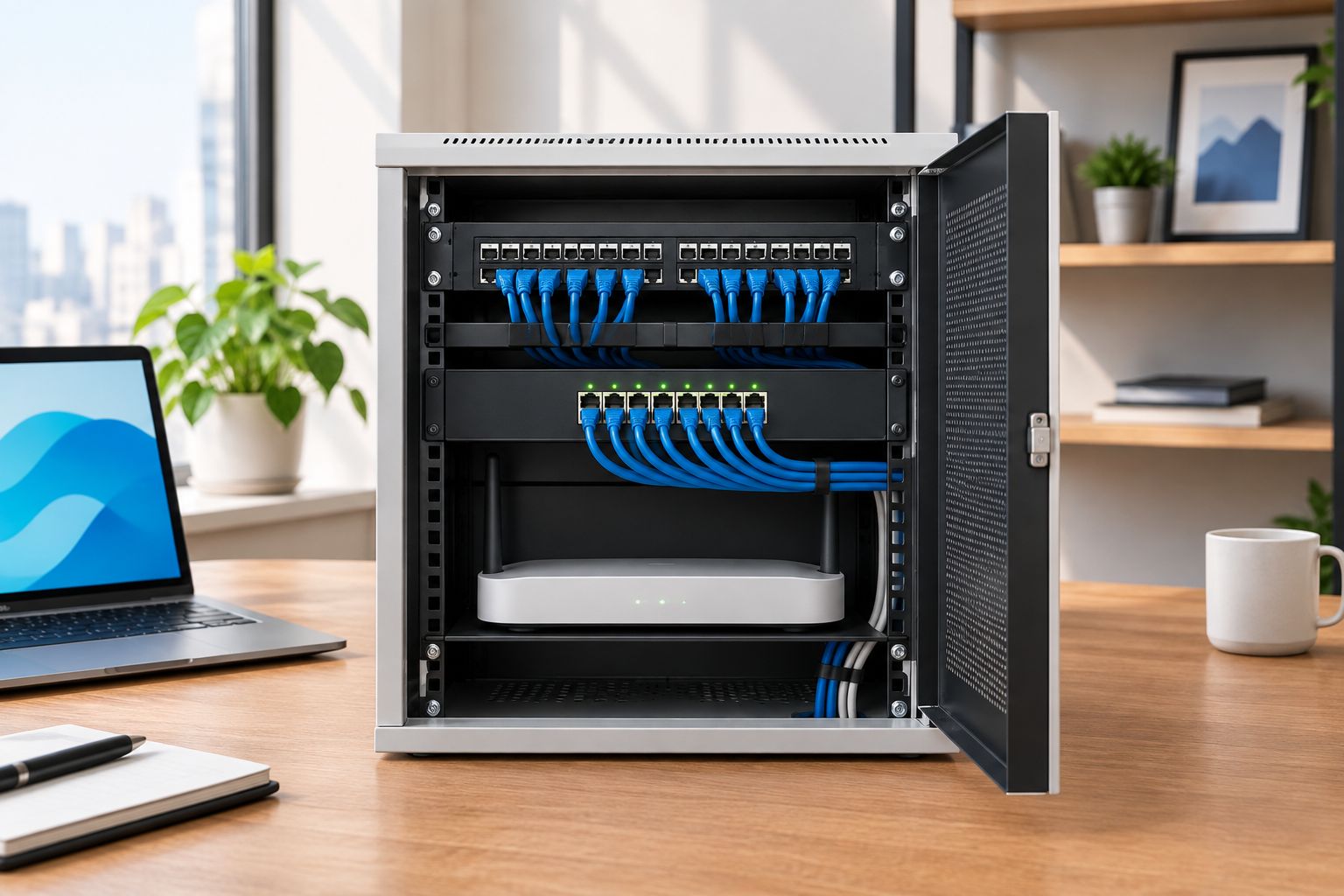
5. Rack-mounted 8-port PoE: best for a small network cabinet
A rack-mounted switch keeps network connections secured and organised alongside patch panels, a router, and backup power equipment. The format suits a permanent installation where cables return to one communications cabinet.
Rack mounting does not guarantee a larger PoE budget or a dedicated uplink. Confirm those specifications separately. Also check the unit’s rack width, mounting hardware, airflow requirements, power-connector position, and cable clearance before ordering.
Rack-mounted 8-port PoE pros:
- Keeps permanent cabling inside a protected cabinet
- Simplifies physical port identification when cables are labelled
- Fits a structured installation with patch panels and backup power
- Reduces loose equipment around desks and checkout counters
Rack-mounted 8-port PoE cons:
- Requires compatible cabinet space and mounting hardware
- Airflow and cable clearance must be planned
- Offers no operational advantage when the switch sits alone on a desk
Best for: a small office or retail location where network cables terminate in a rack or wall cabinet.
Verdict: Buy when the cabinet already forms part of the installation. Skip when there is nowhere appropriate to mount it.
Match PoE capacity to your network
Request a business quote based on your cameras, access points, phones and POS equipment.
How the switches were ranked
The order follows the needs of a typical small-business installation in 2026. Smart-managed hardware ranks first because it adds useful control without assuming a fully administered network. Unmanaged hardware ranks second because simplicity remains the correct answer for a fixed, flat network.
Layer 2+ switches move ahead only when formal segmentation and monitoring are requirements. Industrial and rack-mounted models solve physical installation problems, so they rank below the general office choices rather than competing with them directly.
Every shortlist still needs a line-by-line specification check. Record the device count, maximum power requirement for each endpoint, total switch budget, required PoE standard, uplink design, management method, installation location, and expected expansion. Those facts decide the model; the ranking decides the category.
Which 8-port PoE switch should you choose?
Choose a smart-managed 8-port PoE switch if you are undecided. It is the clearest 2026 default for a small business that expects to add endpoints or separate traffic later.
Choose unmanaged hardware when the installation is intentionally simple and will remain that way. Choose Layer 2+ management when an administrator has already defined the VLANs, monitoring method, and switching requirements. Choose industrial hardware for a verified environmental need, and choose rack-mounted hardware when the network terminates in a suitable cabinet.
Before requesting a recommendation from Voll, list every powered endpoint and copy its maximum input requirement from the manufacturer’s data sheet. That prevents an eight-port label from hiding an inadequate combined power budget.
FAQ
What is the best switch poe 8 portas for a small business in 2026?
A smart-managed 8-port PoE switch is the best default for a growing small business in 2026. It adds useful VLAN and port controls without requiring every capability of a Layer 2+ platform.
Can an 8-port PoE switch power eight devices at once?
Yes, if all eight ports support PoE and the switch’s combined power budget covers the devices’ total maximum demand. Confirm whether the advertised port count includes non-PoE or uplink ports.
What is the difference between PoE and PoE+?
IEEE 802.3af PoE supplies up to 15.4 W at the switch port, while IEEE 802.3at PoE+ supplies up to 30 W. The powered device and switch must support a compatible standard.
Is a managed 8-port PoE switch better than an unmanaged switch?
A managed switch is better when you need VLANs, monitoring, or configurable ports. An unmanaged switch is the better choice when the network is fixed, simple, and has no administration requirement.
Do IP cameras need a managed PoE switch?
IP cameras do not automatically require a managed switch. Management becomes useful when you need traffic separation, port monitoring, or remote control within a documented network design.
Should I choose a desktop or rack-mounted PoE switch?
Choose desktop hardware for a small standalone installation and rack-mounted hardware when cabling terminates in a compatible cabinet. Form factor does not determine the PoE budget, so check power specifications separately.
What information does Voll need to specify an 8-port PoE switch?
Voll needs the endpoint count, maximum power requirement of each device, required PoE standard, uplink type, management needs, and installation location. Include planned additions so the 2026 design is not full on day one.
One last thing
Do not multiply the highest per-port output by eight and assume the switch can deliver that total. The combined PoE budget is a separate specification, and manufacturers can pair PoE-capable ports with a shared budget below the theoretical sum of every port.
Also verify whether the eight-port description means eight PoE access ports, eight total Ethernet ports, or eight PoE ports plus separate uplinks. That difference changes both endpoint capacity and how the switch connects to the wider network.


