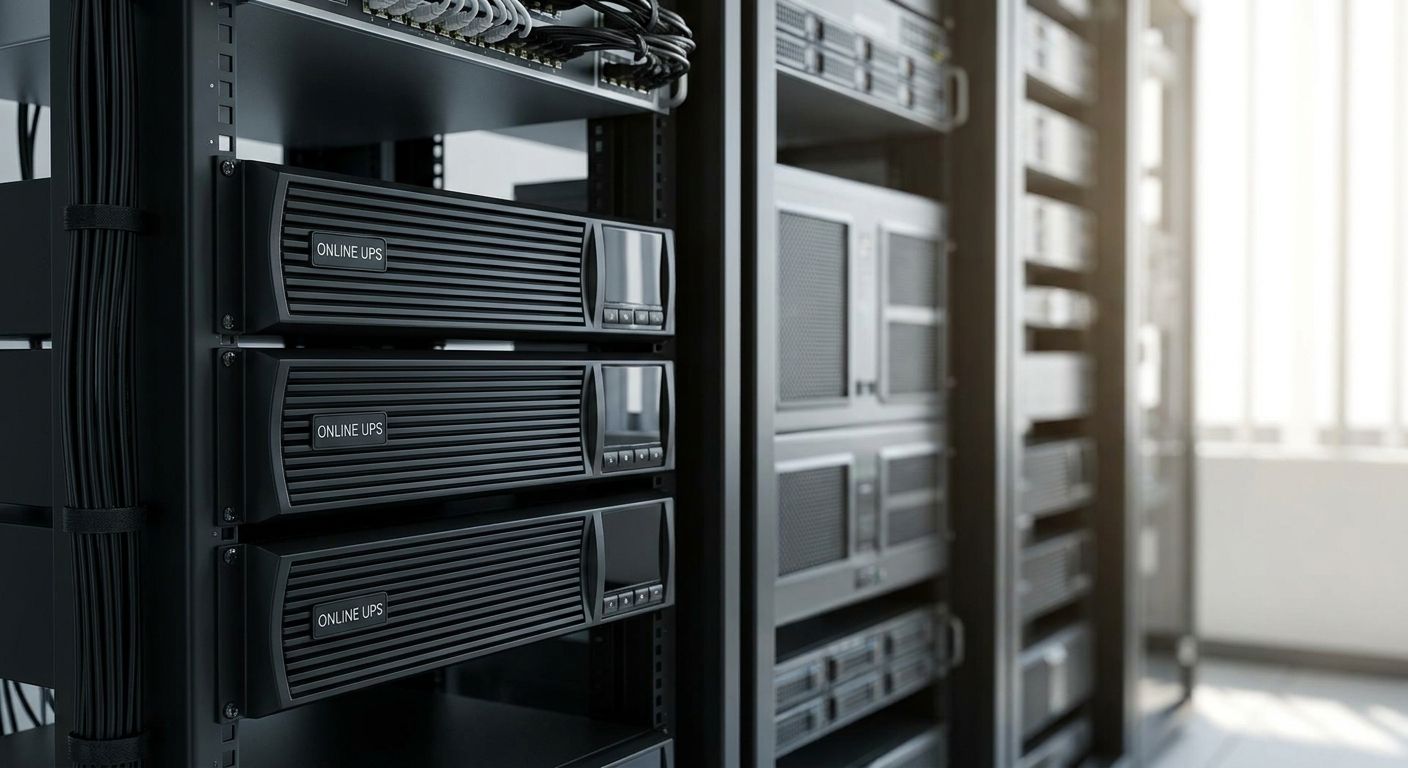
A UPS online (double-conversion) system is the only category that keeps servers, switches, and POS terminals running clean through Portugal's voltage sags and brief outages — this guide ranks the models worth buying for server rooms and network racks in 2026 and flags the ones to skip.
- Eaton 9PX wins for on-prem ERP servers thanks to bundled shutdown software — Buy.
- APC Smart-UPS SRT is the safest default for mixed server and network racks — Buy.
- Line-interactive units are fine for a single POS till but Skip them for a full server room.
- A UPS online setup holds 0ms transfer time versus 4-10ms on line-interactive models.
- Riello Sentinel Dual suits sites with unstable grid voltage — Consider before buying APC.
Why this matters
A network rack that loses power mid-transaction doesn't just go dark — it corrupts POS databases, drops ERP connections mid-sync, and forces a manual recovery that costs hours. Any business running WinTouch POS or Primavera/Cegid ERP on local servers has more to lose from a bad power event than the cost of the UPS itself.
Most small business racks in Portugal still run on basic line-interactive power strips, which is the wrong category for anything hosting a server, a switch stack, or a network rack setup that can't afford a 4-10ms voltage gap. A UPS online (double-conversion) unit regenerates clean AC continuously, so the switchover to battery is effectively instant.
How this list was ranked
The ranking below weighs four things that matter for a server room or network rack specifically, not a general office desk: topology (online vs line-interactive), VA/watt headroom for the actual load, rack form factor and hot-swap battery support, and remote monitoring or auto-shutdown software compatibility with the servers behind it. Pricing isn't listed because VA configurations and battery-pack counts change the total per install — get a quote against your actual rack load rather than trust a headline number. Models that only ship as line-interactive or tower-only were excluded from the Buy tier regardless of brand recognition.
The ranked list
1. APC Smart-UPS SRT (Schneider Electric) — the safe default
This line scales from roughly 1500VA up to 10kVA across the same online double-conversion topology, in 2U to 6U rack chassis. It's the model most IT installers default to because the network management card option lets you monitor load and battery health remotely, which matters once a rack has more than one device behind it.
For a mixed rack — a switch, a small server, an ERP appliance — this is the pick that won't surprise you later with a topology mismatch. Verdict: Buy for any server room or network rack running production workloads in 2026.
2. Eaton 9PX — the software-first pick
Eaton bundles Intelligent Power Manager software with the 9PX series, which triggers a graceful shutdown sequence on connected servers before the battery runs out — critical for anyone running Primavera/Cegid ERP locally, since an abrupt power loss mid-write is what corrupts a database, not the outage itself.
The 9PX range also runs online double-conversion end to end, with rack/tower convertible chassis. Verdict: Buy for businesses whose ERP or POS backend can't tolerate an unplanned hard shutdown.
3. Riello Sentinel Dual — the grid-instability pick
Riello builds for continuous industrial duty, and the Sentinel Dual's wide input voltage tolerance window absorbs the kind of brownouts and voltage swings more common outside major Portuguese cities, without dropping to battery unnecessarily. Constant battery cycling on cheaper UPS units shortens battery life fast.
It's a European brand with strong service coverage, which matters when a battery pack needs replacing on-site. Verdict: Consider it before defaulting to APC if the site has a history of unstable incoming voltage.
4. CyberPower OL series — the budget double-conversion pick
CyberPower's OL line hits the same online double-conversion topology as APC and Eaton at a lower cost per VA, shipping with rack rail kits included in most 2U configurations. It's the pick when the topology requirement is non-negotiable but the budget for a small network closet is tight.
The tradeoff is a smaller service network in Portugal than APC or Eaton, so factor in support lead time. Verdict: Consider for a small server closet on a constrained budget, not for a mission-critical rack.
5. Legrand Keor Line RT — the hot-swap pick
Legrand's Keor Line RT supports hot-swappable battery packs, meaning a battery replacement doesn't require powering down the rack — a real advantage for a 24/7 network rack running a POS system like WinTouch POS software across multiple tills that can't go dark during business hours.
Compact 1U-2U chassis options also fit shallower racks common in retrofitted server closets. Verdict: Buy for any rack that genuinely cannot tolerate scheduled downtime for maintenance.
6. Basic line-interactive UPS (generic desktop/tower models) — the one to skip
A line-interactive unit corrects voltage with a 4-10ms transfer delay and no true double-conversion — acceptable for a single desktop or a lone POS till, not for a server or a switch stack that will brownout-cycle the battery on every dip. These units are usually the cheapest option in a store aisle, which is exactly why they end up in server rooms by accident.
Verdict: Skip for anything labeled a server room or network rack in 2026 — reserve line-interactive units for single-device backup only.
Comparison table
| Model | Topology | VA range | Rack form | Runtime @ half load |
|---|---|---|---|---|
| APC Smart-UPS SRT | Online double-conversion | 1500VA-10kVA | 2U-6U | 8-10 min |
| Eaton 9PX | Online double-conversion | 1000VA-11kVA | 1U-6U | 7-9 min |
| Riello Sentinel Dual | Online double-conversion | 1000VA-10kVA | Tower/rack | 8-10 min |
| CyberPower OL series | Online double-conversion | 1000VA-6kVA | 2U-3U | 6-8 min |
| Legrand Keor Line RT | Online double-conversion, hot-swap | 1000VA-3000VA | 1U-2U | 7-9 min |
| Basic line-interactive | Line-interactive | 500VA-1500VA | Tower/desktop | 5-8 min |
Where to buy
- Match topology to the load first, price second. A cheaper line-interactive unit next to a server rack is a false saving — the transfer gap alone can reset network gear.
- Confirm pure sine wave output. Some budget units ship simulated sine wave, which destabilizes switch-mode power supplies used in servers and managed switches.
- Source from a distributor that stocks batteries locally. UPS batteries have a 3-5 year service life; a supplier without stock nearby means weeks of downtime risk when one fails, not hours.
For the network gear sitting in that same rack — switches, routers, access points — VOLL sources and installs professional-grade equipment with nationwide delivery in 24-48h, which is the same delivery window that matters when a UPS battery needs replacing fast.
Planning a server rack upgrade?
Get a quote on network equipment and rack setup support.
FAQ
What's the best UPS online system for a small server room in 2026?
The APC Smart-UPS SRT and Eaton 9PX are the top picks for 2026 because both run true online double-conversion topology with rack chassis from 1U to 6U. Eaton edges ahead when the server runs local ERP software that needs an automated graceful shutdown.
Is an online UPS better than a line-interactive UPS for network racks?
Yes, an online UPS is better for any rack running servers or switches because it eliminates the 4-10ms transfer delay a line-interactive unit has when switching to battery. That gap is enough to reset network gear on a brownout, which a double-conversion online UPS avoids entirely.
How much runtime does a server rack need from a UPS?
Most rack UPS units deliver 8-10 minutes of runtime at half load, which is enough time for a graceful automated shutdown, not extended operation. If the site needs longer runtime for manual intervention, size the VA rating up rather than relying on the built-in battery alone.
Can one UPS power both a server rack and a POS terminal?
A single rack-mount UPS can power both if the combined load stays within its VA rating, which is common in small retail or restaurant back offices. Calculate the wattage of every connected device first, since exceeding capacity shortens runtime and battery life.
How often should UPS batteries be replaced?
UPS batteries typically last 3 to 5 years under normal cycling, less if the site has frequent brownouts that force constant battery switching. Replace proactively on a schedule rather than waiting for a failure alert, since a dead battery during an outage defeats the purpose of the unit.
What size UPS in VA does a small network rack need?
A rack with a switch, a small server, and a router typically needs 1000-1500VA, while a rack also running a POS backend server pushes closer to 2000-3000VA. Add up the wattage of every device, then size the UPS with roughly 20-30% headroom above that total.
Does a UPS protect against power surges as well as outages?
Yes, every online double-conversion UPS regenerates clean AC continuously, which filters surges and voltage spikes before they reach connected equipment, not just during a full outage. This is one of the reasons online topology outperforms basic surge protectors for server and network gear.
What happens if a UPS output waveform doesn't match server power supplies?
A simulated sine wave output on a budget UPS can cause switch-mode power supplies in servers and managed switches to run unstable or shut down unexpectedly. Always confirm pure sine wave output before buying a UPS for anything beyond a basic desktop.
One last thing
The detail most buyers skip is battery hot-swap support — a Legrand Keor Line RT or similar hot-swap unit lets a technician replace a dying battery pack without powering down the rack, while every non-hot-swap model on this list forces a shutdown window to do the same job. On a rack running a 24/7 POS backend, that difference alone can be worth more than the price gap between models.