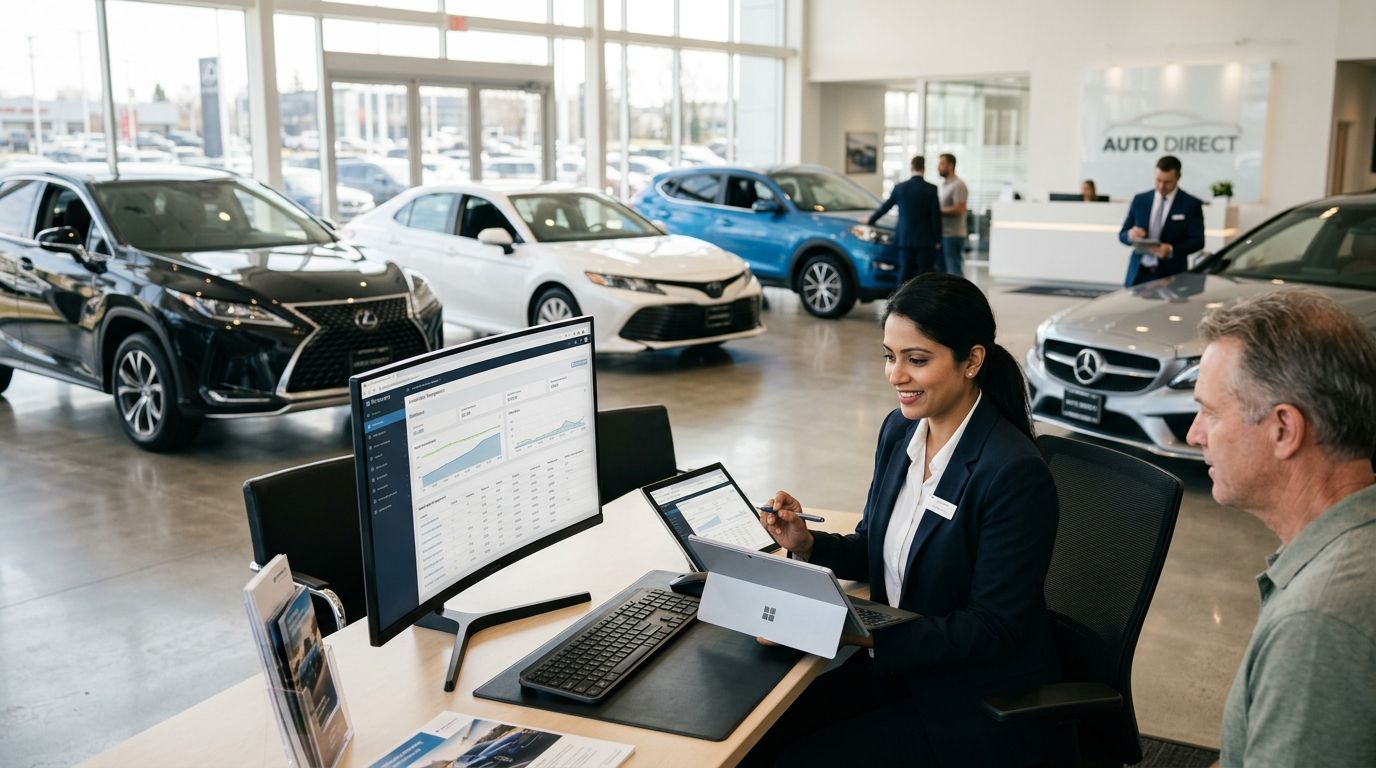
ERP Primavera for car dealerships and auto dealers is a management system that connects vehicle inventory, service bays, parts stock, and finance-and-insurance paperwork into one ledger instead of three or four disconnected tools. A dealership doesn't run like a retail shop or a restaurant — it tracks serialized inventory (VINs, not SKUs), manages consignment and trade-in valuations, and has to reconcile a sale, a service job, and a parts order against the same vehicle record. A generic ERP or a spreadsheet-plus-accounting-software combo breaks down fast once a lot carries 40+ units and a service department runs concurrent repair orders.
- ERP Primavera for car dealerships centralizes VIN-level inventory, service orders, and F&I paperwork in one system — verdict: worth the setup cost once you're past 20-30 active units.
- Dealerships in Portugal need SAF-T compliant invoicing built in, not bolted on, to avoid manual export errors at tax time.
- Integrating WinTouch POS with Primavera via API removes double-entry between the showroom counter and the back-office ledger.
- Multi-brand or multi-location dealer groups need company and user segmentation configured correctly from day one, not retrofitted later.
Why ERP Primavera matters for car dealerships
A car dealership sells three different things through the same door: new or used vehicles, service labor, and parts. Each of those has its own margin structure, its own inventory logic, and its own tax treatment. Running them on separate tools — a spreadsheet for the lot, a standalone invoicing app for service, a cash register for the parts counter — means reconciling three sources of truth every month, and reconciliation errors show up exactly where auditors look first: VAT declarations and SAF-T files.
Portugal requires SAF-T (PT) compliant invoicing for every registered business, and a dealership generating dozens of high-value invoices a month has more exposure than a small retailer if the export format is wrong. ERP Primavera handles SAF-T generation natively, which matters more for dealerships than almost any other segment because the average transaction value is high enough that a formatting error draws attention.
The other pressure point is inventory accuracy. A vehicle sitting on a lot for 90+ days ties up capital differently than a part sitting on a shelf. Primavera's inventory module tracks aging by unit, not just by category, so a sales manager can see which VINs are dragging on turnover instead of guessing from a paper log.
Update your vehicle inventory tracking
Move every unit — new, used, consignment — into serialized records instead of a shared spreadsheet.
- Assign a unique record per VIN with acquisition cost, reconditioning cost, and target margin
- Track aging by days-on-lot, not by month batches
- Flag consignment units separately from owned inventory for tax purposes
- Link trade-in valuations to the appraisal date, not the sale date
Connect the service department to parts inventory
A repair order that doesn't deduct parts from stock in real time creates phantom inventory within weeks.
- Tie each repair order to a parts pick-list that deducts stock automatically
- Set reorder points per part number based on historical usage, not gut feel
- Separate warranty-covered repairs from paid repairs in the reporting view
- Track labor hours against technician output for productivity reporting
Automate SAF-T compliant invoicing
Manual export of invoice data into the SAF-T (PT) format is where most dealerships lose hours every month-end.
- Generate SAF-T files directly from the invoicing module, no manual reformatting
- Cross-check VAT rates automatically for vehicle sales versus parts versus labor
- Keep an audit trail of every invoice correction, since dealership invoices get revised more often than retail receipts
The SAF-T compliant invoicing software for Portuguese businesses page covers what the export actually needs to contain before a Finanças audit flags it.
Integrate finance-and-insurance workflows
F&I paperwork — financing applications, insurance add-ons, warranty upsells — usually lives outside the core ERP entirely, which is a mistake once volume grows.
- Attach financing terms and insurance products directly to the vehicle sale record
- Track F&I product attach rate per salesperson, not just gross sale count
- Reconcile commission payouts against actual product delivery, not just the signed contract
Set up multi-user and multi-company access correctly
Dealer groups running two or three locations under one Primavera license need the company and user structure right from the first configuration, or reporting fragments later.
- Assign one company entity per legal dealership location if they file separately
- Set user permission tiers by role: sales floor, service advisor, parts counter, back office
- Give the general manager a consolidated view across all locations, not location-by-location logins
The how to add users and companies to a Primavera Cegid license guide walks through the exact steps for multi-entity dealer groups.
Connect the sales counter to the back-office ledger
A WinTouch POS terminal at the parts counter or service front desk should never require a separate end-of-day export into Primavera.
- Set up the API connection once, not a manual CSV import each week
- Sync stock levels between the counter and the ERP in real time
- Reconcile daily cash and card totals automatically against the ledger
The connect WinTouch POS to Primavera ERP via API guide covers the setup for dealerships running a parts or accessories counter alongside the main sales floor. For dealerships that also run a service bay with a front counter, the auto repair and car services POS terminal setup pairs directly with this integration.
Measure inventory turnover and F&I attach rate monthly
- Pull a days-on-lot report by vehicle segment (new, used, consignment) every month
- Track F&I attach rate as a percentage of total vehicle sales, not a raw count
- Compare service bay utilization against technician headcount to spot under- or over-staffing
Comparison: options for managing a car dealership's back office
| Option | Best for | Key limitation |
|---|---|---|
| ERP Primavera (Cegid) | Dealerships with 20+ active units or multiple locations needing SAF-T compliance and VIN-level tracking | Requires proper initial configuration by someone who understands dealership inventory logic |
| WinTouch POS integrated via API | Dealerships running a parts counter or service front desk alongside the main ERP | Needs the API connection set up correctly or double-entry creeps back in |
| Generic accounting software | Very small independent lots with under 10 units and no service department | No serialized VIN tracking, no dealership-specific reporting |
| Spreadsheets + manual invoicing | Startup lots in their first year | Breaks down past roughly 15-20 units; no audit trail for SAF-T |
Verdict: ERP Primavera is the right call once a dealership carries enough inventory that a spreadsheet can't track aging accurately — generic accounting software and manual spreadsheets are stopgaps, not long-term solutions for a dealership generating SAF-T-reportable invoices every week.
Get your Primavera setup scoped
Request a quote for licenses, POS integration, and configuration for your dealership.
Common mistakes car dealerships make with ERP setup
- Treating vehicles like retail SKUs. Batch-tracking inventory instead of serializing by VIN makes aging reports meaningless and hides which units are actually dragging on turnover.
- Bolting F&I onto a separate spreadsheet. Financing and insurance data that lives outside the ERP means commission disputes and no visibility into attach rate by salesperson.
- Skipping the parts-to-service link. Repair orders that don't automatically deduct parts stock create inventory that looks fine on paper and is wrong on the shelf.
- Delaying multi-company setup until a second location opens. Retrofitting company and user segmentation after the fact usually means re-entering months of transaction history.
- Manual SAF-T exports. Reformatting invoice data by hand every month instead of generating it natively from the ERP is where dealerships lose the most hours and make the most errors.
FAQ
Is ERP Primavera good for car dealerships in 2026?
Yes, for dealerships carrying 20 or more active vehicle units or running a service department alongside sales, since Primavera handles VIN-level serialized inventory, SAF-T compliant invoicing, and multi-company reporting in one system. Smaller independent lots under 10 units may not need the full setup yet.
Does ERP Primavera integrate with a POS terminal at the parts counter?
Yes, WinTouch POS connects to Primavera via API so parts counter sales sync to the back-office ledger in real time instead of requiring a manual export. This removes the double-entry that most independent dealerships still do by hand.
How does SAF-T compliance work for car dealership invoicing?
SAF-T (PT) requires every registered Portuguese business to generate a standardized export file of invoicing data for tax audits. Dealerships have higher exposure than small retailers because average transaction values are larger, so an ERP that generates SAF-T natively avoids the formatting errors common with manual exports.
Can one Primavera license cover multiple dealership locations?
Yes, a Primavera Cegid license supports multi-company setup so each legal dealership entity gets its own reporting while a general manager keeps a consolidated view across locations. This needs to be configured correctly from the start rather than added after a second location opens.
What's the difference between ERP Primavera and a generic accounting tool for a dealership?
Generic accounting software tracks revenue and expenses but has no concept of serialized VIN inventory, days-on-lot aging, or repair-order-to-parts-stock deduction. ERP Primavera is built to track exactly those dealership-specific relationships between a sale, a service job, and a parts order.
How do dealerships track F&I product attach rate in Primavera?
Financing and insurance products get attached directly to the vehicle sale record instead of living in a separate spreadsheet, which lets the back office pull attach rate as a percentage of total sales per salesperson. Without that link, F&I performance is usually estimated rather than measured.
Does switching to ERP Primavera require re-entering existing vehicle inventory?
Existing inventory records need to be migrated into serialized VIN entries during setup, which takes longer for dealerships that have been running spreadsheets for years. Doing this migration properly the first time avoids months of mismatched aging reports later.
What happens if a dealership keeps using spreadsheets instead of an ERP?
Spreadsheets typically hold up until inventory passes roughly 15-20 units, after which aging reports become unreliable and there's no audit trail for SAF-T invoice corrections. Past that volume, manual tracking becomes a liability at tax time rather than a convenience.
One last thing
The detail dealerships overlook most often isn't the ERP module — it's the license renewal date. A Primavera Cegid license that lapses mid-month during an active sales cycle locks out invoicing exactly when the dealership can least afford it, and the fix usually takes longer than expected because vehicle sale invoices can't be back-dated the way a retail receipt can. Set a renewal reminder at least 30 days out, not the week the license expires.


