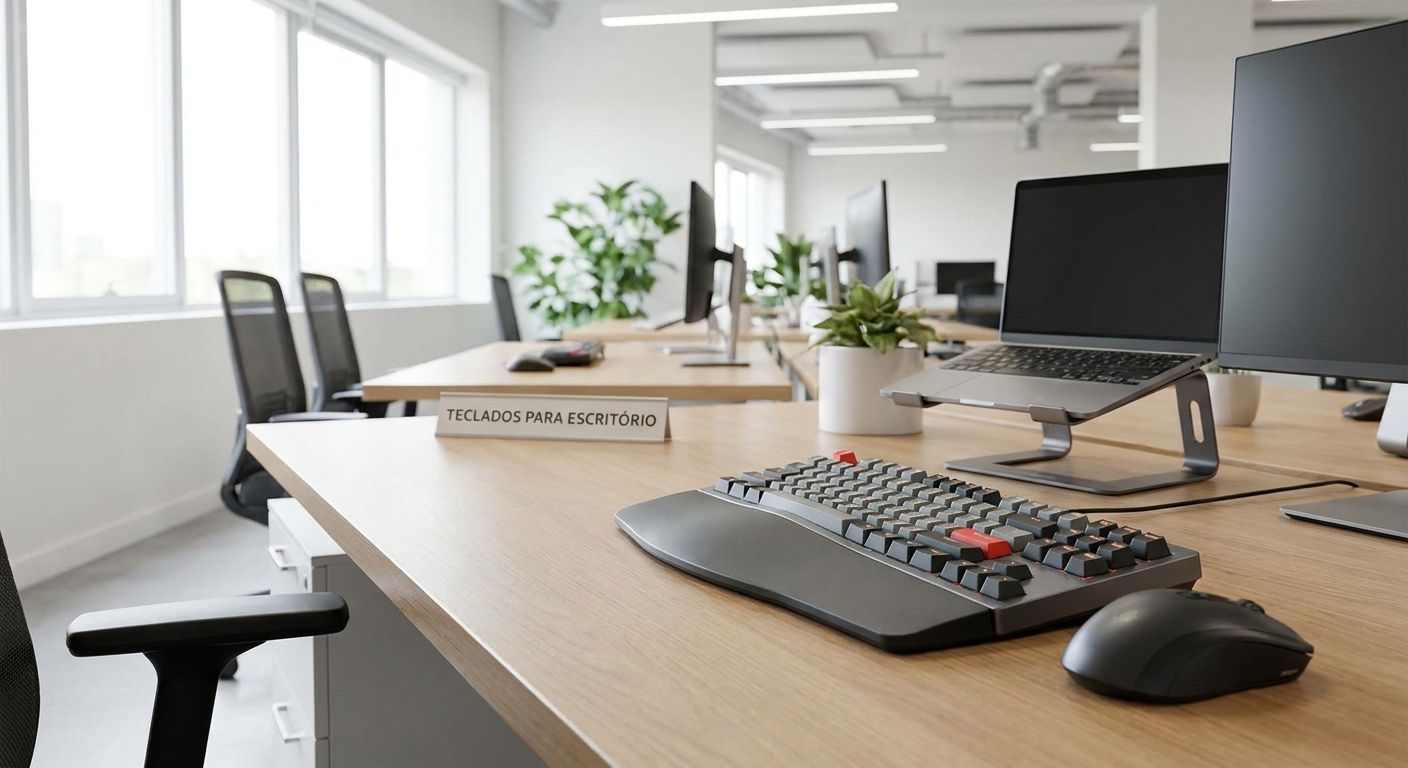
Shared workstations — hot-desks, coworking floors, call center pods, multi-shift retail back offices — put more wear on keyboards and mice than any single-owner desk ever will. Buy the wrong teclados para escritório and you're replacing sticky spacebars every quarter instead of every three years.
- IP54-rated membrane keyboards are the safe teclados para escritório pick for shared desks in 2026 — buy them.
- Skip full-size RGB mechanical keyboards on hot-desks; loud switches and dongle-only wireless fit gaming rooms, not shared offices.
- Bluetooth multi-device keyboard-mouse combos cut cable clutter and pair with up to three rotating devices.
- USB-C docking keyboards with 4K pass-through solve multi-monitor hot-desking without extra cabling per user.
- Washable IP66 keyboards earn their cost only near food or health counters, not on a standard open-plan floor.
Why this matters
A shared workstation gets touched by more hands in a week than a personal desk sees in a year. Coworking floors, POS counters, and 24/7 call center pods all carry the same risk: keyboards fail fast when nobody owns the cleaning or the wear. VOLL (voll.pt) fields this question constantly from Portuguese offices switching to hot-desking in 2026, because the failure pattern is always the same — stuck keys, dead dongles, and a spacebar that dies six months before the rest of the unit.
Buying office keyboards built for rotation, not the cheapest bulk SKU on a supplier list, keeps IT tickets down and keeps desks usable across shifts.
Who this is for
Teclados para escritório for shared workstations matter most to IT managers running hot-desking floors, coworking operators, call centers, and retail back offices where three or more people touch the same keyboard across a rotating shift. If your office issues one keyboard per employee and it never leaves that desk, most of this guide doesn't apply — buy whatever's comfortable and move on.
If the same keyboard sees a different set of hands every eight hours, the durability and hygiene criteria below decide whether you're buying once or buying three times in 2026.
What to look for in teclados para escritório for shared workstations
Spill and dust resistance
A hot-desk keyboard sits under a rotating cast of coffee cups and lunch crumbs, so an IP54 rating — the standard industry scale for dust and splash protection — is the minimum, not a nice-to-have. Below that rating, the first spilled coffee of the quarter kills the unit and you're back to procurement.
Quiet key travel for open floors
Clicky mechanical switches read as fun on a personal desk and as a nuisance on an open floor where six people share earshot of the same keyboard. Low-profile membrane or quiet mechanical switches keep noise complaints out of the IT queue.
Wireless reliability across rotating users
A keyboard that only pairs through a single proprietary 2.4GHz dongle is one lost dongle away from being dead weight on a shared desk. Bluetooth fallback that lets a new user re-pair in seconds matters more here than on a personal workstation where the same person owns the same dongle for years.
Surfaces that survive daily disinfecting
Keycaps that pop off for cleaning, and coatings rated for alcohol-based disinfectant, are the difference between a keyboard that lasts through 2026 and one that turns yellow and sticky by summer. Sealed, non-removable keycaps trap residue under the keys where nobody can reach it.
Compatibility with shared docking and multi-monitor setups
Hot-desks increasingly run dual monitors off a single USB-C dock, and the keyboard needs to sit downstream of that dock without adding a second cable run. If the desktop itself is overdue for a refresh, pair the new keyboard with a RAM upgrade for office laptops and desktops so the whole workstation performs, not just the peripherals.
Battery logistics for keyboard fleets
Wireless fleets need a charging plan — a shared charging station near the desk pool, or keyboards with a wired fallback mode — because a dead battery mid-shift is a support ticket nobody budgeted for.
Top picks for shared office workstations
The safe pick — IP54 membrane keyboard. Spill and dust rated to IP54, with the 55-60 gram actuation force typical of quiet office membranes, this is the default for any hot-desk floor in 2026. It's boring, it's cheap to replace in bulk, and it survives the average lunch-hour accident. Buy.
The wildcard — hot-swappable low-profile mechanical. Switches rated for roughly 50 million keystrokes, the same longevity benchmark used across the mechanical switch category, give this option a real edge on lifespan if noise isn't a concern on your floor. It costs more per unit and isn't right for a shared open-plan office with thin partitions. Consider.
The low-clutter pick — wireless keyboard-mouse combo. A single 2.4GHz USB receiver with Bluetooth fallback lets the combo pair across up to three devices, which matters when the same hot-desk hosts a laptop in the morning and a docked desktop in the afternoon. Pair it with video conferencing equipment for hybrid teams on any desk that doubles as a call station. Buy.
The hygiene pick — washable IP66 keyboard. Sealed silicone membranes rated IP66 can be rinsed under a tap, which is the right answer for a pharmacy counter or a clinic reception desk, not for a standard office floor where the extra cost buys nothing. Consider for health and food-service counters, Skip for typical open-plan offices.
The docking hub pick — USB-C hub with keyboard pass-through. A dock delivering 4K@60Hz video pass-through lets one cable drive dual monitors from a laptop bag, which is exactly the setup a rotating hot-desk needs. Buy for any workstation running more than one monitor.
Set up bulk peripheral orders
Order teclados para escritório and docking peripherals for multiple desks through one business account.
What to avoid
- Full-size RGB gaming keyboards. Loud clicky switches annoy the neighboring desk, and the per-unit cost is hard to justify across a hot-desking fleet in 2026.
- Proprietary-dongle-only wireless keyboards. Lose the dongle once on a shared floor and the entire unit is dead weight — Bluetooth fallback isn't optional at scale.
- Sealed, non-removable keycaps near food or health counters. Crumbs and residue build up under keys that can't be popped off and cleaned, which defeats the point of a shared-desk purchase.
Verdict comparison table
| Pick | Spill/Dust Rating | Noise | Connectivity | Best For | Verdict |
|---|---|---|---|---|---|
| IP54 membrane | IP54 | Low | Wired or 2.4GHz | General hot-desking | Buy |
| Low-profile mechanical | None stated | Medium | Wired or 2.4GHz | Quiet single-team floors | Consider |
| Wireless combo | Splash-resistant | Low | 2.4GHz + Bluetooth | Multi-device rotation | Buy |
| Washable IP66 | IP66 | Low | Wired | Clinics, food counters | Consider/Skip |
| USB-C dock + keyboard | IP54 | Low | USB-C pass-through | Multi-monitor desks | Buy |
FAQ
What's the best keyboard type for shared office workstations in 2026?
An IP54-rated membrane keyboard is the safest default for shared office workstations in 2026 because it resists spills and dust at a price that survives bulk replacement. Mechanical and washable models fit specific niches but aren't the general-purpose answer.
Are wireless keyboards reliable for hot-desking?
Wireless keyboards work well for hot-desking as long as they support Bluetooth fallback alongside a 2.4GHz receiver. A dongle-only model is a single lost part away from failure across a rotating desk pool.
How often should shared office keyboards be replaced?
Shared keyboards wear out faster than personal ones because rotating users hit the same spacebar and Enter key all day. Watch for sticking keys and unresponsive presses as the trigger to replace, rather than following a fixed calendar.
Do washable keyboards make sense for regular offices?
Washable IP66 keyboards make sense for pharmacies, clinics, and food-service counters, not for a standard open-plan office. The added sealing cost buys hygiene that a normal desk doesn't need.
Is Bluetooth or a USB dongle better for shared desks?
Bluetooth is better for shared desks because a new user can re-pair in seconds without hunting for a specific dongle. A 2.4GHz dongle still works but ties the keyboard to one receiver that's easy to lose across a rotating fleet.
Can one docking station serve multiple people on a hot-desk?
Yes, a USB-C dock with 4K@60Hz video pass-through serves multiple people on a hot-desk because each user just plugs in their own laptop to the same cable run. It removes the need for a separate keyboard and monitor setup per person.
How much does an office keyboard for shared desks typically cost?
Cost depends on the rating and switch type: basic membrane models cost the least, while hot-swappable mechanical and IP66 washable keyboards cost more due to the switches and sealing involved. Request current 2026 pricing for a bulk order rather than assuming a fixed number.
What's the difference between membrane and mechanical keyboards for office use?
Membrane keyboards use a pressure-sensitive pad under the keys and run quieter and cheaper, while mechanical keyboards use individual switches rated for tens of millions of keystrokes and cost more per unit. For shared offices, membrane wins on cost and noise; mechanical wins on lifespan.
One last thing
The spacebar and Enter key almost always fail first on a shared keyboard, worn down by every rotating user hitting them hardest. Buy a model with swappable or field-replaceable keycaps and you extend the unit's life by replacing two keys instead of the whole keyboard.