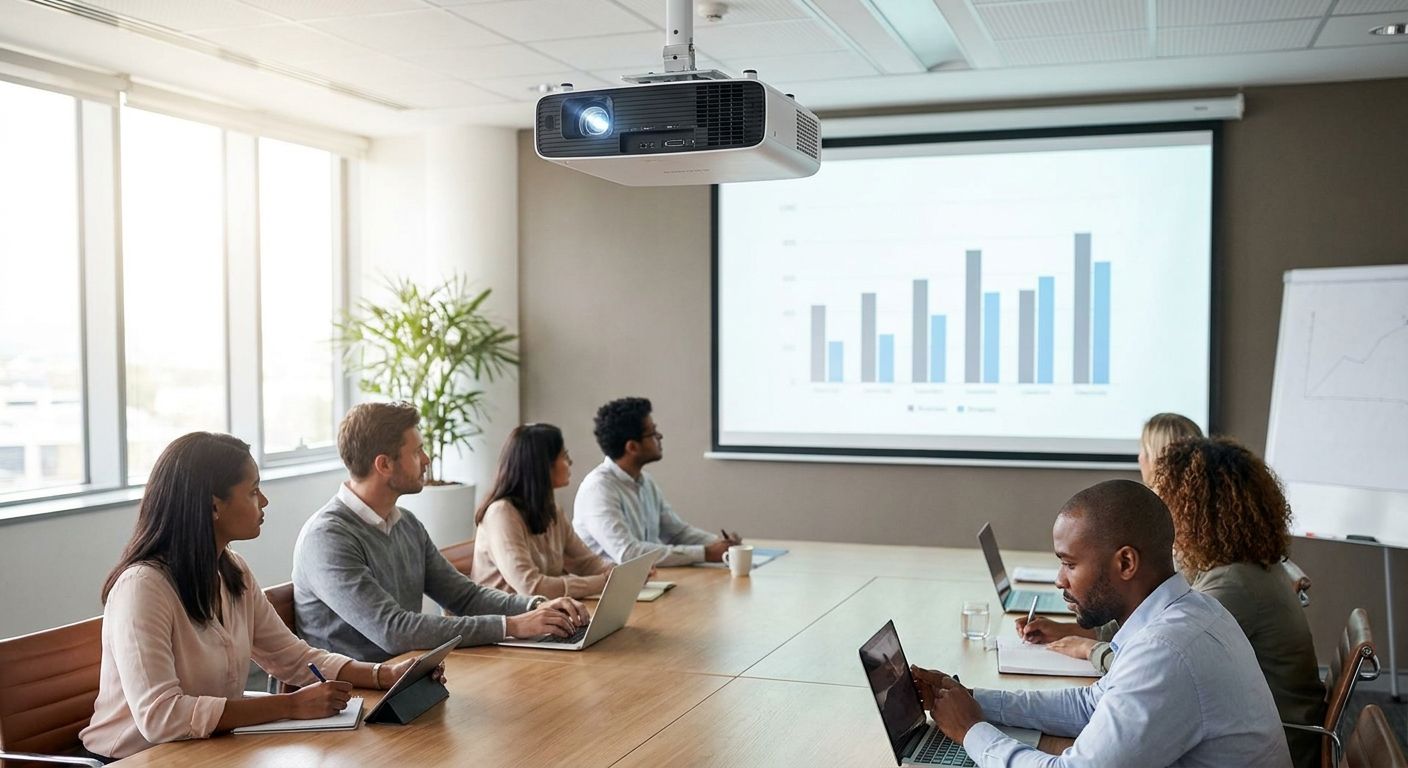
Meeting rooms and training rooms punish projectors that home-theater specs were built for. Ambient light, daily use and back-to-back sessions expose weak brightness and short lamp life fast — this guide breaks down what actually matters for a videoprojetor para salas de reunião bought for corporate use in 2026.
- For a videoprojetor para salas de reunião in 2026, buy laser models rated 4,000+ ANSI lumens for daylight rooms.
- Short-throw laser projectors fit huddle rooms under 15 m2 without a long cable run to the ceiling mount.
- Skip lamp-based projectors for daily training use — lamps rated 4,000-6,000 hours fail mid-cycle; laser units run about 20,000 hours.
- Pair the projector with a stable office network and a UPS on the AV rack, not just the projector itself.
- 4K resolution rarely earns its price in meeting rooms; 1920x1080 covers slides, spreadsheets and video calls fine.
Why this matters
A projector that dims after two years of daily training sessions isn't a bargain — it's a recurring interruption cost. Corporate training rooms and hybrid meeting spaces run the same fixture five days a week, often with windows or overhead lighting left on for note-taking. Consumer projectors built for a dark living room fail that test within the first year of 2026 use. The spec sheet differences between a home projector and a business one are small on paper and large in a lit conference room at 10am.
Who this is for
This guide is for office managers, IT leads and facilities buyers at Portuguese companies fitting out a meeting room, training room or hybrid-conference space in 2026. If you're procuring on a company invoice and need the purchase to survive daily use rather than the occasional weekend movie night, the criteria below apply directly. Buyers replacing equipment across several offices should also check how to buy IT equipment tax-free for your business before placing the order, since business pricing and invoicing rules differ from consumer retail.
What to look for in a meeting room projector
Brightness for the room's actual light level
Brightness, measured in ANSI lumens, is the single spec that decides whether slides stay readable with the lights on. A room with windows or fluorescent ceiling panels needs 4,000 to 5,000+ ANSI lumens; a windowless huddle room can run fine at 2,000 to 3,000. Buying a 2,000-lumen unit for a sunlit training room is the most common return-driving mistake in corporate purchasing.
Native resolution matched to content
1920x1080 (Full HD) covers slide decks, spreadsheets and video calls without strain, and it's what most conference-room content is authored at anyway. 3840x2160 (4K) matters for CAD reviews or detailed dashboards but adds cost most meeting rooms never recover in visible quality. Match resolution to what actually gets projected, not to the spec sheet.
Throw ratio and room depth
Throw ratio determines how far back the projector sits to fill the screen — short-throw units (roughly 0.5:1) work in tight huddle rooms where a standard-throw unit would need to sit in the hallway. Standard-throw projectors (1.5:1 to 2:1) fit larger conference rooms where distance to the screen isn't a constraint. Get this wrong and the image either overshoots the screen or leaves it half-lit.
Light source and duty cycle
Laser light sources are rated for roughly 20,000 hours before brightness drops meaningfully, versus 4,000 to 6,000 hours for a traditional lamp. A training room running six hours a day burns through a lamp's rated life in under three years; a laser unit outlasts the room's next refresh cycle. For anything used daily in 2026, laser is the only light source worth budgeting for.
Connectivity and network stability
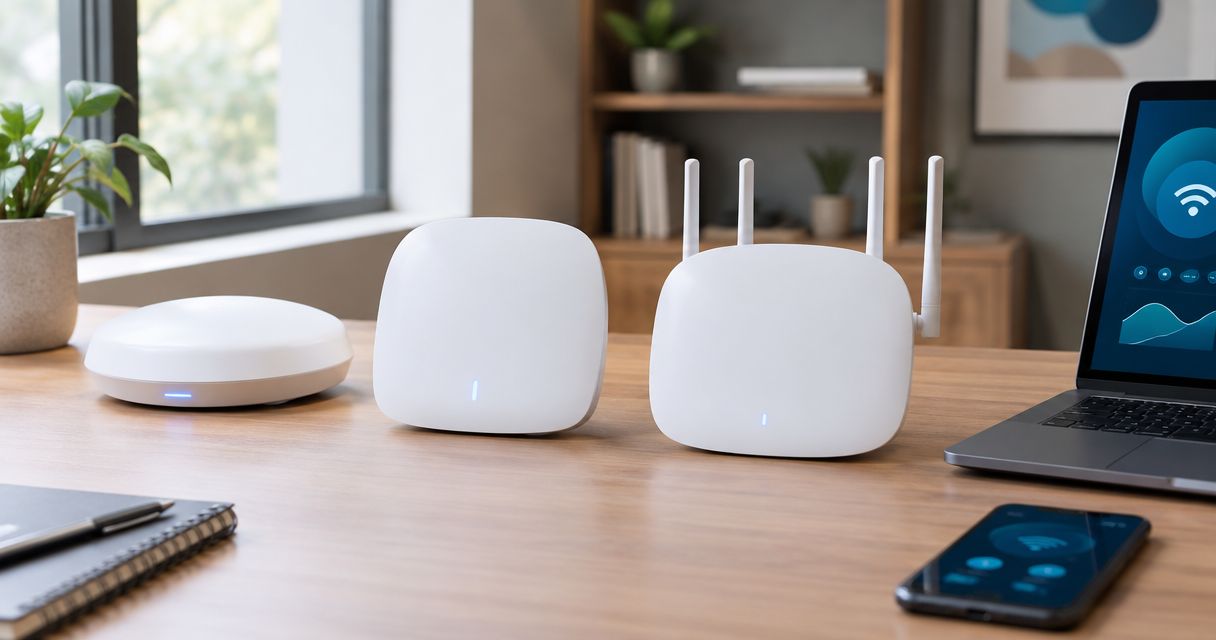
Wireless casting, HDMI-in from laptops, and USB-C for single-cable video and power are now standard expectations, not premium features. Wireless casting only works reliably if the room sits on a properly segmented office network — a projector that drops mid-presentation is usually a network problem, not a projector problem. Reviewing your office Wi-Fi network setup before the projector arrives avoids blaming the wrong piece of equipment.
Power stability on the AV circuit
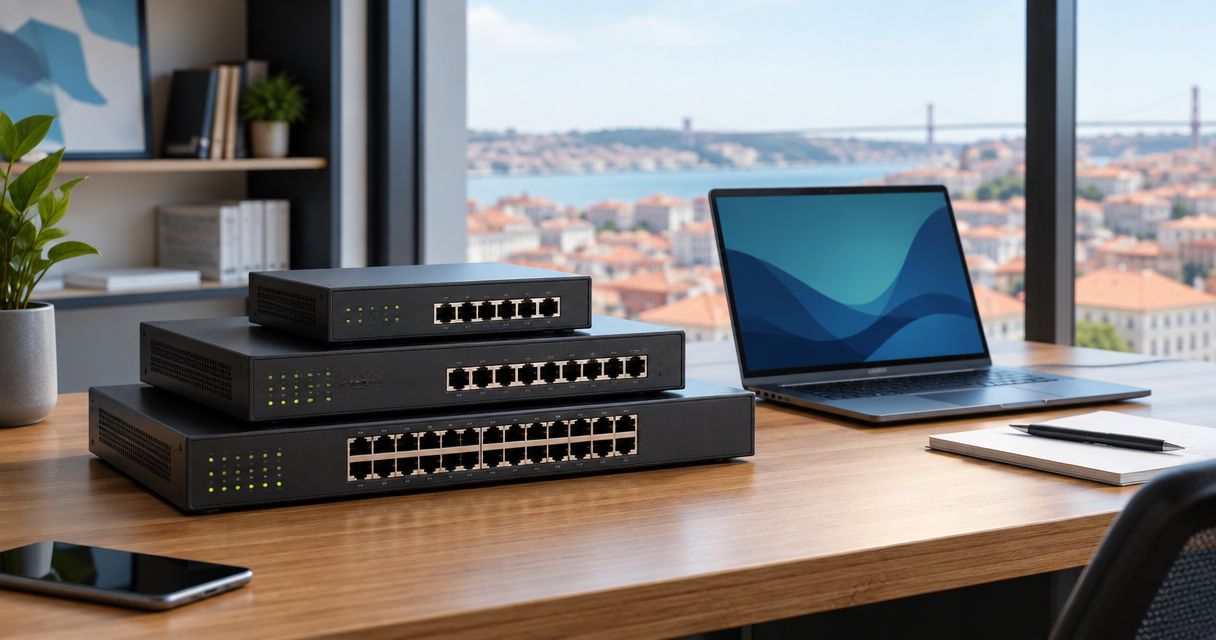
A brownout or a tripped breaker mid-training-session costs more than the projector itself in wasted attendee time. Putting the projector, switch and any streaming box on a dedicated UPS system built for network racks keeps the room running through short outages instead of restarting a session from scratch.
Top picks by use case
The safe pick — mid-size conference laser projector. Rated around 4,500 ANSI lumens with a standard throw ratio, this category fits rooms seating 10 to 20 people with some daylight exposure. Laser light source, 1920x1080 native resolution, HDMI plus USB-C. Buy for any standard company meeting room in 2026.
The wildcard — ultra-short-throw laser unit. Mounts almost against the wall and throws a large image without a ceiling drop, which matters in shared or reconfigurable spaces where a fixed mount isn't practical. Brightness typically sits around 3,500 to 4,000 ANSI lumens. Consider it for flexible huddle spaces, skip it for large training rooms where standard throw covers distance more cheaply.
The training room workhorse — high-brightness laser projector. Built for rooms with large windows and 20+ trainees, this class runs 5,000+ ANSI lumens with laser durability rated near 20,000 hours. It costs more upfront than a standard conference unit. Buy if the room genuinely fights daylight; skip it if the room already has good blackout blinds — you're paying for lumens you won't use.
The budget trap — lamp-based economy projector. Cheaper on the invoice, rated around 3,000 ANSI lumens with a 5,000-hour lamp life, and marketed heavily to small offices. Daily training use burns through that lamp inside two to three years, and replacement lamps aren't always stocked locally. Skip for daily-use rooms; consider only for a rarely-used spare meeting room.
What to avoid
- Home-theater projectors marketed as "cinema" models. They're tuned for dark rooms at 1,500-2,000 lumens and wash out completely under office lighting.
- VGA-only legacy units. Modern laptops don't ship VGA out anymore; a projector without HDMI or USB-C forces a dongle on every guest presenter.
- Lamp-based units sold for "daily business use." The light source spec is the tell — if the listing doesn't say laser, assume lamp replacement costs within three years of daily training sessions.
Verdict comparison
| Category | Best for | Brightness | Light source | Verdict |
|---|---|---|---|---|
| Huddle-room short-throw laser | Rooms for 4-8, no windows | 2,000-3,000 lumens | Laser | Buy |
| Mid-size conference laser | Rooms for 10-20, some daylight | 4,000-5,000 lumens | Laser | Buy |
| High-brightness training room unit | Large windows, 20+ trainees | 5,000+ lumens | Laser | Consider |
| Budget lamp-based projector | Rare-use spare room only | 3,000 lumens | Lamp | Skip for daily use |
Fitting out a meeting room in 2026?
Check current business pricing and delivery on voll.pt before you order.
FAQ
What's the best videoprojetor para salas de reunião in 2026?
A laser projector rated 4,000+ ANSI lumens with 1920x1080 resolution and HDMI plus USB-C inputs covers most corporate meeting rooms. Rooms with heavy daylight need the higher end of that brightness range; windowless huddle rooms can run at 2,000-3,000 lumens.
Is laser better than lamp for a training room projector?
Yes, for daily use. Laser light sources run roughly 20,000 hours before brightness drops, versus 4,000-6,000 hours for a lamp, which means a lamp unit needs replacement bulbs within two to three years of daily training sessions.
How many lumens does a meeting room projector need?
A room with windows or overhead lighting needs 4,000 to 5,000+ ANSI lumens to keep slides readable. A dark, windowless room can run fine at 2,000 to 3,000 lumens, so match the spec to the room, not the biggest number available.
Do meeting rooms need 4K projectors?
Rarely. 1920x1080 covers slide decks, spreadsheets and video calls without visible loss, and most corporate content is authored at that resolution anyway. 4K adds cost that shows up mainly on detailed CAD or dashboard reviews.
What causes wireless casting to drop during a presentation?
Usually the room's network, not the projector. A properly segmented office Wi-Fi network with adequate coverage in the meeting room fixes most casting dropouts that get blamed on the hardware.
Should a meeting room projector be on a UPS?
Yes, for any room used for client meetings or paid training. A UPS on the AV circuit keeps the projector, switch and streaming box running through short power dips instead of restarting a session from zero.
What throw ratio fits a small huddle room?
A short-throw projector, roughly 0.5:1, fills a screen from close range without a ceiling drop, which suits huddle rooms under about 15 square meters. Standard-throw units, 1.5:1 to 2:1, need more distance and fit larger conference rooms better.
One last thing
The spec that gets skipped most often in 2026 purchasing decisions isn't brightness or resolution — it's the light source rating. Two projectors can list nearly identical lumens and resolution on the box, and one still needs a €150-plus replacement lamp inside three years while the other runs 20,000 hours untouched. Ask for that number before comparing anything else.