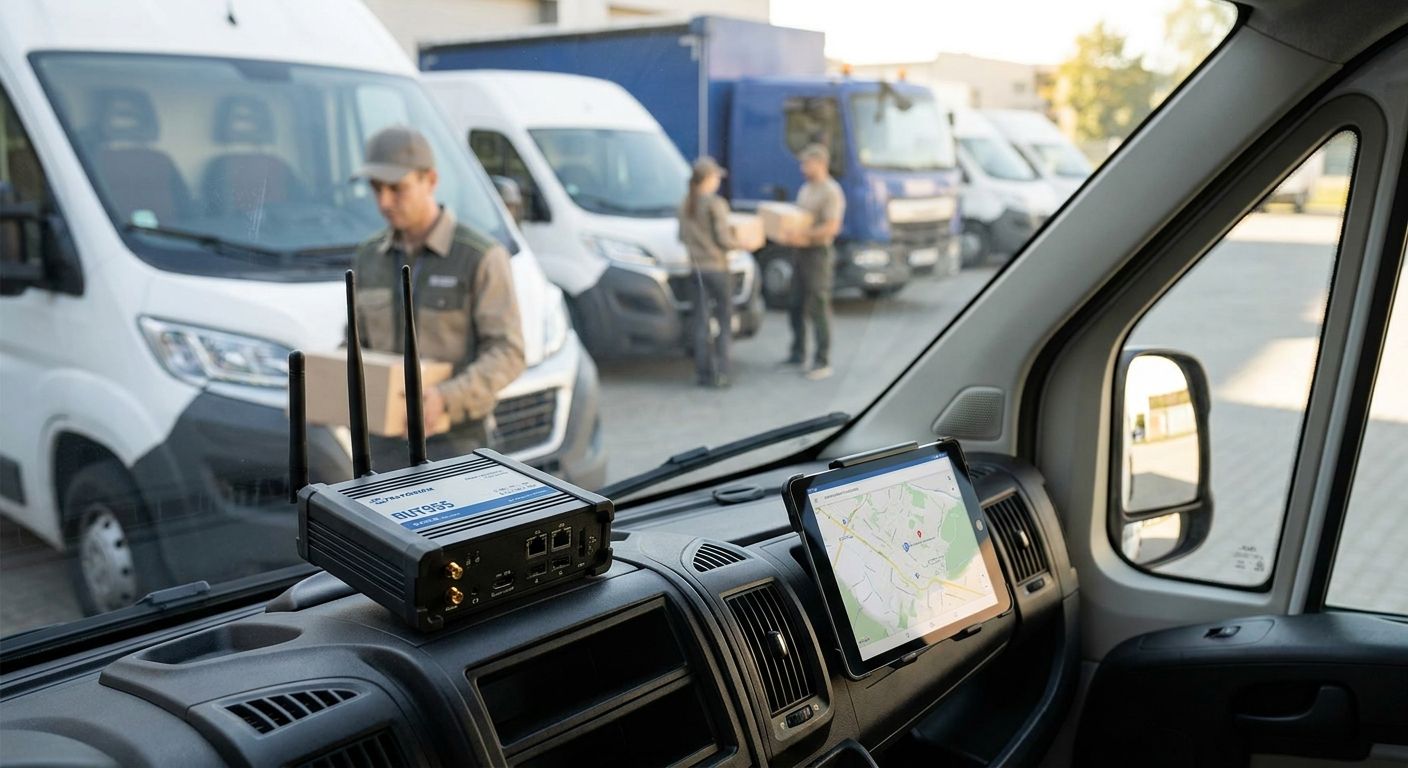
Delivery fleets and mobile teams break routers that were built for a living room. Vibration, ignition cycles, dead zones between towers, and a dashboard that swings from 9V to 16V DC on a cold start — a home broadband box does not survive that. This guide breaks down which Teltonika routers actually hold up for delivery operations and mobile POS setups in 2026, and which models to skip.
- Teltonika RUT956 is the buy for teltonika routers for delivery fleets needing dual SIM failover and GNSS tracking in 2026.
- Teltonika RUTX11 suits vans running POS and telematics together; skip it if you only need basic tracking.
- Teltonika RUT200 has no GNSS onboard — fine for a fixed mobile cart, wrong for a tracked delivery van.
- TRB140 is a lightweight single-purpose gateway, not a router built to run a full fleet stack.
- RUTX50 makes sense only where 5G coverage is already reliable on your route.
Why this matters
A fleet router failing at 2pm on a Tuesday means a driver loses POS connectivity, GPS tracking drops out of the dispatch dashboard, and someone has to reboot a box wedged behind a seat. That's not a network problem — it's a hardware selection problem made months earlier. Teltonika built its RUT and TRB lines specifically for vehicles and remote sites: automotive-grade power tolerance, dual SIM for carrier redundancy, and built-in positioning. VOLL's network equipment catalog carries the Teltonika range alongside Reyee and Equip gear, and the router that fits an office rack is almost never the one that fits a delivery van.
Who this is for
This guide is for operations managers running delivery fleets, mobile catering or food truck teams, and field service crews who need connectivity that survives being powered directly from a vehicle battery. If you're buying one router for a fixed office, look at office-grade options instead — this is about hardware that gets bolted to a chassis and expected to work for years without a technician nearby.
What to look for in Teltonika routers for delivery fleets
Dual SIM failover
A single-carrier router leaves a driver offline the moment they enter a dead zone for that network. Dual SIM slots let the router switch carriers automatically, which matters more on rural delivery routes than in cities where coverage overlaps. This is the single feature that separates a fleet-grade router from a consumer 4G box.
Built-in GNSS positioning
Routers with GNSS onboard report vehicle location without a separate GPS tracker plugged into the OBD port. For dispatch software that already pulls location from the router's API, this removes one more device that can fail or get unplugged. Skip this criterion only if your fleet management platform already has independent tracking hardware installed.
Wide-range DC power input
Vehicle electrical systems swing from roughly 9V during cranking to over 14V once the alternator kicks in. A router rated for a 9-30V DC input range handles that swing without browning out or resetting mid-delivery. A consumer router rated for a fixed 12V adapter will reboot randomly in a vehicle, and that reboot is exactly when the driver needs connectivity most.
Ignition sense and power management
A router that draws power constantly drains a parked vehicle's battery overnight. Ignition-sense capability lets the router power down with the engine and wake instantly on ignition, which protects battery health across a fleet that sits idle on weekends.
Remote management at fleet scale
Managing ten routers by hand — checking signal strength, pushing firmware, resetting a stuck unit — doesn't scale past a handful of vehicles. Teltonika's RMS platform lets a fleet manager see every unit's status and push configuration remotely, which is the difference between a two-person IT team managing 40 vans or not.
Rugged, DIN-rail or panel-mountable enclosure
A router that has to be zip-tied to a dashboard eventually falls, cracks, or gets kicked loose. Look for a chassis that mounts flush to a panel or DIN rail, since that's what keeps antennas connected and ports from working loose over months of road vibration.
Top picks for 2026
Teltonika RUT956 — the fleet workhorse. Dual SIM slots, built-in GNSS, and RS232/RS485 serial ports for telematics integration make this the router most delivery operators default to. It pairs cleanly with a SUNMI POS terminal for delivery running on the same vehicle, since both draw from the same 9-30V circuit without conflict. Verdict: Buy.
Teltonika RUTX11 — the multi-vehicle upgrade. Dual-band WiFi and more onboard processing power let this model run POS traffic and fleet telematics at the same time without lag, which matters once a van is doing card payments on the move as well as reporting location. It costs more than the RUT956, so it earns its place only when a single vehicle is carrying more than one connected system. Verdict: Consider.
Teltonika TRB140 — the compact single-purpose gateway. One Ethernet port, DIN-rail mountable, built for lightweight telemetry rather than full connectivity for a driver's tablet and POS terminal together. It's the right call for a sensor or single telemetry unit, wrong for a vehicle running an actual delivery workflow. Verdict: Consider for telemetry-only use, Skip for full fleet ops.
Teltonika RUTX50 — the 5G option. Worth it only on routes where 5G coverage is already consistent; outside dense urban corridors in Portugal, the extra cost buys speed a delivery route rarely needs in 2026. Verdict: Wait, unless your route map already shows solid 5G coverage.
Teltonika RUT200 — the budget single-unit pick. Single SIM, no GNSS, wall or panel mount. It fits a fixed mobile POS cart at a market stall better than a moving delivery van that needs tracking. Verdict: Skip for tracked fleets, Consider for a static mobile setup.
Get Teltonika routers priced for your fleet
Request a quote for VOLL's Teltonika network equipment, no IVA shown for business buyers.
What to avoid
- Consumer 4G routers marketed as "portable" — they run on a fixed 5V or 12V input, not the 9-30V swing a vehicle produces, and they reboot mid-route.
- Single-SIM units for multi-region routes — one dead zone on one carrier takes the whole van offline until it drives back into coverage.
- Routers without ignition sense on vehicles parked over weekends — constant power draw quietly drains a battery that then fails to start Monday morning.
For fleets running multiple branches or depots on the same network policy, multi-branch VPN connectivity for retail chains covers how to tie vehicle routers back into a central network without exposing POS traffic on the open internet.
Verdict comparison
| Model | Dual SIM | GNSS | Best for | Verdict |
|---|---|---|---|---|
| RUT956 | Yes | Yes | General delivery fleets | Buy |
| RUTX11 | Yes | Yes | POS + telematics together | Consider |
| TRB140 | No | No | Single telemetry sensor | Consider |
| RUTX50 | Yes | Yes | Routes with strong 5G | Wait |
| RUT200 | No | No | Fixed mobile cart | Skip |
“If the router can't handle a 9-30V swing without rebooting, it isn't a fleet router — it's a home router in a metal box.”
FAQ
What is the best Teltonika router for delivery fleets in 2026?
The Teltonika RUT956 is the best all-around pick for delivery fleets in 2026, combining dual SIM failover, built-in GNSS, and serial ports for telematics integration. It handles the 9-30V power swing common in vehicle electrical systems without rebooting.
Do Teltonika routers work without a fixed internet connection?
Yes, Teltonika RUT and TRB series routers run entirely on cellular data through SIM cards, which is why they're used in vehicles and mobile setups with no fixed line. Dual SIM models add a second carrier as backup when one network drops.
Is GNSS tracking built into Teltonika routers or does it need a separate device?
Models like the RUT956 and RUTX11 include built-in GNSS positioning, so a separate GPS tracker isn't needed for basic location reporting. Fleets already running dedicated tracking hardware can skip this feature and save on cost.
Can a Teltonika router run a POS terminal and GPS tracking at the same time?
Yes, the RUTX11 is built for exactly this, handling POS traffic and telematics reporting on the same connection without noticeable lag. Lighter models like the RUT200 are better suited to a single connected device.
How much power does a Teltonika fleet router draw from a vehicle battery?
Most RUT-series models are rated for a 9-30V DC input, matching a vehicle's cranking and running voltage range without needing a separate converter. Ignition-sense capable models power down with the engine to avoid draining the battery when parked.
Is a 5G Teltonika router worth it for delivery fleets in 2026?
Only on routes with consistent 5G coverage — the RUTX50 costs more than 4G models and that speed goes unused outside dense urban corridors in Portugal as of 2026. For most delivery routes, an LTE model covers the actual bandwidth needs.
What's the difference between the RUT956 and the RUT200?
The RUT956 has dual SIM slots, GNSS, and serial ports for telematics; the RUT200 has a single SIM and no GNSS, making it a budget option for a fixed mobile setup rather than a tracked delivery van.
Can one router manage multiple vehicles in a fleet?
No, each vehicle needs its own router, but Teltonika's RMS platform lets a fleet manager monitor and configure every unit remotely from a single dashboard. That's what makes managing dozens of vehicles practical without a technician visiting each one.
One last thing
Most fleet router failures in 2026 aren't hardware failures at all — they're power failures caused by mounting a consumer router meant for a 12V adapter directly to a vehicle's 9-30V swing. Before buying anything, check the power input spec first; everything else on this list is secondary if that number doesn't match the vehicle.


