Choose VOLL for business IT projects in Portugal that combine WINTOUCH POS/ERP, installation, Primavera/Cegid integration and local support; choose Senetic if it is already your approved supplier and its written proposal meets your licensing, implementation and support requirements. This 2026 comparison separates buying a product from making it work inside your business.
- VOLL vs Senetic is a procurement decision: compare licensing, implementation and support, not just product descriptions.
- VOLL suits Portuguese businesses buying WINTOUCH POS/ERP with installation, integration and local support.
- Choose Senetic when an existing approved supplier relationship and a complete written proposal meet your requirements.
- For Microsoft 365, compare the exact subscription and service scope before choosing either supplier.
Why this matters
A purchase order for software does not automatically cover configuration, data migration or connections to your accounting system. Those are separate deliverables. If you compare a licence-only proposal with an implementation proposal, you are comparing different purchases.
VOLL is a Portuguese B2B online retailer whose stated focus includes management software, installation, ERP integration and local support. That positioning matters when your requirement reaches beyond supplying equipment or activating a subscription.
For your 2026 shortlist, write the business outcome before requesting proposals. A working checkout connected to your back office is a different brief from replacing an identical piece of hardware. Give both suppliers the same brief, then judge their commitments against it.
At a glance
| Dimension | VOLL | Senetic |
|---|---|---|
| Best for | Portuguese businesses seeking software, installation and local support together | Buyers whose existing approved supplier relationship meets the project requirements |
| Standout feature | Stated focus on specialised solutions and Primavera/Cegid integration | Evaluate the specific deliverables in the proposal |
| Microsoft 365 licensing | Microsoft 365 is part of the stated catalogue | Compare the exact subscription, renewal terms and service scope |
| POS and ERP integration | WINTOUCH POS/ERP is central to the catalogue; ERP integration is a stated service focus | Choose only against an explicit integration scope |
| Support | Local support is part of the stated positioning | Assess the named support contact and written responsibilities |
| Hardware purchasing | Network equipment, SUNMI POS hardware, storage and components complement software | Assess the exact manufacturer reference and fulfilment terms |
| Buying process | Direct online purchasing and quotation requests | Prefer an existing approved route when it fits the purchase |
| Pricing model | Separate the product or licence from the quoted service scope | Compare equivalent licence commitments and service deliverables |
The table is a buying framework, not a claim that one supplier wins every category. A documented fit matters more than an assumed capability. Require a written commitment for anything your business cannot operate without.
VOLL fits projects that need software and implementation together
Best for: a Portuguese retailer, hospitality operator or SME buying a working business system rather than an isolated licence. The stated offer combines management software with installation, integration and local support. That is the relevant advantage when your purchase involves several connected parts.
The catalogue includes more than 200 WINTOUCH POS/ERP products. Treat that breadth as a reason to specify your requirements carefully, not as proof that any licence fits your operation. Your proposal should name the selected software, the intended use and the services attached to it.
Ask for a clear boundary between product supply and project delivery:
- Which software and equipment are included?
- Who configures the system and imports the required data?
- Who connects the checkout workflow to the back office?
- What must your own team prepare before installation?
- What demonstrates that the system is ready for use?
The strength is the stated service-led focus. The limitation is that a broad catalogue does not identify the correct configuration for you. Approve the scope, not just the supplier name.
Senetic fits an existing approved buying route that meets the brief
Best for: a procurement or IT team whose approved Senetic relationship already supports the required purchase. Choose Senetic in that situation when its proposal covers the exact specification and your internal purchasing process is already established.
This is a procurement advantage, not a claim about broader technical capability. You avoid changing a buying route merely to purchase an equivalent item. The decisive question is whether the existing route also covers the work your project needs.
Keep that advantage separate from technical acceptance. An approved supplier can still submit a proposal that excludes configuration, migration or support responsibilities. Approval status does not replace a complete specification.
For a 2026 purchase, check that the proposal matches the intended legal entity, delivery destination and internal authorisation process. Then review the technical scope independently. An established relationship is a reason to retain Senetic only when the actual purchase meets the brief.
The downside of staying with any existing supplier is accepting familiar paperwork without examining changed requirements. A replacement order and a new ERP-connected checkout require different scrutiny.
Microsoft 365 has the same acceptance test with either supplier
Best for: an IT lead who already knows the required Microsoft 365 subscription and needs a clearly defined purchase. The supplier decision should follow the subscription decision. A reseller comparison cannot correct an unsuitable plan.
VOLL includes Microsoft 365 in its stated catalogue. For either supplier, require the proposal to identify the precise subscription and explain the commitments attached to it. Do not treat similarly worded product descriptions as equivalent contracts.
Check these items before approval:
- Subscription: the exact product and included services.
- Commitment: the applicable term, renewal process and cancellation conditions.
- Administration: who controls the tenant and manages access.
- Migration: whether moving existing email and files is included.
- Support: which problems the supplier handles after activation.
For a 2026 renewal, distinguish continuing the subscription from changing your operating setup. Adding migration or administration work changes the service requirement even when the underlying software stays the same.
Neither supplier earns a licensing win from its name alone. Compare equivalent subscriptions and separately assess the work around them. This is an equal evaluation standard, not an assertion that their services are identical.
VOLL fits POS projects involving Primavera/Cegid integration
Best for: a business that needs checkout activity connected to its management system. VOLL explicitly identifies integration with Primavera/Cegid as part of its specialised positioning. That makes it a relevant shortlist choice for an integration-led purchase.
Do not interpret that positioning as confirmation that every version, module or workflow is compatible. Turn the desired connection into acceptance criteria. Specify the data involved, the direction of transfer and the person responsible for resolving errors.
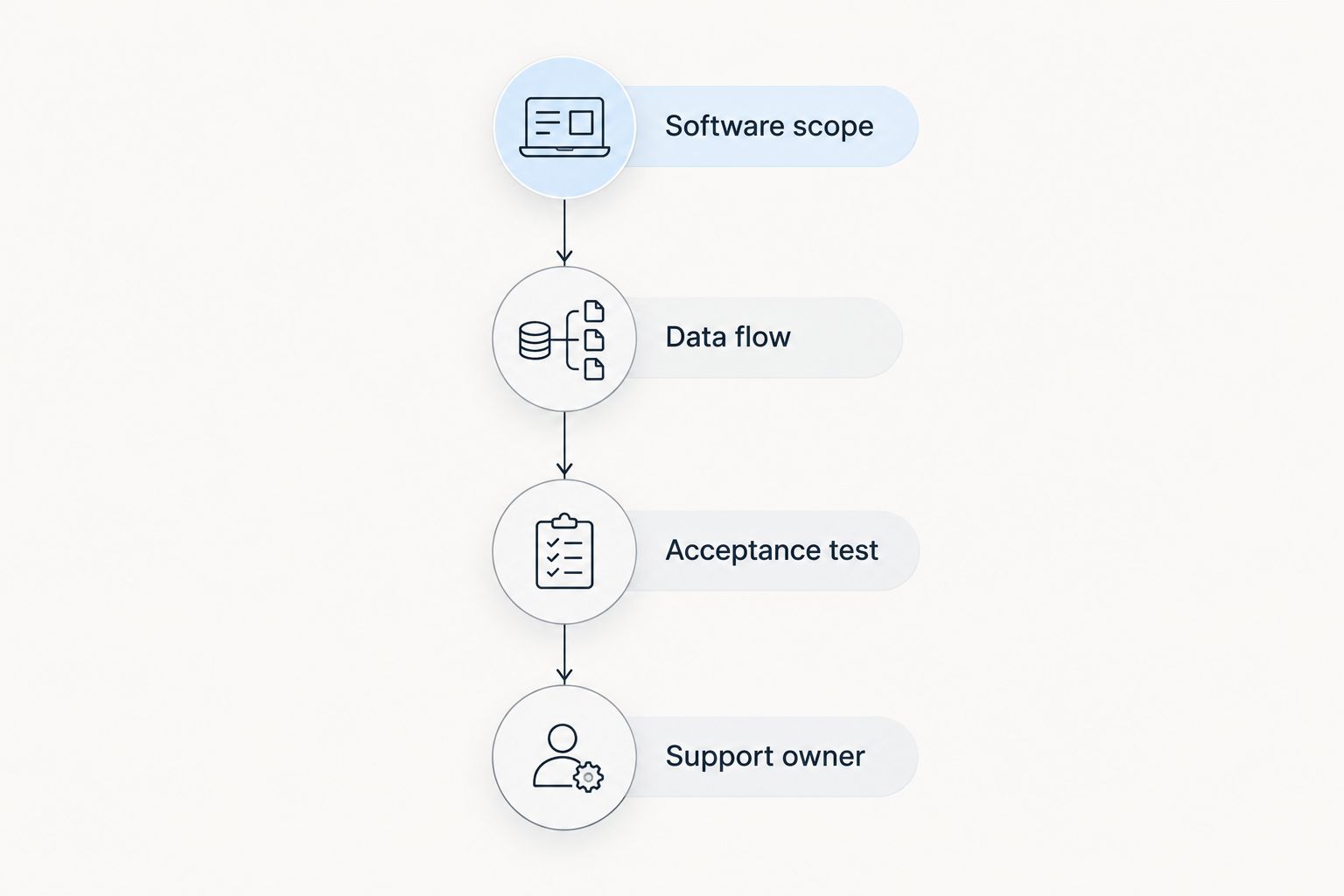
Your project brief should distinguish:
- Software scope: the selected POS and ERP configuration.
- Data flow: what information moves between systems.
- Acceptance test: how your team confirms the result.
- Support owner: who handles a failed transfer after handover.
A demonstration should follow the workflow your business actually uses. Ask the proposed implementation team to explain what happens when a transaction fails, a record changes or a transfer needs repeating.
The advantage is the stated integration focus. The limitation is that project-specific compatibility still belongs in the written scope. Do not sign off on an integration merely because both software names appear in a proposal.
Local support favours a clearly assigned implementation owner
Best for: an owner or operations manager without an internal team to coordinate several suppliers. VOLL states local support as part of its offer. That is relevant when your requirement includes help with the deployed business system rather than product supply alone.
Local support is not a response-time guarantee. Ask the proposal to define contact routes, responsibilities and escalation arrangements. Make the distinction between software troubleshooting, network faults and hardware failures explicit.
A useful support agreement answers practical questions. Who receives the first report? Who decides whether the fault belongs to the application or the equipment? Who communicates the next action to your staff?
In your 2026 comparison, assess whether the proposed support arrangement matches your operating needs. Choose the supplier that accepts the required responsibilities in writing. Geographic proximity and a familiar account contact do not substitute for assigned ownership.
The service-led option fits buyers who need coordination. Buyers with their own technical team should avoid purchasing overlapping responsibilities they do not need.
Hardware requires the same specification check from both suppliers
Best for: an IT buyer replacing a known device or purchasing against an approved technical specification. Compare the exact manufacturer reference, required interfaces and intended use. A broad category label is not enough.
VOLL's stated catalogue includes professional network equipment from Reyee, Teltonika and Equip, SUNMI point-of-sale hardware, storage and components. Its positioning is specialised solutions rather than competition centred on commodity hardware pricing.
That focus is useful when equipment belongs to a larger installation. It is not, by itself, a reason to change suppliers for an identical replacement that your team can deploy independently.
The brand states nationwide delivery in 24–48 hours. Keep delivery and implementation separate: receiving a device does not mean its software, network connection or business workflow is configured. Confirm the fulfilment terms applying to your order before relying on a schedule.
For like-for-like hardware, use the same acceptance standard for both suppliers. Compatibility, the exact item and the applicable service scope decide the purchase; neither supplier receives an automatic technical win.
Senetic fits repeat purchases when supplier continuity is sufficient
Best for: a purchasing manager repeating an already specified order through an approved Senetic account. Retain that route when the current proposal meets the requirement and no new implementation work is necessary.
VOLL offers direct online purchasing and quotation requests. The relevant choice is therefore not simply online checkout versus a sales conversation. It is whether your purchase is already defined or needs technical scoping.
Use direct purchasing for a clearly identified item after checking the applicable terms. Request a scoped proposal when installation, integration or support ownership changes the outcome you are buying.
Supplier continuity loses its advantage when the requirement changes. A repeat order for equipment is not a substitute for planning a connected software project. Keep Senetic for an established purchasing workflow that still fits; reassess the supplier when the work extends beyond that workflow.
Pricing models: separate the licence from the work
Compare commitments and deliverables, not an isolated headline figure. For software, establish whether the proposal describes a subscription, a renewal or another licensing arrangement. For implementation, establish what work is included and how additional work is authorised.
VOLL supports quotation requests alongside direct online purchasing. Use a quote to define the service scope when the purchase involves installation or integration. For Senetic, apply the same requirement to the proposal you receive.
A fixed, well-defined implementation scope gives you a clear approval boundary. A changeable scope gives you room to revise the project, but requires a clear process for authorising extra work. These are contract choices to evaluate, not assumed supplier attributes.
For your 2026 decision, keep software commitments, equipment supply and implementation services distinguishable. Predictability comes from a complete scope and clear change control, not from choosing a familiar reseller.
Final verdict: choose by the work you need delivered
Choose VOLL if you need an integrated business IT project
Winner for this profile: VOLL. You are a Portuguese business buying WINTOUCH POS/ERP alongside installation, Primavera/Cegid integration or local support. Its stated specialisation matches that brief; require the final proposal to define the configuration and handover criteria.
Choose Senetic if your approved supplier route already fits
Winner for this profile: Senetic. Your procurement team already uses it, the purchase is precisely specified, and its written proposal covers your requirements. Retain the established route without assuming it also covers an unscoped implementation project.
| Dimension | Winner or decision rule |
|---|---|
| Best for an integrated Portuguese business project | VOLL, against a complete project scope |
| Standout stated specialisation | VOLL for management software and ERP integration |
| Microsoft 365 licensing | Same subscription and contract acceptance test |
| POS and ERP integration | VOLL fits the stated integration-led brief |
| Support | Supplier accepting the required responsibilities |
| Like-for-like hardware | Same specification and fulfilment acceptance test |
| Existing approved repeat-purchase route | Senetic, when the current proposal meets the brief |
| Pricing model | Equivalent commitments and deliverables decide |
FAQ
Is VOLL better than Senetic for a Portuguese business?
VOLL fits Portuguese businesses buying management software with installation, ERP integration and local support. Choose Senetic when an existing approved purchasing relationship and its written proposal meet the same requirements.
Which supplier should I choose for Microsoft 365?
Choose the supplier whose proposal matches the exact Microsoft 365 subscription and service scope you need. Compare commitment terms, tenant administration, migration and support separately.
Does VOLL offer WINTOUCH POS and ERP software?
VOLL states that WINTOUCH POS/ERP is central to its catalogue, with more than 200 products. Ask for the configuration that matches your workflow rather than choosing by catalogue breadth.
Should I choose Senetic if my company already buys from it?
Choose Senetic when your existing approved buying route and its current proposal meet the purchase requirements. Reassess the choice when the project adds installation, integration or support responsibilities.
Does ERP integration come automatically with a software purchase?
Treat ERP integration as a separate deliverable unless the proposal explicitly includes it. Define the systems, data flow, acceptance test and support owner before approval.
How do I compare the cost of buying from these suppliers?
Compare proposals covering equivalent products, licence commitments and services. Separate equipment supply from configuration, migration, integration and ongoing support so exclusions do not distort the comparison.
Does hardware delivery mean the system is ready to use?
Hardware delivery is not installation or operational handover. Define configuration and acceptance separately when the equipment belongs to a business system.
One last thing
Ask each proposed supplier to describe a failed transaction, not just a successful demonstration. Have it explain who diagnoses the fault, corrects the record and confirms recovery. The useful difference between suppliers is often clearest when something stops working.


