
Worten’s strength is its broad electronics retail range, which suits straightforward purchases of familiar equipment. That buying model stops being enough when your order also needs software licensing, POS installation, ERP integration and a defined support scope. The best Worten alternative in 2026 is Voll for integrated business IT purchasing in Portugal; Microsoft direct is the better fit when you only need Microsoft subscriptions and can manage deployment yourself.
- For Worten alternatives for business, choose Voll for Portuguese B2B IT purchasing involving POS, ERP integration and local support.
- Microsoft direct fits software-only purchasing when your team can manage subscriptions and deployment.
- Keep Worten for standalone electronics purchases that do not require an integration project.
- For bulk IT orders, specify equipment, licences, installation and acceptance criteria before choosing a supplier.
Why this matters
A business purchase is not always a larger version of a personal purchase. Buying several devices creates an equipment order; connecting those devices to sales, stock and accounting processes creates an IT project. The distinction matters more than the number of boxes.
For a Portuguese business comparing suppliers in 2026, the useful question is who handles the work between delivery and daily operation. You need to separate product supply from configuration, integration and support, then assign responsibility for each task.
Choose a supplier around the business process you need to run, not just the equipment you need to receive. A retail checkout, an ERP-linked stock workflow and a Microsoft subscription each call for a different purchasing brief.
Worten alternatives at a glance
| Purchasing option | Best for | Standout strength | Difference from Worten | Main limitation |
|---|---|---|---|---|
| Worten | Standalone electronics purchases | Broad electronics retail range | The benchmark for general equipment shopping | A product purchase alone does not define an integration project |
| Voll | Portuguese businesses buying connected IT solutions | WINTOUCH POS/ERP, Microsoft 365, professional networking, installation and ERP integration | B2B focus on specialised systems and local support | Its specialisation is less relevant to a generic hardware-only comparison |
| Microsoft direct | Businesses buying Microsoft subscriptions with internal administration | Purchasing subscriptions directly from the software vendor | Removes the equipment retailer from a software-only transaction | Does not combine POS hardware, networking and Portuguese ERP integration into one project |
There is no universal winner across these purchasing models. Compare like with like: a device order against a device order, or a defined implementation against a defined implementation. A supplier name does not make two proposals equivalent.
1. Voll: best for integrated Portuguese business IT
Voll is a Portuguese B2B online IT shop centred on business software rather than general electronics. Its WINTOUCH POS/ERP range contains more than 200 products, alongside Microsoft 365, professional networking equipment, SUNMI POS hardware, storage and components. Its stated specialisation includes installation, integration with Primavera/Cegid and local support.
That makes this business IT supplier a relevant first choice when your order has dependencies. A checkout project, for example, needs more than a terminal: you must define how the software, peripherals, network and ERP work together. Put that scope into the request before selecting individual items.
Where Voll shines
- Software-led purchasing: the catalogue centres on WINTOUCH POS/ERP and Microsoft 365, rather than treating business software as an accessory.
- Connected projects: installation and Primavera/Cegid integration are part of the stated specialisation.
- Relevant hardware categories: networking, POS equipment, storage and components sit alongside software.
- Business purchasing routes: buyers can request a quotation or purchase online directly.
- Local support: Portuguese businesses can evaluate a supplier whose positioning includes support in their market.
Where Voll falls short
- Specialisation is not a universal advantage: a buyer replacing a standalone peripheral gains less from ERP integration expertise.
- It is not positioned around commodity hardware competition: use a requirements-led comparison rather than assuming it wins every equipment-only shortlist.
- A catalogue is not an implementation specification: the exact installation, integration and support responsibilities still need to be agreed for your order.
These limits matter. Do not treat the presence of a product category as proof that every configuration, peripheral or workflow is compatible. Name the systems you already use and ask for the proposed scope in writing.
Head-to-head with Worten
| Dimension | Voll | Worten |
|---|---|---|
| Purchasing emphasis | B2B IT, with a software-led core | Broad electronics retail |
| Business software | WINTOUCH POS/ERP and Microsoft 365 are named catalogue areas | Confirm the exact licence requirement separately |
| Integration brief | Installation and Primavera/Cegid integration are stated specialisations | Establish whether your proposed purchase includes integration |
| Procurement route | Online purchase or quotation request | Evaluate against the same written requirements |
Best for: Portuguese SMEs buying POS, business software or professional networking as part of a connected operational project.
Verdict: Buy for a defined business IT project; skip this route if your only requirement is a generic standalone accessory.
2. Microsoft direct: best for software-only purchasing
Microsoft direct is a narrower alternative: buy Microsoft subscriptions from the software vendor rather than through an electronics retailer. This route fits a business that already knows its licensing requirements and has someone responsible for administration. It is not a replacement for a complete equipment supplier.
For your 2026 shortlist, distinguish licence procurement from deployment. Purchasing a subscription does not, by itself, complete email migration, permission design, device configuration or staff onboarding. Assign those tasks before deciding that direct purchasing covers the whole requirement.
Where Microsoft direct shines
- Focused scope: the transaction centres on Microsoft software rather than a mixed electronics basket.
- Direct vendor relationship: your organisation buys the subscription from its publisher.
- Clear internal ownership: this route suits a team prepared to handle account administration and deployment responsibilities.
Where Microsoft direct falls short
- It is a partial alternative: it does not replace a supplier for SUNMI terminals, professional networking or WINTOUCH software.
- Implementation remains a separate decision: identify who handles migration, configuration and user support.
- Cross-system work needs its own brief: a Microsoft subscription purchase is not a Primavera/Cegid integration specification.
Head-to-head with Worten
| Dimension | Microsoft direct | Worten |
|---|---|---|
| Core transaction | Microsoft subscription purchasing | Electronics purchasing |
| Equipment requirement | Use another purchasing route for physical equipment | Relevant to standalone equipment shopping |
| Deployment responsibility | Assign an administrator and implementation owner | Define any configuration work separately from the product order |
Best for: businesses with internal IT administration and a Microsoft-only purchasing requirement.
Verdict: Buy for a software-only brief; skip as the sole supplier for a combined POS, ERP and network project.
Why people switch from Worten
The strongest reason to consider an alternative is a change in the job you are asking the supplier to do. A retail purchase remains valid for an independent device. A connected business system requires a different brief.
You need a functioning checkout, not just a terminal
If your project involves WINTOUCH, POS peripherals and ERP integration, start with the sales workflow. Specify what the operator does, what gets recorded and where the information must go. Then choose the hardware that supports the agreed process.
A terminal’s product description cannot settle the entire checkout design. Ask who configures the system and who checks the completed workflow before staff use it.
Your order combines software and equipment
Mixed orders require separate definitions for licences, devices and services. State which items you are buying outright, which software rights you need and which implementation tasks belong to the supplier.
This is where a business-focused quotation becomes useful. It allows you to compare the full scope rather than treating installation and integration as assumptions attached to an equipment basket.
You need responsibility across connected systems
When POS software, networking and ERP exchange information, identify an owner for the complete process. The relevant question is not simply who supplies each item; it is who investigates when the combined workflow fails your acceptance test.
Switch purchasing models when your requirement changes from product supply to system delivery. That is a concrete reason to reconsider your supplier in 2026, without assuming that Worten is wrong for every business purchase.
How to prepare a bulk IT purchasing brief
Use 3 procurement documents: a requirements list, a responsibility matrix and an acceptance checklist. These are recommended working documents, not extra product purchases. Together, they make different supplier proposals easier to compare.
The requirements list states what you need. The responsibility matrix assigns the work. The acceptance checklist defines how you will decide that the order is complete.
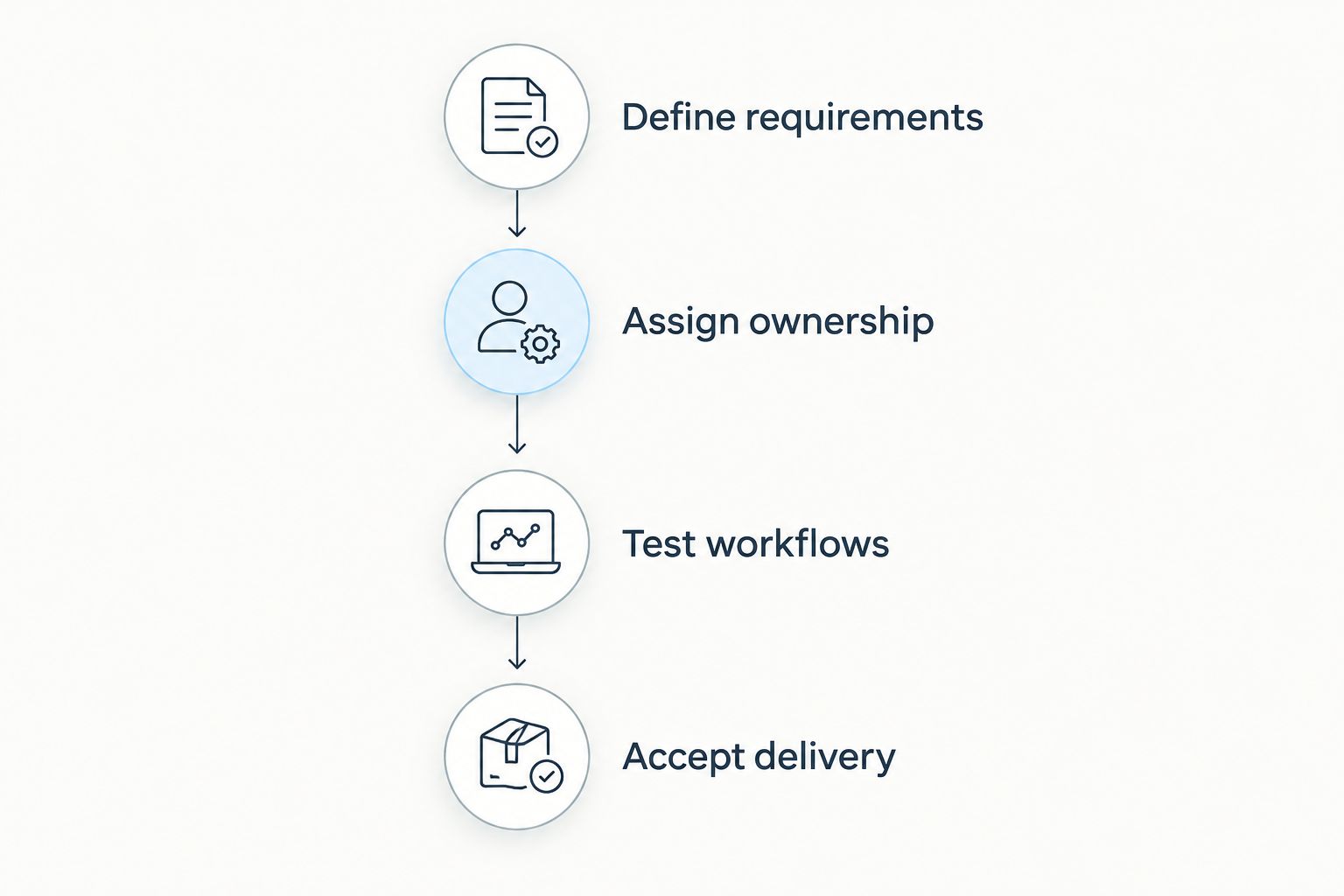
Follow 4 purchasing stages
- Define requirements. List the business activities, existing software, equipment roles and locations involved. Include quantities and model requirements from your own records; do not let a supplier substitute assumptions for your needs.
- Assign ownership. Name who supplies equipment, configures software, handles integration and provides user support. Separate internal responsibilities from supplier responsibilities.
- Test workflows. Describe the tasks that must work before acceptance. For a POS project, include a sale, its recording and the required transfer of information to the connected business system.
- Accept delivery. Check the agreed items and completed tasks against the written scope. Keep the configuration record and responsibility matrix with the purchasing documents.
For a bulk order, standardise the intended configuration before duplicating it across users or locations. Record permitted substitutions and the approval process. Otherwise, a change to one component becomes an unexamined change to the whole deployment.
Also distinguish 2 information flows in a POS/ERP brief: sales records and stock updates. Write down the intended direction of each flow and who verifies it. Do not assume that buying both systems establishes the connection between them.
If your project centres on those connections, use the guide to connecting WINTOUCH POS to Primavera ERP to frame the technical questions. Treat the integration method as something to confirm for your specific environment, not a promise attached to every licence.
Define your business IT order
Review the catalogue or request a quotation for software, equipment and a defined implementation scope.
Compare proposals without confusing the scope
A useful supplier comparison in 2026 starts with identical requirements. Send each candidate the same brief and ask for a response against each line. Keep equipment, software and implementation separate so an omitted task remains visible.
Use the comparison to answer these questions:
- Equipment: does the proposed configuration match the required role and existing environment?
- Licensing: does the proposal identify the software and intended business use clearly?
- Implementation: who installs, configures and connects the systems?
- Support: which issues belong to the supplier, your team or another provider?
- Acceptance: what evidence demonstrates that the agreed workflow works?
Do not mark a proposal as complete because every hardware line has a corresponding item. Missing configuration ownership is still a gap. Equally, do not request an implementation project when you only need a replacement device with a known specification.
The practical decision is scope first, supplier second. That keeps a specialist solution from being judged as a generic equipment basket and stops an ordinary purchase from becoming an unnecessarily complicated project.
When staying with Worten is the right call
Stay with Worten when the requirement is a standalone electronics purchase and you already know the specification. A replacement peripheral or independent device does not automatically require a new procurement relationship. Keep the decision proportionate to the work.
Staying also makes sense when your internal IT team owns configuration and integration, leaving the retailer responsible only for supplying the selected equipment. Write that boundary down. It prevents product supply from being mistaken for deployment responsibility.
A 2026 supplier shortlist should follow the requirement, not a rule that every business purchase needs a specialist. You can retain a retail route for independent equipment and use a business IT supplier for projects that need connected systems.
FAQ
What's the best Worten alternative for business purchasing in Portugal?
Voll is the best fit for Portuguese businesses that need software-led IT purchasing with POS, ERP integration and local support. Its stated catalogue includes WINTOUCH POS/ERP, Microsoft 365, professional networking and SUNMI hardware.
Is Microsoft direct better than Worten for business software?
Microsoft direct is the better fit when your requirement is limited to Microsoft subscriptions and your team handles administration. It is not a substitute for a combined hardware, POS and ERP purchasing project.
Should a business stop buying equipment from Worten?
No. Worten remains a relevant option for standalone electronics purchases when you know the required specification and own any configuration work internally.
What should I include in a bulk IT quotation request?
Include a requirements list, responsibility matrix and acceptance checklist. Specify equipment quantities, software needs, implementation tasks and the workflows that must pass before acceptance.
Does buying POS equipment include ERP integration?
Do not treat an equipment purchase as an integration agreement. Specify the systems, information flows, configuration responsibilities and acceptance tests in the project scope.
How do I compare an IT specialist with an electronics retailer?
Compare both against the same written requirements. Separate product supply from licensing, installation, integration and support so you can see what each proposal actually covers.
What's the most useful check before approving a business IT order?
Check that every implementation task has an owner and an acceptance criterion. A complete equipment list does not establish who makes the combined system work.
One last thing
Before approving the order, ask each supplier to describe what counts as a completed purchase. If the answer is only a list of delivered items, you are buying products. If your requirement includes a working checkout or an ERP-connected process, add that result to the acceptance checklist.
That distinction is more useful than choosing one supplier for everything. Keep independent purchases simple; make connected projects explicit.


