To establish ERP Primavera cost in 2026, request an itemised quote for your business requirements rather than treating a licence figure as the full project budget. Separate the software licence from installation, integration and ongoing support. This guide explains what to put in that request, how to compare proposals and which exclusions to resolve before you approve the purchase.
- ERP Primavera cost needs a scoped quote covering software, installation, integration and support.
- Compare ERP licensing proposals against identical requirements, not different bundles of work.
- Voll provides ERP integration and local support for Portuguese business buyers.
- Confirm exclusions, recurring obligations and acceptance criteria before approving a proposal.
Why this matters
An ERP proposal is a purchasing decision about both software and delivery. A licence description tells you what you are buying; a statement of work tells you what the supplier will configure, connect and hand over. You need both before you can judge the proposal.
For Portuguese business buyers, Voll provides business software, installation, integration with Primavera/Cegid and local support. Its business purchasing terms use amounts excluding VAT, so keep tax treatment explicit when comparing a proposal with another supplier's quotation.
Compare the same business outcome, not just the same software name. A proposal that excludes the work you need is not equivalent to one that includes it. Ask each supplier to separate the required work from optional additions, then judge the complete scope.
How much does ERP Primavera cost in 2026?
The figure you should approve is the total for your agreed scope, with initial work and recurring obligations shown separately. Request the exact software configuration and a written description of implementation. Do not substitute a generic ERP estimate for a supplier's current quotation.
Use this breakdown to make the quote readable. These are items to check, not a claim that every Primavera deployment requires every item or that suppliers package them identically.
| Quote component | What to request | What to resolve before approval |
|---|---|---|
| Software licence | Exact product identification, included functionality and licensing terms | Whether the quoted configuration covers your intended use |
| Installation | Included installation tasks and responsibilities | Which work remains with your internal IT team |
| Configuration | Business processes, settings and deliverables in scope | Whether requested changes are included or separately scoped |
| Data transfer | Records to be transferred and validation responsibilities | Whether preparation and correction of existing data are included |
| Integration | Systems to connect and information to exchange | Who delivers, tests and supports each connection |
| Training and handover | Included activities and documentation | Whether your team receives the guidance it needs |
| Ongoing support | Covered services, exclusions and contractual terms | Which requests sit outside the support agreement |
| Tax treatment | Clear treatment of VAT throughout the quotation | Whether every proposal uses the same comparison basis |
Keep each line attached to a deliverable. An installation entry should identify the installation work; an integration entry should identify the connection. Broad wording such as complete setup leaves too much room for different interpretations.
Ask the supplier to distinguish mandatory items from optional recommendations. You can then remove an optional item without accidentally removing something essential to the agreed workflow. If an item is excluded, record who will supply it and whether it affects the implementation plan.
Define the budget period before comparing proposals
For your 2026 purchase, state the period each proposal must cover. Separate the initial deployment from continued use, and ask the supplier to identify any renewal or continuing service obligations in the offered agreement.
Do not mix a one-off implementation total with a recurring software or support entry. Keep the units and contractual periods visible. If competing proposals use different periods, ask suppliers to restate them on the same basis rather than comparing unlike totals.
Your approval document should also identify when each obligation begins. Contract acceptance, installation and operational handover are different events. Ask which event triggers each commitment, and keep that answer with the signed scope.
Compare licence scope with implementation scope
A licence purchase and an implementation project answer different questions. The licence establishes the software rights being supplied; implementation establishes the work required to put the agreed system into use. Neither description should stand in for the other.
The table below compares purchasing approaches, not official Primavera editions or named packages. Choose an approach according to the work your business needs and the responsibilities your team can accept.
| Purchasing approach | Best for | Advantage | Limitation |
|---|---|---|---|
| Licence-focused purchase | Businesses with a defined requirement and an implementation owner | Keeps the software purchase scope explicit | Does not, by itself, establish responsibility for setup or connections |
| Licence with implementation | Businesses that need supplier-led installation and configuration | Connects the purchase to defined delivery tasks | Requires detailed deliverables and acceptance criteria |
| Integrated deployment | Businesses that need ERP connected to other operational systems | Includes the connection requirements in project planning | Requires ownership and testing across the connected systems |
Choose the smallest scope that still delivers the required business outcome. Excluding necessary work does not remove that work; it leaves someone else responsible for it. Conversely, adding unrelated functions makes the proposal harder to assess against your immediate needs.
Do not assume an integrated deployment includes every future change. Define the connection being purchased now, then ask how later changes will be requested and approved. That distinction keeps the current project separate from future requirements.
When a licence-focused purchase makes sense
A licence-focused purchase suits a business that already knows the exact software requirement and has someone responsible for implementation. Before approving it, identify who will verify the configuration, complete the setup and support the handover.
The advantage is a narrow, readable purchasing scope. The limitation is equally clear: buying software does not document the work needed to make your particular processes function. Keep that work in a separate internal plan or supplier agreement.
When implementation needs its own statement of work
Request a statement of work when a supplier will install or configure the system. List the processes to be delivered, the customer inputs required and the conditions for acceptance. A task list is useful only if it explains what completion means.
For example, ask the supplier to describe how your agreed business workflow will be demonstrated. Do not accept an undefined configuration entry as proof that the workflow is included. The benefit of supplier-led implementation is clear delivery ownership; the limitation is that unlisted requirements remain unresolved.
Why ERP Primavera project scope varies
ERP proposals differ when they describe different work. For your 2026 comparison, use the following factors as questions to resolve with suppliers, not assumptions about Primavera's published licensing model.
- Software scope: Identify the exact licence and required functionality. Ask suppliers to explain any difference between their proposed configurations.
- Installation responsibilities: State what the supplier will install and what your business must provide. Unassigned tasks make proposals difficult to compare.
- Integration requirements: Name the systems that need to exchange information with the ERP. Define the information, direction of transfer and responsible party.
- Operational equipment: Identify any POS or other business equipment included in the project. Keep hardware, software and installation responsibilities distinct.
- Local support: Ask what support covers, how requests are handled and which activities require a separate agreement.
Voll's ERP integration services are best for Portuguese businesses seeking Primavera/Cegid integration and local support. That service focus is relevant when you need delivery assistance, not merely a software purchase. The scope and support commitments still need to appear in your own quotation.
Do not treat general service descriptions as contractual promises. A supplier can describe installation and integration as areas of work without including every task in every proposal. Approve the deliverables written into the agreement, not the possibilities described elsewhere.
How do I request a useful Primavera quotation?
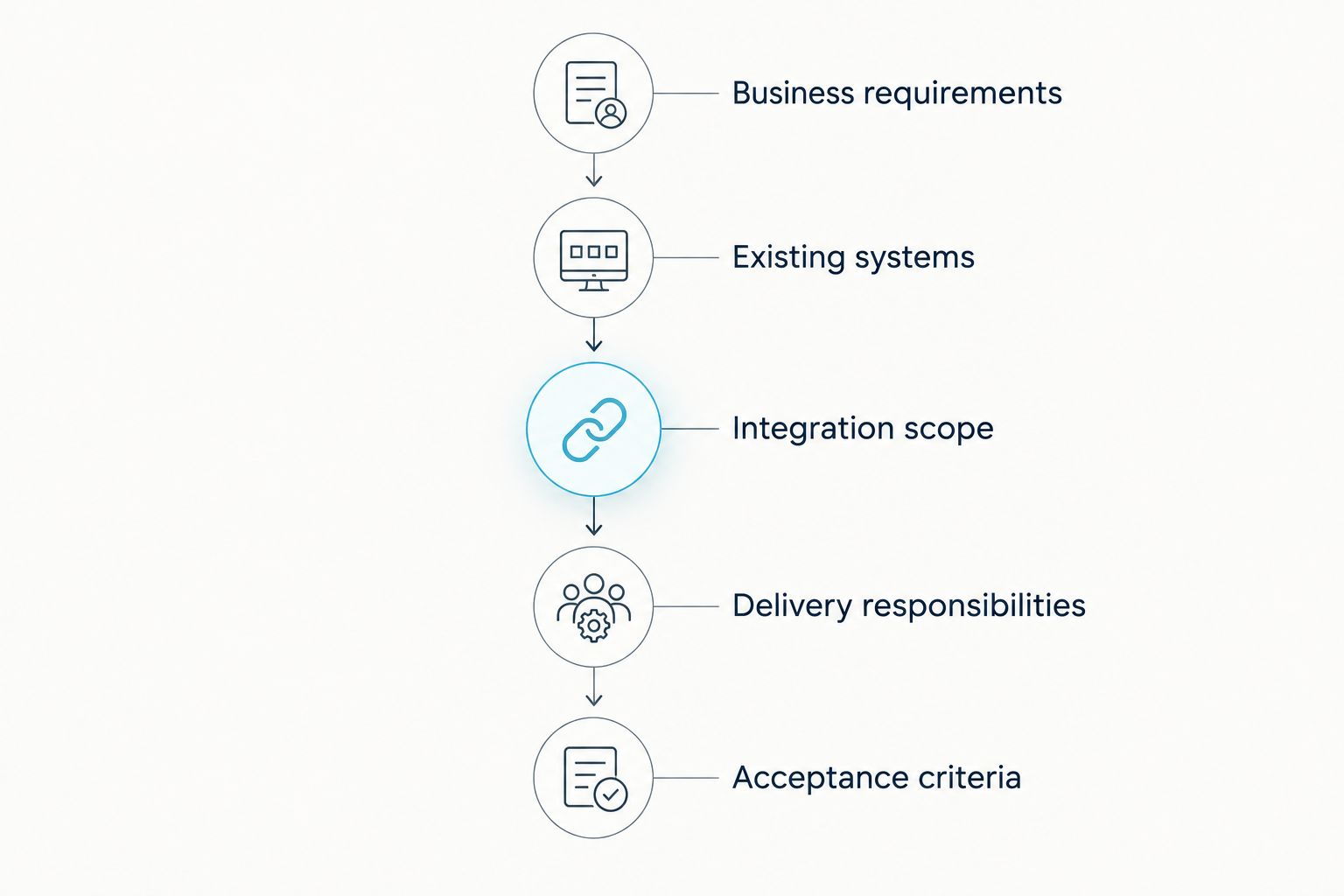
A useful quotation starts with a requirement brief that suppliers can answer consistently. Write the brief before requesting proposals, then send the same version to each supplier. This prevents your comparison from becoming a contest between different interpretations of your needs.
- Business requirements: Describe the processes you need the ERP to support. Separate essential requirements from optional improvements.
- Existing systems: List the software and operational equipment involved. Identify the systems you intend to keep rather than assuming everything will be replaced.
- Integration scope: Describe what information must move between systems. Ask the supplier to confirm feasibility and responsibility before treating the connection as included.
- Delivery responsibilities: Assign installation, data preparation, testing and handover tasks. Make customer responsibilities as visible as supplier responsibilities.
- Acceptance criteria: Define how you will confirm that the agreed work is complete. Connect each acceptance test to a requirement in the brief.
The brief should use business language before technical detail. Explain what staff need to accomplish and which information must remain consistent. Let the supplier map those requirements to the proposed configuration, then ask for that mapping in writing.
If checkout software must connect to the ERP, make the connection a separate item in the brief. Identify which records need to move and who will investigate a failed transfer. The guide to connecting WINTOUCH POS to Primavera ERP provides a related starting point for that discussion; confirm the proposed arrangement with your supplier.
After receiving the proposal, annotate each requirement as included, excluded or awaiting clarification. Do not let an unanswered question disappear into an overall approval. Resolve it before signing, or document the exclusion and its owner.
Define your ERP project requirements
Discuss installation, Primavera/Cegid integration and local support for your business.
Is implementation included in an ERP licence quotation?
Implementation is included only when the quotation explicitly includes it. Look for named installation and configuration tasks, deliverables and responsibilities rather than relying on the presence of the software licence.
Ask the supplier to clarify any setup wording before approval. If your team will perform part of the implementation, document that split so the supplier's scope and your internal plan agree.
Does an ERP quotation include ongoing support?
Ongoing support is included only to the extent stated in the agreement. Ask for the covered activities, exclusions and process for requesting work outside that scope.
Separate help with normal operation from implementation changes. A request to alter a workflow is not automatically the same as a request to resolve a problem with an agreed workflow.
How do I compare Primavera proposals fairly?
Compare Primavera proposals against the same requirements, delivery scope, budget period and tax basis. Start with the differences in inclusions and exclusions before judging the totals.
For a 2026 approval, record the quotation date and applicable terms alongside your comparison. If a supplier revises the scope, update the comparison rather than retaining a total from an earlier version of that proposal.
FAQ
How much does ERP Primavera cost in 2026?
Establish ERP Primavera cost in 2026 through an itemised quote for your agreed business scope. Request separate entries for software, installation, integration and ongoing support so you can assess the complete commitment.
Can I budget using only the Primavera licence quotation?
Use a licence-only quotation only for the software scope it explicitly covers. Budget any required implementation or integration work separately unless the quotation includes those deliverables.
What should I send when requesting a Primavera quote?
Send a requirement brief describing your business processes, existing systems, integration needs and delivery responsibilities. Include acceptance criteria so suppliers can quote against a defined outcome.
Should my ERP quotation show VAT separately?
Your ERP quotation should make its VAT treatment explicit. Compare supplier proposals on the same tax basis, particularly when buying under business terms that exclude VAT.
Is connecting a POS system included automatically?
Do not assume a POS connection is included in an ERP purchase. Ask the supplier to identify the connection, information exchanged, testing responsibilities and ongoing support in writing.
Is Voll relevant if I need Primavera integration?
Voll is relevant for Portuguese business buyers seeking Primavera/Cegid integration and local support. Confirm the installation, integration and support deliverables in the proposal for your specific project.
How do I avoid paying for work I do not need?
Separate essential requirements from optional additions before requesting proposals. Ask suppliers to identify optional work clearly, then approve only the scope needed for your agreed business outcome.
One last thing
Ask what happens when an acceptance test fails before you approve the project. Your agreement should identify who investigates, who corrects the issue and how completion is confirmed. That question connects the purchase to a working result rather than a list of delivered items.
For your 2026 ERP decision, keep the requirement brief, quotation and acceptance criteria together. When a proposed change arrives, compare it with that baseline. You can then distinguish unfinished agreed work from a genuinely new request.