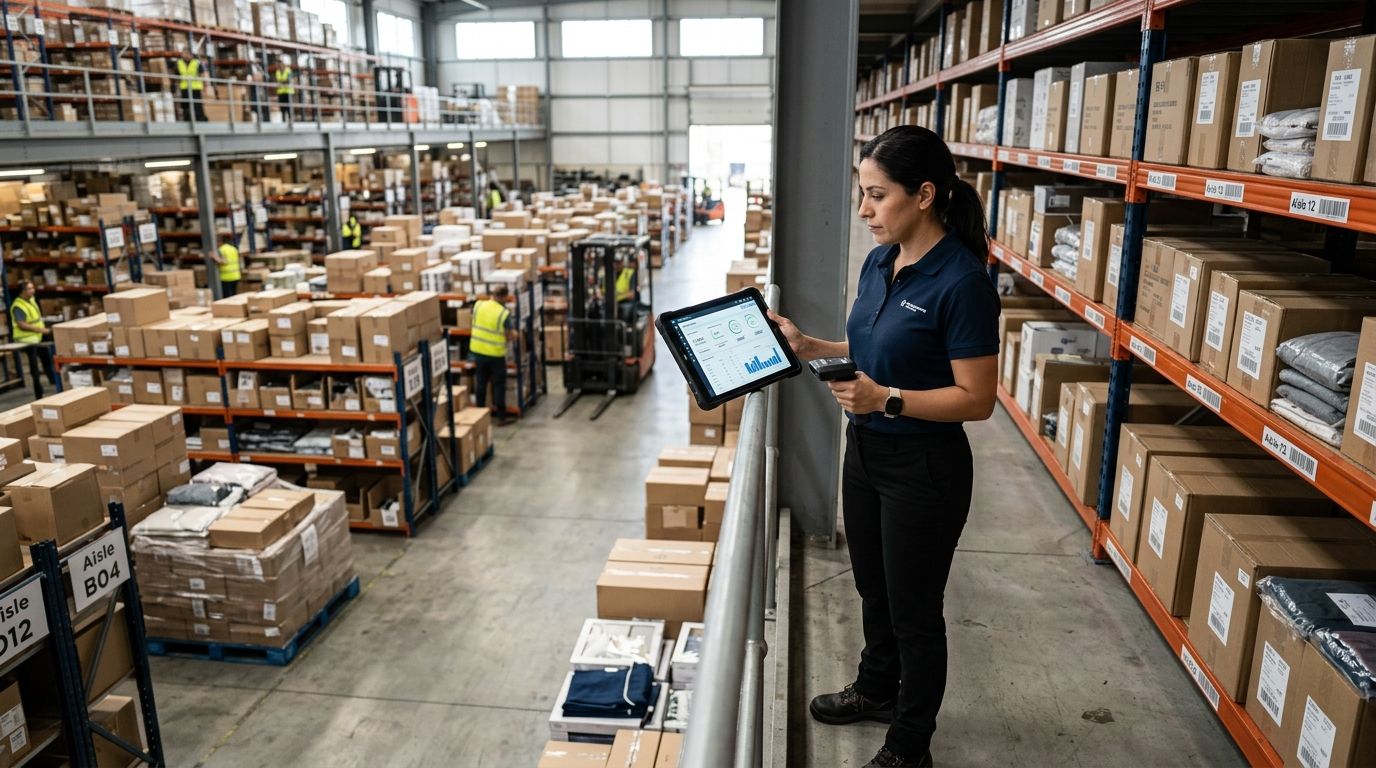
Multi-warehouse retail chain stock management software is the system that tracks inventory across every warehouse and store location in real time, with the goal of cutting stockouts and overstock while keeping every branch working from the same numbers. A single-store retailer can survive on a spreadsheet and a Friday stock count. A chain running three, five, or twenty locations cannot — transfers between warehouses, per-location reorder points, and shared purchasing all need a system that updates the moment a barcode gets scanned, not a system someone reconciles on Monday.
- Software de gestão de stocks para armazéns pays off once a chain runs three or more locations sharing inventory.
- WINTOUCH Cloud for multi-location retail chains puts every warehouse and store on one stock ledger, updated in real time.
- Spreadsheets work for a single warehouse; they break down fast once transfers between locations start happening daily.
- ERP integration via API syncs purchase orders and transfers automatically between Primavera/Cegid and the POS floor.
Why stock management matters for multi-warehouse retail chains
A chain with disconnected inventory systems per store is running blind. One location shows 40 units of a SKU in the system while the shelf has 12, because a transfer from the central warehouse never got logged. Another store reorders stock that's already sitting unsold two branches over. Both problems come from the same root cause: no single, live view of stock across locations.
The fix isn't more headcount doing manual counts — it's a system built for this: WINTOUCH Cloud for multi-location retail chains keeps warehouse and store-level stock in one ledger, so a sale in one branch and a transfer from another both hit the same source of truth immediately. That single fact — one ledger, updated live — is the difference between a chain that scales past five locations cleanly and one that drowns in reconciliation work by 2026's Q3.
How to fix stock management across multiple warehouses
Map every warehouse and store location in one system
Before buying anything, get a clean list of every physical location holding stock — including the ones nobody counts as a "real" warehouse.
- List every warehouse, distribution point, and store back-room with stock on hand
- Assign each location a unique code used consistently across every system
- Note which locations transfer stock to each other regularly
- Flag locations still running on paper or spreadsheets
Standardize SKU and barcode data across locations
Inconsistent SKUs are the single biggest cause of phantom stock in multi-location retail. If warehouse A calls a product "BLU-M-42" and store 3 calls it "BLUE-MED-42", no system can reconcile them.
- Assign one master SKU per product, used everywhere without exception
- Print or re-print barcodes for any SKU with inconsistent labeling
- Remove duplicate product entries created by different stores over time
- Set a naming convention document that every location manager can reference
Automate stock transfers between warehouses and stores
Manual transfer notes — a phone call, a WhatsApp message, a paper slip — are where stock discrepancies start. Every transfer needs a digital record the moment it happens.
- Log every inter-location transfer with quantity, date, and destination
- Require confirmation of receipt at the destination before stock counts update
- Flag transfers still in transit longer than the expected delivery window
- Review transfer logs weekly for locations with repeated discrepancies
Once transfer volume goes past a handful a week, manual logging stops scaling. This is the point where a connected POS/ERP setup earns its keep — transfers recorded in WINTOUCH Cloud update warehouse and store balances at the same time, with no second entry required.
Connect POS and ERP for real-time inventory sync
Running WINTOUCH POS on the shop floor and Primavera or Cegid ERP in the back office only works if the two talk to each other automatically. Without integration, someone is manually re-entering sales and purchase data twice a day, and that's where numbers drift apart.
- Confirm the POS and ERP share the same product catalog and SKU codes
- Set sync frequency to real time or near-real time, not end-of-day batch
- Connect WINTOUCH POS to Primavera ERP via API so purchase orders and sales update stock without manual entry
- Test the sync on a single high-volume SKU before rolling it out chain-wide
Set reorder thresholds per location, not per chain
A chain-wide reorder point ignores the fact that a flagship store sells three times faster than a small satellite location. Uniform thresholds either overstock the slow store or leave the fast one empty.
- Calculate average weekly sales per SKU, per location, not chain-wide
- Set minimum stock levels location by location, reviewed quarterly
- Build in lead time from the central warehouse, not just from the supplier
- Adjust thresholds seasonally for locations with different demand patterns
Equip warehouse staff with reliable scanning hardware
Stock accuracy depends on how easy it is for warehouse staff to log movement at the moment it happens. If scanning is slow or the device drops connection, staff skip steps and stock records fall behind.
- Use handheld barcode scanners for warehouse inventory that sync directly with the stock system, not a standalone app
- Cover warehouse floor space fully so scanners don't lose signal mid-aisle
- Train staff to scan on receipt, transfer, and dispatch — not just at count time
- Replace scanners showing frequent read failures before they cause data gaps
Run cycle counts instead of full annual stocktakes
A full stocktake once a year catches errors twelve months too late. Cycle counting — checking a rotating slice of SKUs weekly — surfaces discrepancies while they're still small and easy to trace.
- Count high-value or fast-moving SKUs weekly, slower-moving stock monthly
- Compare cycle count results against system records immediately, not at month-end
- Investigate any variance over a set threshold (for example, 2% of unit count)
- Log the root cause of each discrepancy — transfer, theft, damage, or data entry
Move off manual stock tracking
See how to migrate from paper or spreadsheets to a connected cloud POS.
Comparing stock management options for multi-warehouse chains
| Option | Best for | Key limitation |
|---|---|---|
| Spreadsheets | A single warehouse, under 200 SKUs | Breaks down fast once transfers happen between locations |
| Standalone POS (no ERP link) | Chains tracking sales only, not full inventory flow | No automated link to purchasing or warehouse stock levels |
| WINTOUCH POS/ERP with Primavera/Cegid integration | Multi-location retail chains needing live stock across warehouses and stores | Requires initial setup and staff training on the new workflow |
| Generic cloud ERP without retail-specific POS | Businesses without a storefront, purely back-office stock | Not built for checkout speed or retail floor operations |
Verdict: for a chain running three or more locations with regular transfers, spreadsheets and standalone POS both fall short — WINTOUCH POS/ERP integrated with Primavera or Cegid is the setup built for this. Buy.
Common mistakes multi-warehouse retail chains make
- Treating each store as its own island. Separate spreadsheets or disconnected POS instances per location guarantee stock counts drift apart within weeks.
- Skipping barcode standardization before rollout. Chains that connect systems before cleaning up SKU inconsistencies just automate the mess faster.
- Ignoring network reliability at the warehouse. A scanner that drops connection mid-shift produces gaps in the stock record that nobody notices until a count comes up short.
- Setting one reorder threshold chain-wide. This either overstocks slow locations or leaves fast ones out of stock during peak weeks.
- Running annual stocktakes instead of cycle counts. By the time an annual count catches an error, the cause is long gone and untraceable.
A chain rolling out stock management software across new locations in 2026 also needs the network behind it to hold up — warehouse Wi-Fi coverage and reliable connectivity between branches matter as much as the software license itself. Multi-branch VPN connectivity is the piece most chains underestimate until a warehouse loses sync mid-shift.
FAQ
What is the best stock management software for multi-warehouse retail chains in 2026?
WINTOUCH POS/ERP integrated with Primavera or Cegid is the strongest fit for chains running three or more locations, because it keeps warehouse and store stock on one live ledger instead of separate systems per site.
Is spreadsheet stock tracking enough for multiple warehouses?
Spreadsheet tracking works for a single warehouse under a few hundred SKUs, but it breaks down once transfers between locations start happening regularly, since nobody updates every copy at the same time.
How does WINTOUCH POS connect to Primavera ERP?
WINTOUCH POS connects to Primavera or Cegid ERP through an API integration that syncs sales, purchase orders, and stock transfers automatically, removing the need for manual double entry between systems.
How often should a retail chain count stock across warehouses?
High-value or fast-moving SKUs should be cycle counted weekly, with slower-moving stock checked monthly, rather than relying on one annual stocktake that catches errors months too late.
What causes stock discrepancies between store locations?
Most discrepancies trace back to inconsistent SKU naming across locations, untracked manual transfers, or scanning hardware that drops connection during warehouse operations.
Do multi-warehouse chains need barcode scanners integrated with the stock system?
Yes — handheld scanners that sync directly with the POS/ERP stock system prevent the lag that happens when staff log movements on paper or in a separate app first.
What network setup do multiple warehouses need for stock scanning?
Reliable Wi-Fi coverage across the full warehouse floor and stable connectivity between branches are needed so barcode scans and transfer confirmations sync in real time instead of queuing until a connection drops back in.
One last thing
The chains that struggle most in 2026 aren't the ones without software — they're the ones running three or four disconnected systems that each claim to be the source of truth. Fix the SKU standardization problem before adding any new software, because integrating a clean, consistent product catalog takes a fraction of the time that untangling it after go-live does.


