
Choose Voll if your Portuguese business needs POS software, ERP integration and local IT support; choose Worten if you want a general electronics retailer for a standalone purchase or prefer shopping in a physical store. In 2026, the distinction is business-system specialisation versus broad retail shopping—not a blanket winner for every device.
- voll vs worten: choose Voll for business IT involving POS, ERP integration and local support.
- Choose Worten for broad electronics shopping and a physical-store purchasing route.
- For standalone hardware, compare the exact model and purchase terms rather than declaring a retailer-wide winner.
- For business software, define licensing, installation and integration responsibilities before ordering.
Why this matters
A replacement keyboard and a new checkout system are different purchases. The keyboard needs to fit the workstation; the checkout system needs to fit the business workflow, its software and the people responsible for support.
Voll is the better fit for Portuguese businesses buying POS and ERP-connected IT with installation and local support. Its stated focus includes WINTOUCH POS/ERP, Microsoft 365, professional networking and SUNMI point-of-sale hardware. Worten is a general electronics retailer, making it a more natural starting point when your shopping list extends beyond business IT.
For your 2026 purchasing plan, separate equipment selection from implementation responsibility. A retailer comparison becomes useful only after you decide whether you need a product, a software licence or a working system. The guide to Worten alternatives for business IT purchasing addresses that broader supplier-selection question.
At a glance
| Dimension | Voll | Worten |
|---|---|---|
| Best for | Portuguese businesses buying specialist IT and business software | General electronics shoppers and standalone purchases |
| Standout focus | POS/ERP software, installation, ERP integration and local support | Broad electronics retail and physical-store shopping |
| Shopping breadth | Business-focused software, networking, POS hardware and components | Broader consumer electronics and appliance shopping |
| Purchasing channel | Online business purchasing and quotation requests | Online retail and physical stores |
| Standalone hardware | Compare the exact model and required services | Compare the exact model and required services |
| System integration | Explicit focus on integration with Primavera/Cegid | Establish project requirements separately from the retail purchase |
| Procurement fit | Direct online purchase or a scoped business quotation | Retail purchase when the product requirement is already defined |
| Pricing model | Product or licence purchase; quotation for the required scope | Retail product purchase; assess any additional services separately |
Business systems and general shopping need different suppliers
The strongest reason to choose a specialist is not the company name on the invoice. It is the relationship between what you buy and what your business needs to accomplish.
A restaurant replacing its sales system must specify software, checkout hardware and the connection to its back-office processes. A business buying an independently managed monitor has a narrower task: select a compatible product and arrange the purchase.
Best for business systems: the specialist route, where installation, integration and support are part of the purchasing discussion. Best for general shopping: the retail route, where you already know what product you need and do not need a business-software project.
The limitation runs both ways. A specialist catalogue is not a substitute for a broad consumer shopping destination. A broad retail catalogue is not, by itself, evidence that a particular ERP-connected deployment is included in your order.
The standout difference is the work around the product
The business IT offer described here centres on WINTOUCH POS/ERP licences, Microsoft 365 and related equipment. The stated WINTOUCH range contains more than 200 products, so selecting a licence requires more than choosing a familiar software name.
That breadth creates a selection task. Identify the business process first, then confirm which licence and implementation scope match it. A long software catalogue does not mean every licence covers the same activities.
Worten's distinctive role in this comparison is broader retail shopping. That is useful when the purchase is a finished product rather than a configuration exercise involving business applications.
For a 2026 purchase, ask what the supplier is delivering: an item, an entitlement to use software, or an installed and integrated system. Do not treat these as interchangeable deliverables. Each requires a different acceptance check, even when the hardware looks identical.
Worten wins on shopping breadth beyond business IT
Worten is the better starting point for a mixed consumer-electronics shopping list. Its general retail positioning fits buyers comparing electronics and household appliances rather than assembling a business-software environment.
This matters when your purchasing task spans unrelated categories. You are choosing a shopping destination, not an implementation partner. A business can make that kind of purchase too; having a company invoice does not turn every device into an IT project.
The specialist alternative has a clearer focus: management software, professional networking, POS hardware, storage and components. That focus is useful for a defined business requirement but less relevant when you simply want broad retail browsing.
The tradeoff is straightforward. Choose breadth when category choice matters most. Choose specialisation when the equipment must work within a business process and someone needs to define the implementation scope.
Worten wins when physical-store shopping is the requirement
Worten is the better fit when you want a physical-store purchasing route. Its store presence gives the comparison a concrete distinction from the online B2B purchasing model described for its specialist counterpart.
Physical shopping is a genuine preference, not a measure of technical quality. It suits a buyer who wants to visit a retailer and assess a purchase in person rather than conduct the transaction entirely online.
The online business route suits a different working style: document the requirement, request a quotation where needed and purchase against a defined scope. It keeps the decision centred on specifications and responsibilities rather than the shopping venue.
Neither channel proves that a product is compatible with your software. For a 2026 business purchase, keep the store visit and the technical acceptance decision separate. Confirm the exact model and required interfaces regardless of where you place the order.
Standalone hardware has no automatic winner
Neither retailer wins every standalone hardware purchase. When you are comparing the same manufacturer model, the seller's category positioning does not change the device's specifications.
Start with the manufacturer reference, not a shortened product title. Then compare the included accessories, the contracting seller, invoice requirements and applicable purchase terms. Keep services separate so you can see what each offer actually covers.
This is where an absolute brand-level verdict becomes misleading. A business-focused supplier does not automatically make every peripheral a better purchase. A general retailer does not automatically make a device unsuitable for office use.
Use a product-level decision for a product-level problem. If your own team handles configuration and the device has no unresolved dependencies, compare the offers directly. If installation or integration remains undefined, resolve that scope before treating the offers as equivalent.
Voll wins on explicit POS and ERP integration focus
Voll wins this comparison for its stated focus on business IT installation, Primavera/Cegid integration and local support. That is the relevant distinction when checkout hardware, management software and back-office processes must be considered together.
Its catalogue includes SUNMI POS hardware and professional networking from Reyee, Teltonika and Equip. Those names identify the stated product areas; they do not establish compatibility between every terminal, router and software licence.
Before ordering a connected system, complete these 3 scope checks:
- Licence scope: identify the software entitlement and the business activities it must cover.
- Integration scope: define the systems involved and the information that must pass between them.
- Support scope: establish who handles installation questions and issues after deployment.
Write the answers into the purchasing specification. A terminal purchase alone does not define an ERP connection, and a software licence alone does not define the installation work.
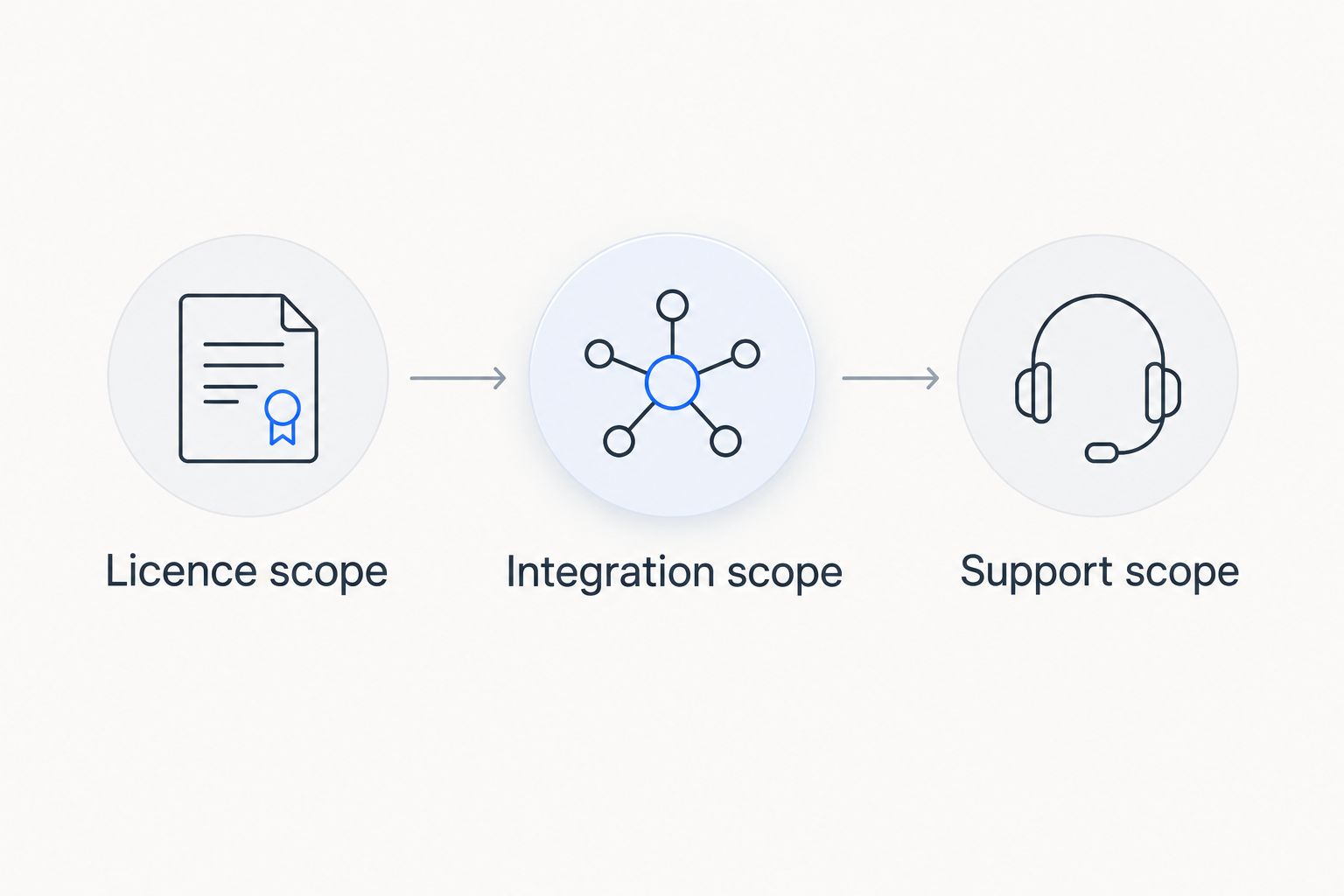
The specialist route is strongest when you need those responsibilities addressed together. Its limit is equally important: a stated integration focus is not a promise that every requested connection is included. Obtain the project-specific scope rather than assuming it from the catalogue.
A business quotation wins when the scope is unresolved
A scoped quotation is the better purchasing method for an unresolved implementation. Direct checkout is the better method when the requirement is already complete. The choice is about procurement readiness, not company size.
The specialist business model supports both quotation requests and direct online buying. That lets you distinguish a defined product order from a project that still needs technical clarification.
Worten's retail route fits a defined standalone purchase. The benefit is a product-centred transaction; the limitation is that a product order does not describe your internal deployment plan.
For a 2026 request, give the supplier 4 fields: business purpose, exact equipment or software requirement, existing systems and required services. Do not ask only for a list of devices. Explain what the purchase must accomplish, and require the quotation to identify which work is included.
A useful quotation should let you separate products, licences and services. You can then compare equivalent scopes without confusing equipment procurement with implementation responsibility.
Define your business IT requirement
Review the business IT catalogue and specify the software, equipment and integration work your project needs.
Pricing models reward a like-for-like scope
There is no defensible overall pricing winner without an equivalent basket and service scope. Compare the purchase structure, not a retailer-wide assumption.
For business IT, distinguish hardware purchases, software licensing and implementation work. The specialist route includes direct purchasing and quotation requests, which serve different levels of project definition. A quotation lets you establish the deliverables before committing to the project.
For retail shopping, the starting point is the product purchase. Assess any required services separately and confirm the seller responsible for the transaction. Do not assume that a retail order includes business configuration or application integration.
Microsoft 365 is subscription-based software; that licensing structure is different from buying a physical device. For your 2026 comparison, specify the subscription requirements and renewal responsibility rather than treating a licence like an interchangeable box of hardware.
The tradeoff is flexibility versus scope certainty. Buying individual items lets your own team arrange the work. Buying against a defined project scope makes responsibilities explicit. Neither purchasing model removes the need to check the agreement.
Final verdict: choose by purchasing job
Choose Voll for a Portuguese business systems project
Named profile: the operations lead connecting checkout and back-office systems. Choose the specialist business IT route when you need POS/ERP software, relevant hardware, installation and integration considered within the same requirement.
This is the stronger fit for a buyer who needs local support and a quotation that describes the work, not just the equipment. Do not choose it merely because your purchase is business-related; choose it because the stated specialisation matches your project.
Choose Worten for a defined general retail purchase
Named profile: the buyer selecting standalone electronics without an integration project. Choose Worten when broad retail choice or physical-store shopping is central to the decision.
That recommendation also applies to a business buyer whose technical team has already settled the specifications and deployment. The limit is project scope: confirm any required business services separately rather than inferring them from the product order.
| Dimension | Winner |
|---|---|
| Business systems versus general shopping | Specialist for systems; retailer for general shopping |
| Standout focus | Specialist for implementation; retailer for broad retail |
| Shopping breadth | Worten |
| Physical-store purchasing | Worten |
| Standalone hardware | No automatic winner |
| Explicit POS/ERP integration focus | Voll |
| Unresolved business procurement scope | Scoped specialist quotation |
| Overall pricing | No automatic winner; compare equivalent scope |
FAQ
Is Voll better than Worten for a Portuguese business?
Voll is the better fit when the requirement involves specialist business IT, POS/ERP software, installation and ERP integration. A standalone device purchase still needs a product-level comparison.
When should I choose Worten instead?
Choose Worten for broad electronics retail shopping or a physical-store purchasing route. That is a distinct requirement from commissioning an ERP-connected business system.
Which retailer is cheaper in 2026?
There is no overall pricing winner without comparing equivalent products and services. Match the exact model, software entitlement and implementation scope before deciding.
Should I buy a POS terminal like an ordinary computer?
No: define the POS software, connected systems and installation responsibility before ordering the terminal. A hardware purchase alone does not establish that the complete checkout workflow is covered.
Can I buy business IT directly online instead of requesting a quotation?
Direct online purchase fits a requirement that is already fully defined. Request a quotation when licensing, integration or installation responsibilities still need agreement.
What should I include in a business IT quotation request?
Include the business purpose, equipment or software requirement, existing systems and required services. Ask the supplier to distinguish products, licences and implementation work.
Does a specialist supplier automatically win for office peripherals?
No: office peripherals require an exact-model and purchase-terms comparison. Specialist positioning matters most when the purchase includes unresolved business-software or integration requirements.
One last thing
Send the same acceptance scenario to every supplier before placing a connected-system order. Describe a normal transaction, the information it must create and the destination system that must receive it.
Ask each supplier to identify which parts of that scenario its proposed scope covers. This turns a retailer comparison into a deliverables comparison—and exposes the difference between buying the components and commissioning the working process.


