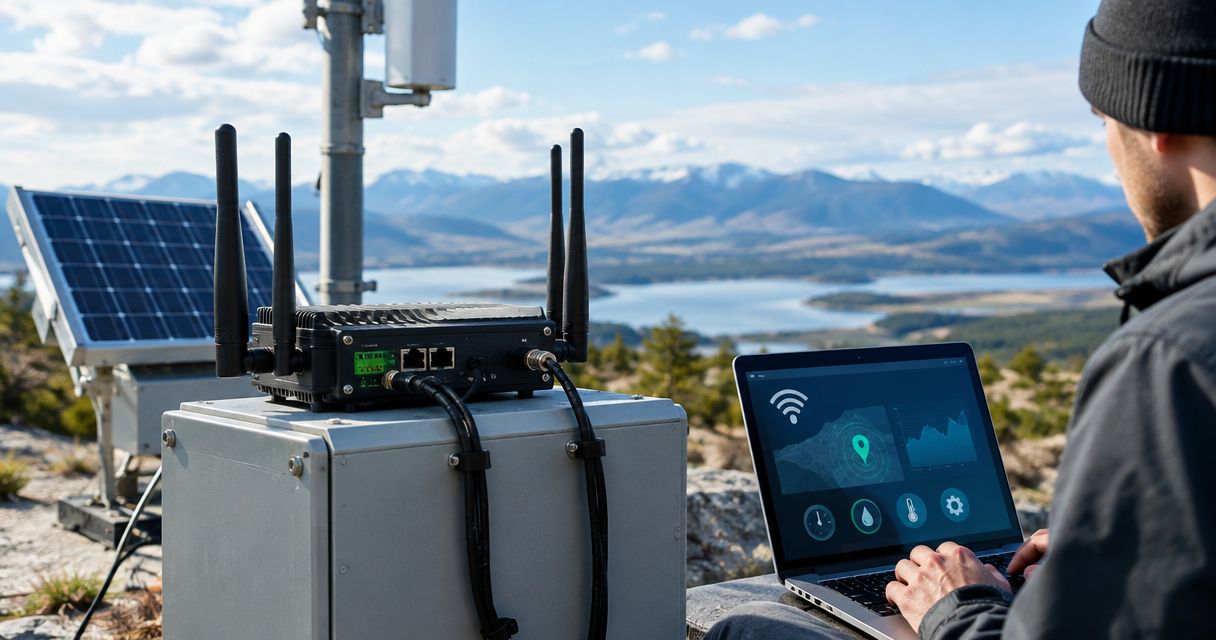
Industrial 4G routers keep remote sites, vending machines, ATMs, kiosks and IoT sensors online when fibre isn't an option and Wi-Fi isn't reliable enough. Best overall: Teltonika RUT956. Best for fleet and mobile deployments: Cradlepoint IBR900. Best for mission-critical uptime: Peplink MAX BR1. Best budget option: Teltonika RUT240. Best for large-scale IoT fleets: Digi IX20.
- Teltonika RUT956 is the best overall industrial 4G router for 2026, built for DIN-rail installs with dual-SIM failover and VPN.
- Cradlepoint IBR900 wins for vehicle and fleet connectivity thanks to automotive-grade certification and GPS tracking.
- Peplink MAX BR1 is the pick for sites that cannot tolerate downtime, using multi-carrier bonding instead of simple failover.
- Teltonika RUT240 is the budget entry point for a single remote sensor or till that just needs a stable 4G uplink.
- Digi IX20 fits operations managing hundreds of remote devices from one central dashboard.
Why this matters
A remote site without a wired connection depends entirely on its cellular router. If that router drops a SIM and doesn't fail over automatically, a warehouse scanner, a POS terminal or a remote camera goes dark until someone drives out to reset it.
VOLL's B2B catalog covers exactly this gap for Portuguese companies running branch offices, delivery fleets and unattended sites — see VOLL for the full network equipment range. Picking the wrong router for the deployment type is the most common mistake: a router built for a parked vehicle is not the same product as one built for an outdoor DIN-rail cabinet running at -30°C in winter.
What makes the best industrial 4G router
- Dual-SIM automatic failover — switches carriers without manual intervention when one network drops
- Rugged, DIN-rail mountable enclosure — survives cabinets, vehicles and outdoor boxes without a fan
- Remote management platform — a cloud dashboard to push configs and monitor uptime across sites
- VPN support — IPsec, OpenVPN or WireGuard for secure tunnels back to head office
- Serial and digital I/O ports — talks to legacy PLCs, sensors and alarm panels, not just Ethernet devices
- Wide operating temperature range — rated for unheated cabinets and outdoor enclosures, not just office desks
At a glance
| Router | Best for | Standout feature | Key limitation |
|---|---|---|---|
| Teltonika RUT956 | Industrial IoT and remote site monitoring | DIN-rail mount with dual-SIM failover and I/O ports | Needs RMS subscription for full fleet management |
| Cradlepoint IBR900 | Fleet and mobile connectivity | Automotive-grade certification, GPS tracking | Not built for static outdoor cabinet installs |
| Peplink MAX BR1 | Mission-critical uptime | SpeedFusion multi-carrier bonding | Configuration overhead for single-site jobs |
| Teltonika RUT240 | Budget single-site deployments | Compact dual-SIM router at entry cost | Fewer I/O ports, lower throughput ceiling |
| Digi IX20 | Large-scale IoT device fleets | Digi Remote Manager scales to thousands of units | Overkill and costly for a handful of sites |
1. Teltonika RUT956: best industrial 4G router for remote site monitoring
The RUT956 is built for the cabinet-and-sensor use case: DIN-rail mounting, dual-SIM failover, and RS232/RS485 serial ports alongside digital I/O for legacy equipment. It runs the standard VPN protocol set (OpenVPN, IPsec, WireGuard) so a remote pump station or unmanned kiosk can tunnel securely back to a central network without a technician on site.
Teltonika RUT956 pros:
- Dual-SIM failover keeps a remote site online when one carrier drops
- Serial and digital I/O ports connect to PLCs, alarms and legacy hardware directly
- Wide operating temperature range suits unheated outdoor cabinets
- Local installation and integration support available through VOLL's network equipment desk
Teltonika RUT956 cons:
- Initial VPN and failover configuration assumes some networking knowledge
- Full fleet-wide monitoring requires the Teltonika RMS cloud platform, an added step to set up
- The DIN-rail form factor isn't the most compact option for tight indoor spaces
Teltonika RUT956 verdict: Buy. It's the safest default for any business standardizing on one industrial 4G router across multiple remote sites in 2026.
Best for: industrial IoT sensors, remote monitoring cabinets, unattended kiosks.
2. Cradlepoint IBR900: best industrial 4G router for fleet and mobile deployments
Cradlepoint built the IBR900 around vehicles, not cabinets — automotive-grade certification, GPS location tracking, and integration with the NetCloud management platform for pushing configuration to hundreds of vans or trucks at once. It's the router category delivery and field-service fleets reach for when a static DIN-rail box doesn't fit the use case.
Cradlepoint IBR900 pros:
- Automotive-grade design tolerates vibration and voltage swings in a moving vehicle
- GPS tracking built in, useful for fleet dispatch without a separate device
- NetCloud dashboard manages large numbers of vehicles from one screen
Cradlepoint IBR900 cons:
- Not the natural choice for a fixed outdoor cabinet or warehouse installation
- NetCloud is a subscription platform, an ongoing line item beyond the hardware
- Less common in Portuguese B2B stock than Teltonika, which can mean longer lead times
Businesses already standardized on Teltonika hardware for other sites can compare a fleet-specific alternative on the Teltonika routers for delivery fleets page rather than mixing two brands.
Cradlepoint IBR900 verdict: Buy for vehicle fleets specifically, Skip for fixed-site deployments.
Best for: delivery fleets, field-service vans, mobile route sales.
3. Peplink MAX BR1: best industrial 4G router for mission-critical uptime
Peplink's SpeedFusion technology bonds multiple SIM connections into one link instead of just switching between them on failure. For a site where even a 30-second gap during failover is unacceptable — a payment terminal, a live video feed, a critical monitoring alarm — bonding beats simple failover.
Peplink MAX BR1 pros:
- SpeedFusion bonding removes the failover gap entirely, not just shortens it
- InControl cloud management covers configuration and monitoring across sites
- Supports multiple carrier SIMs simultaneously for combined throughput, not just redundancy
Peplink MAX BR1 cons:
- Bonding features add configuration complexity most single-site deployments don't need
- Running multiple active SIMs increases the monthly data cost versus a failover-only setup
- Overkill for a low-bandwidth sensor that only needs to check in once an hour
Peplink MAX BR1 verdict: Buy for uptime-critical applications, Wait if a simple failover router already meets the need.
Best for: payment infrastructure, live monitoring feeds, sites with zero acceptable downtime.
4. Teltonika RUT240: best budget industrial 4G router for a single remote site
The RUT240 strips the RUT956 down to the essentials — dual-SIM, VPN support, compact enclosure — without the extra serial ports and I/O. For a single remote till, a standalone sensor, or a small site that just needs a stable internet uplink, it's the entry point into the same product family without paying for capacity you won't use.
Teltonika RUT240 pros:
- Dual-SIM failover on a compact, affordable router
- Same VPN protocol support as the larger RUT956
- Small footprint fits tight installation spaces
Teltonika RUT240 cons:
- No RS232/RS485 serial ports, so it can't talk to legacy PLC equipment
- Lower throughput ceiling than the RUT956 or IBR900
- Narrower operating temperature range than the fully industrial DIN-rail models
Teltonika RUT240 verdict: Buy for single low-bandwidth sites, Skip if the site has legacy serial equipment to connect.
Best for: single remote sensors, small kiosks, one-off backup connections.
5. Digi IX20: best industrial 4G router for large-scale IoT fleets
Digi's IX20 is built for the operation running hundreds of remote devices rather than a handful. Digi Remote Manager handles configuration push, firmware updates and health monitoring across an entire fleet from one console, which matters once a business passes the point where checking each router by hand is realistic.
Digi IX20 pros:
- Digi Remote Manager scales cleanly to hundreds or thousands of units
- Strong industrial certifications for demanding environments
- Dual-SIM failover included as standard
Digi IX20 cons:
- The management platform and licensing overhead isn't worth it below a few dozen sites
- Stock and local support in the Portuguese market are thinner than for Teltonika
- Setup complexity is higher than a plug-and-play single-site router
Digi IX20 verdict: Buy for large multi-site rollouts, Skip for a single office or warehouse.
Best for: utility companies, large retail chains, national IoT sensor networks.
How the ranking works
Each router is scored against the six criteria above: failover behavior, ruggedness, remote management, VPN support, I/O ports and temperature rating. No single router wins every category — the RUT956 leads on I/O and price-to-feature ratio, the IBR900 wins on vehicle-specific certification, the BR1 wins on zero-downtime bonding, and the IX20 wins on fleet-scale management. The ranking order matches the table above, not a single overall score.
Get an industrial 4G router quote for 2026
Set up a business account and order network equipment with local installation support.
Which industrial 4G router should you choose?
For most remote-site and IoT deployments in 2026, the Teltonika RUT956 is the default choice — DIN-rail mounting, dual-SIM failover and legacy I/O ports cover the majority of unattended installations without paying for fleet-management overhead you don't need yet. Move to the Cradlepoint IBR900 only if the connection is riding in a vehicle, to the Peplink MAX BR1 only if a failover gap is genuinely unacceptable, and to the Digi IX20 only once the site count runs into the hundreds. Businesses running branch offices instead of unattended remote sites should compare against business-grade routers for branch connectivity rather than an industrial cellular model, and any site that already has a wired connection but needs a backup path fits the 4G LTE backup router category instead.
FAQ
What is the best industrial 4G router for 2026?
The Teltonika RUT956 is the best overall industrial 4g router for 2026 for most remote-site and IoT deployments, thanks to DIN-rail mounting, dual-SIM failover and legacy serial ports. Fleet, mission-critical and large-scale use cases have their own better fit further down the ranking.
Is a dual-SIM router necessary for a remote site?
Yes, if the site cannot tolerate downtime when one mobile carrier drops signal or has an outage. A single-SIM router leaves the site offline until someone manually swaps the connection or drives out to reset it.
What's the difference between an industrial 4G router and a consumer 4G router?
An industrial router adds DIN-rail mounting, a wider operating temperature range, serial and digital I/O ports for legacy equipment, and remote management for multiple units. Consumer routers are built for one home network, not a fleet of unattended sites.
Do I need 5G instead of 4G for an industrial deployment?
Most industrial IoT and remote monitoring traffic is low-bandwidth and doesn't need 5G speeds; 4G LTE routers remain the standard for 2026 deployments because coverage is broader and hardware costs less. 5G matters more for high-bandwidth video or bonded multi-site links.
Can an industrial 4G router replace a fixed internet line entirely?
Yes, for sites where running fibre or DSL isn't practical, a dual-SIM industrial 4G router can serve as the primary connection rather than a backup. Bandwidth and monthly data cost are the two factors to check against the site's actual traffic.
How much does an industrial 4G router cost in Portugal?
Cost varies by SIM slot count, I/O ports and management platform included, so request a quote against your specific site count and requirements rather than assuming a flat number.
Is Cradlepoint or Teltonika better for a delivery fleet?
Cradlepoint's IBR900 is purpose-built for vehicles with automotive-grade certification and GPS tracking, while Teltonika's fleet-oriented models suit businesses that want to standardize on one brand across fixed sites and vehicles. The right pick depends on whether the fleet is the only deployment or one part of a mixed site portfolio.
What VPN protocols should an industrial 4G router support?
Look for OpenVPN, IPsec and WireGuard support at minimum, since these cover most head-office tunnel requirements for 2026 network security standards. A router missing all three limits which VPN setup the IT team can standardize on.
One last thing
The detail most buyers skip is the SIM data plan itself, not the router: a dual-SIM failover router bought with two SIMs from the same carrier's infrastructure doesn't protect against a regional outage, only against one SIM's data cap running out. Pair the router with SIMs from two genuinely separate mobile networks, or the failover feature is decorative.


