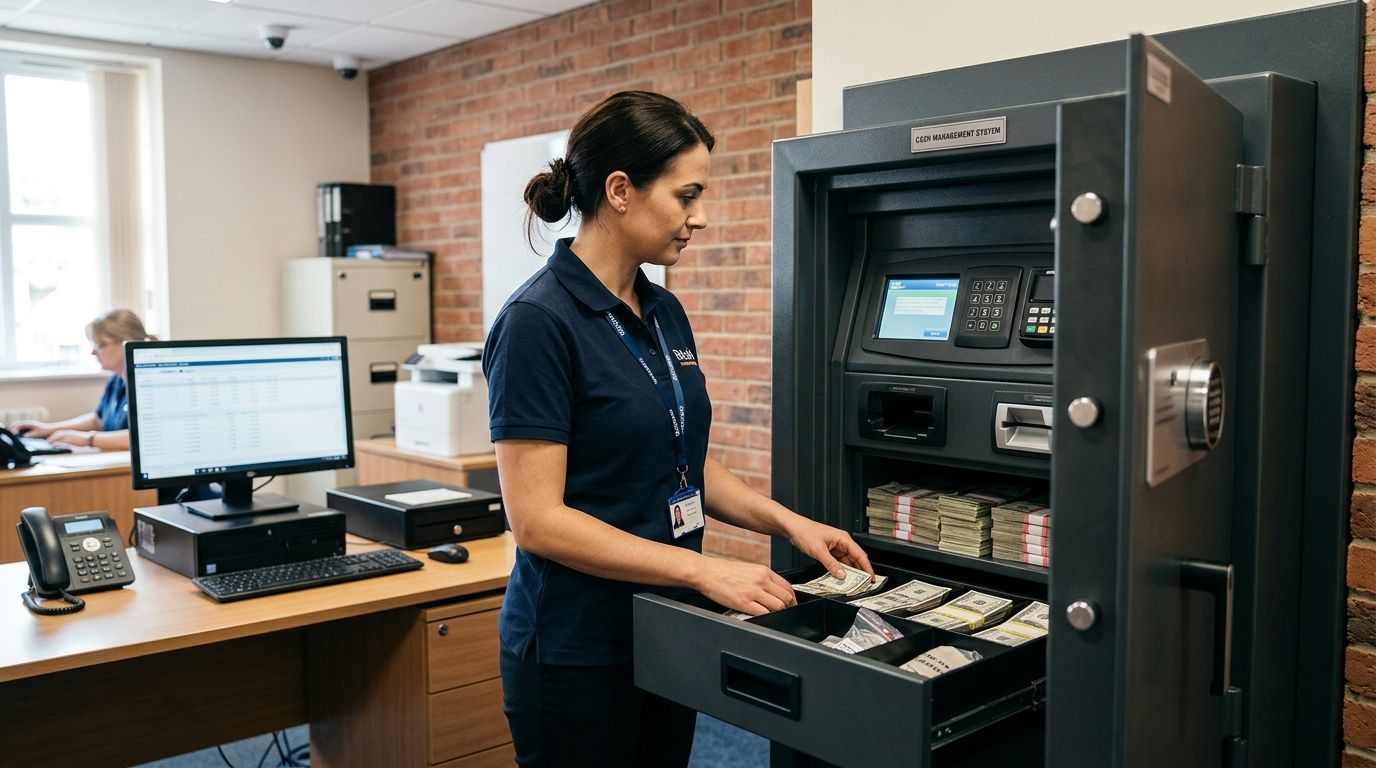
Retail back-office cash management safes protect the cash a store handles between the register and the bank, cutting counting time, limiting who touches deposits, and creating a paper trail an auditor can follow without asking the store manager to remember anything. Retail back-offices differ from other segments because cash moves fast, multiple shifts touch the same drawer, and the safe has to work alongside POS reporting, not as a separate silo.
- Cash management safes for retail cut count time and limit who touches deposits between shifts.
- Smart safes and drop safes solve different problems — volume and shrinkage risk decide which one fits.
- A safe with no link to POS reporting still leaves a manual reconciliation gap in 2026.
- Dual-custody access and a fixed pickup schedule close most of the theft exposure a single-key safe leaves open.
Why cash management matters for retail back-offices
A retail counter generates cash exposure every hour it is open, and the back-office is where that exposure either gets controlled or quietly leaks. Count errors and unlogged access both concentrate around the point where cash leaves the drawer and enters the safe — that handoff is exactly what a cash management safe is built to control.
Most retail stores already run cash drawers at the checkout counter tied to a POS system. The safe is the next link in that chain: it is where shift totals land before the deposit goes to the bank, and it is the point where a store either has an audit trail or does not.
In 2026, the safe and the POS reporting should be treated as one workflow, not two separate purchases. A safe that cannot be reconciled against register totals just moves the same manual count problem one room over.
Assess your daily cash volume and risk
Start with what actually moves through the drawer, not what a vendor recommends. A single boutique with two shifts a day has a different risk profile than a small supermarket running six registers.
- Track average daily cash intake for at least two full weeks, including weekend peaks
- Count how many employees currently have access to the existing safe or lockbox
- Note how often deposits get delayed past the scheduled bank run
- Flag any past discrepancy between register close-out and deposit total
- Check whether cash volume varies enough by season to need more capacity at certain times of year
Choose the safe type that matches your store
Safe types split mainly by how much manual handling they remove, not by size. A drop safe is a slot you feed cash into with no unlocking required at the counter; a smart safe counts and validates bills as they go in.
- Drop safe: staff insert an envelope or bag, no counting on-site, simplest deterrent
- Smart safe or cash recycler: counts and validates each note, reduces manual recount at close-out
- Under-counter safe: bolts into the counter itself, fast access for frequent small deposits
- Dual-custody floor safe: requires two people or two codes to open, suits higher cash volume stores
- Look for a UL Group 1 lock or a TL-rated body if the store has had break-in attempts before — these ratings measure resistance to drilling and prying, the two most common physical attacks
Position the safe where it deters, not just stores
Placement changes both the deterrent value and the practical speed of end-of-day close-out. A safe bolted where it is visible from the sales floor discourages tampering; one buried in a back corner with no camera coverage does the opposite.
- Bolt the safe to the floor or a load-bearing wall, never leave it freestanding
- Keep it within sight of the IP security cameras for retail store surveillance already covering the back office
- Avoid placing it next to an exterior wall or loading door
- Keep the safe location out of window sightlines from the street
- Route the safe location into your insurance and emergency documentation
Set dual-custody access controls
A single-key safe means a single point of failure. Retail back-offices with more than one shift manager should never rely on one person holding sole access.
- Require two codes or two keys for any safe holding more than a day of average deposits
- Rotate access codes when a keyholder leaves the company, not only on a fixed schedule
- Log every safe opening with a timestamp and the employee name, on paper if nothing digital exists
- Separate who counts the drawer from who opens the safe
- Review the access list monthly, not annually
Connect the safe to your POS and reporting workflow
This is where the safe stops being a standalone box and becomes part of the store cash control system. Manual reconciliation between register totals and safe deposits is the step most retail back-offices skip, and it is the step where discrepancies hide longest.
Running end-of-day sales reports in WINTOUCH POS alongside the safe deposit log turns a manual count into a same-day match. Voll covers that POS side of retail cash management — reporting software, drawers and the hardware around the counter — while the safe itself stays a separate piece of equipment that has to feed the same numbers.
- Print or export the register close-out report before the safe deposit, not after
- Match the deposit total against the POS report the same day, not at month-end
- Flag any variance over a fixed threshold for manager review immediately
- Keep the safe deposit log and the POS report in the same file, not two systems
- With multiple registers, consolidate all shift totals before the safe deposit
Build a pickup and deposit schedule
An overloaded safe is a bigger target and a bigger loss if it is ever compromised. A fixed schedule for cash pickup and bank deposit limits how much sits in the store at any one time.
- Set a maximum cash-on-hand threshold per safe and trigger a pickup when it is hit
- Vary the timing of a manual bank run rather than repeating the same slot daily
- Confirm the deposit bag is sealed and logged before it leaves the building
- Keep backup power in mind for POS and safe electronics — a UPS for POS systems and cash registers avoids a mid-count power cut on a smart safe
- Document the pickup schedule in writing so it survives staff turnover
Audit and reconcile on a fixed calendar
Cash controls decay fast without a repeating check. A safe configured correctly in January 2026 can drift by mid-2026 if nobody revisits the access list or the reconciliation habit.
- Run a full physical count against the logged total at least monthly
- Rotate who performs the audit so nobody checks their own work
- Cross-check safe deposit logs against bank statements quarterly
- Update the access list and codes any time the audit finds a gap
- Keep audit records for at least the length of your tax retention requirement
Comparing cash management safe options
| Option | Best for | Key limitation |
|---|---|---|
| Drop safe | Low-volume stores wanting a simple deterrent | No counting or validation, still needs manual reconciliation |
| Smart safe or cash recycler | Multi-shift stores wanting less manual counting | Higher setup effort and a staff training curve |
| Under-counter safe | Fast, frequent small deposits at a single register | Limited capacity, not built for bulk end-of-day deposits |
| Dual-custody floor safe | Higher cash volume stores needing shared control | Slower access, requires two people present |
Get your retail back-office set up right
Match your cash workflow to POS reporting and counter hardware.
Common mistakes retail back-offices make
- Treating the safe as a single purchase, not a workflow. A safe with no reconciliation habit attached still leaves the same manual gap it was bought to close.
- Giving every shift manager the same access code. One code for everyone means no way to trace who opened the safe when a discrepancy appears.
- Skipping the same-day match against POS totals. Waiting until month-end to compare deposits against register reports buries small discrepancies until they compound.
- Placing the safe out of camera range. A safe with no visual coverage loses most of its deterrent value, whatever its lock rating.
- Sizing for today's volume only. Stores that grow past their original cash volume during 2026 often find the safe undersized within a year and delay the upgrade until a problem forces it.
FAQ
What is a cash management safe for retail?
A cash management safe for retail is a secured unit used to store cash between register close-out and bank deposit, often with logging or counting features. It sits at the end of the POS cash cycle, after the drawer and before the deposit.
What is the difference between a drop safe and a smart safe?
A drop safe only accepts cash through a slot with no counting, while a smart safe validates and counts each note as it is inserted. Smart safes cut manual recount time at close-out but cost more to set up and train staff on.
Is a smart safe worth it for a small retail store in 2026?
It depends on daily cash volume and how many shifts handle the drawer. A single-shift boutique rarely needs one, while a multi-register store closing out several times a day usually recovers the setup effort in reduced counting time.
Where should a cash management safe be positioned in a store?
Bolt it to the floor or a load-bearing wall, within camera coverage, and away from exterior walls or loading doors. Visibility from the sales floor adds deterrent value beyond the lock itself.
How does a cash management safe connect to POS reporting?
The safe deposit log gets matched against the POS end-of-day sales report on the same day, so discrepancies surface immediately instead of at month-end. That reconciliation step is what turns a safe from storage into a control.
What safe rating should a retail store look for?
Look for a UL Group 1 lock or a TL-rated body, which measure resistance to drilling and prying, the two most common physical attacks on retail safes. Stores with past break-in attempts should prioritise the rating over convenience.
How often should retail staff access the safe?
Access should be limited to scheduled deposit and pickup times, with dual custody required for anything above the store average daily deposit. Frequent unlogged access is one of the biggest gaps in retail cash controls.
Can one safe serve a multi-location retail chain?
No. Each location needs its own safe and its own reconciliation routine, though a chain can standardise the safe type, access policy and reporting workflow across all sites.
One last thing
The safe rating matters less than most retail back-offices assume. A UL Group 1 lock resists drilling and prying, but it does nothing against the far more common failure: a discrepancy nobody noticed because the deposit log was never matched against the POS report that same day. Fix the reconciliation habit before upgrading the hardware — a simpler safe with same-day matching beats an expensive one checked only at month-end in 2026.


