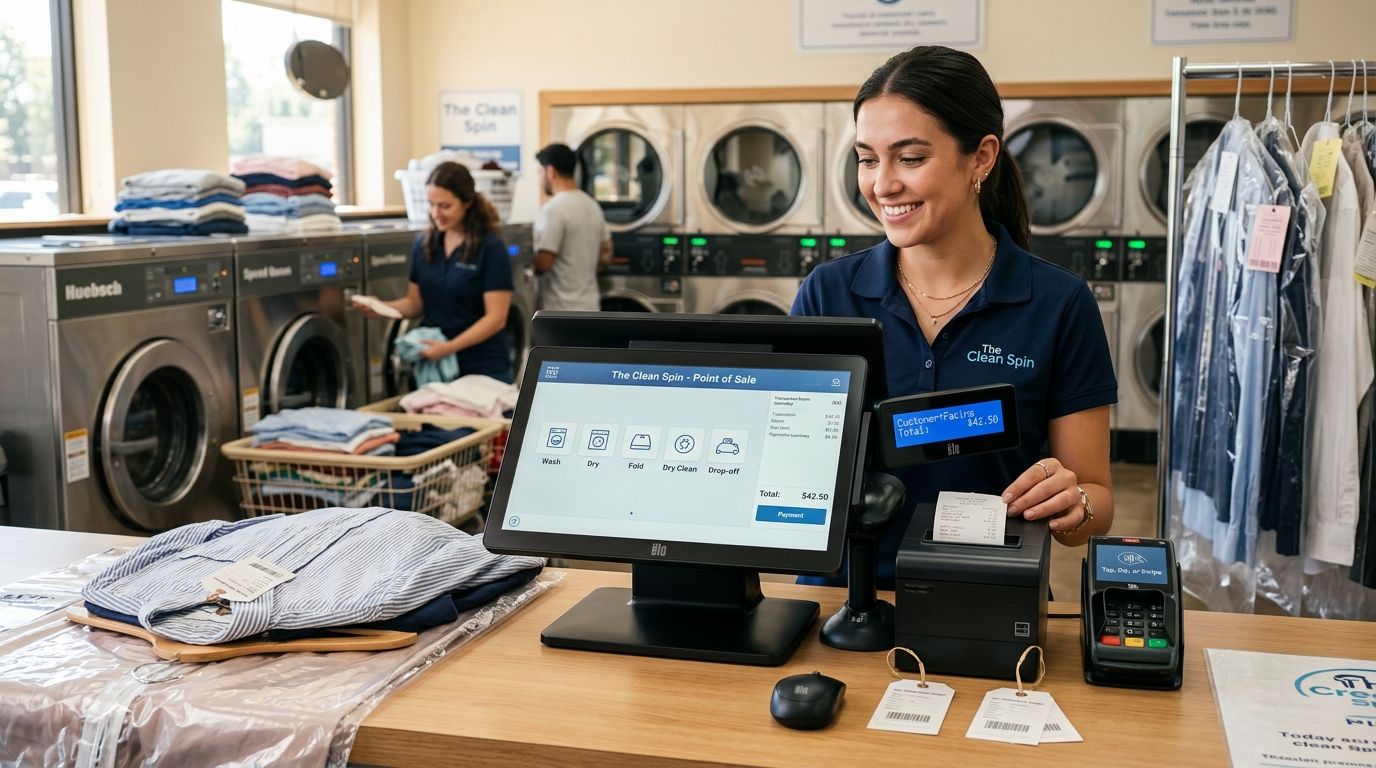
A complete POS terminal for laundromats and dry cleaners is a hardware-and-software bundle — terminal, cash drawer, ticket printer, barcode scanner and card reader — configured to track wash cycles, garment tickets and repeat customer accounts, with the goal of cutting counter time and eliminating lost orders. Self-service laundromats and drop-off dry cleaners run on ticket-based order tracking and irregular walk-in traffic, which behaves nothing like a retail counter selling fixed-price items off a shelf.
- A complete POS terminal for laundromats needs ticket status tracking, weight-based billing and garment tag scanning — not just card payments.
- WINTOUCH POS handles order status, per-garment pricing and loyalty credit for repeat wash-and-fold customers in 2026.
- Battery backup on the terminal is non-negotiable; a power blip mid-shift without one means re-keying every open ticket.
- Paper tickets still work under roughly 50 orders a week at one location, and stop working the moment you add a second service line.
Why POS setup matters for laundromats and dry cleaners
A laundromat sells a promise, not a product: come back Thursday and the order is ready. That promise breaks the second a paper ticket disappears or the till fails to reconcile against what actually left the shop.
This segment runs three revenue streams through one counter — self-service machine credit, wash-and-fold priced by weight, and dry cleaning priced per garment. A complete POS terminal for laundromats has to price all three without three separate systems, and it has to do it while staff are handling wet bags and hangers. That's the practical difference from a generic retail setup, and it's why a bookstore or boutique bundle doesn't transfer cleanly.
The second difference is the customer lookup. Retail customers pay and leave. Laundry customers come back three to seven days later, frequently without the claim ticket, and expect the counter to find their order from a phone number in under ten seconds. Any system that can't do that lookup creates a queue. A thermal receipt printer rated for continuous ticket printing is part of that, because every garment bundle needs a durable tag, not a fading receipt.
How to set up a complete POS terminal for laundromats
Map your service lines before buying hardware
Don't order a terminal until the ticket structure is written down. Every service line needs its own pricing logic in software, or staff will improvise prices at the counter and the margin walks out the door.
- Self-service machine top-ups (coin, card or stored credit)
- Wash-and-fold priced by weight tiers in kilograms
- Dry cleaning priced per garment with category codes for shirts, suits, coats and bedding
- Household items priced per piece — duvets, curtains, rugs
- Rush and same-day surcharge tiers
- Commercial accounts for hotels, gyms and restaurants billed monthly
Choose the terminal and the peripherals that survive the room
Most complete kits ship with a screen, cash drawer and card reader. The components that actually decide whether the setup lasts three years in a laundromat are the ones nobody looks at in the spec sheet: the printer duty cycle, the enclosure rating and the scanner.
- A lockable cash drawer that logs every open against a staff ID
- A ticket printer built for continuous runs, not occasional receipts
- A barcode or QR scanner for garment tags and claim tickets
- A card payment terminal that reconciles automatically into the day's till
- Battery backup sized to keep the terminal and printer alive through a short outage
- A sealed or wipe-clean terminal surface — steam and detergent residue kill consumer keyboards fast
A complete POS terminal for laundromats assembled from mismatched consumer-grade parts fails at the printer first. A dry cleaner processing 80 garments a day prints far more tags than a boutique prints receipts, and a low-duty-cycle thermal head fades or jams within months.
Configure ticket tracking and order status
This is the step generic retail POS software skips entirely. Each ticket needs a status field — dropped off, in process, ready, collected — plus search by phone number, surname and ticket number.
WINTOUCH POS software handles order status inside the same screen used for checkout, so staff aren't flipping between a till and a separate spreadsheet while three people wait. Set the statuses up on day one, before any live tickets exist, because retrofitting status codes onto 400 open orders is miserable work.
- Four or five statuses maximum — more than that and staff stop updating them
- Phone number as the primary customer lookup key
- A flag for orders uncollected past 30 days
- Notes field per garment for stains, damage and customer instructions
Set weight and per-garment pricing rules
Manual pricing at the counter is where margin leaks quietly. Every on-the-fly discount has to surface somewhere in reconciliation, and a paper ticket never captures it.
- Weight tiers with an automatic rounding rule (round up to the next 0.5 kg, for example)
- Per-garment category pricing so a suit and a shirt never carry the same code
- Rush surcharge as a percentage or a flat add-on, applied by the system not by memory
- Commercial account rates applied automatically when the account is selected
- A permission setting that requires a manager code for any manual price override
Add loyalty credit and repeat-customer accounts
Laundromats live on repeat visits inside a two-kilometre radius. Stored credit and visit-based rewards are the cheapest retention tool in the building, and running them in the POS instead of on a punch card means you keep the contact data.
- Prepaid balance customers can top up and draw down across visits
- Visit counters that trigger a reward automatically at a set threshold
- Customer contact details captured at first drop-off, not at reward redemption
- Gift credit for corporate or seasonal promotions
Connect the till to your accounting workflow
A till that balances daily but never reaches the books creates the same work twice. Route end-of-day totals into the accounting or ERP system that handles invoicing and VAT reporting instead of re-keying figures every month.
- Daily close-out export in a format your accountant accepts
- VAT breakdown split by service line
- Monthly invoicing for commercial laundry accounts
- Sales history retained for a full tax year minimum
Plan the network before opening day
A cloud POS with a single unprotected internet line is one outage away from a cash-only afternoon. Wired connections beat Wi-Fi at the counter, and a failover path is cheap insurance for a shop that takes card payments on 70% of transactions.
- A wired connection from the terminal to the switch, not Wi-Fi
- Mobile failover for the payment terminal
- Separate network segment for customer Wi-Fi if you offer it
- Automatic offsite backup of sales data, verified once a month
Get a quote for your laundromat POS setup
Pricing on terminal, ticket printer and software bundles sized to your location count.
Comparing the options for this segment
| Option | Best for | Key limitation |
|---|---|---|
| Paper tickets and a cash box | A single location under roughly 50 orders a week | No status tracking, no customer data, manual VAT reconciliation |
| Generic retail POS software | Shops selling fixed-price items only | No weight tiers, no per-garment codes, no ticket status field |
| WINTOUCH POS terminal bundle | Laundromats and dry cleaners running two or more service lines | Requires upfront setup of pricing tiers and staff training |
| POS integrated with ERP | Chains of three or more sites needing consolidated accounts | Overkill for a single-counter operation |
Verdict: a one-site laundromat under 50 tickets a week survives on paper, but any operator combining wash-and-fold with dry cleaning — or running a second location — needs a ticket-tracking POS terminal, and WINTOUCH POS is built for that exact mix.
“If a customer arrives without their ticket and the counter can't find the order from a phone number in ten seconds, the system is wrong.”
Common mistakes laundromats and dry cleaners make
- Pricing dry cleaning by memory instead of by code. Every manual override becomes a discrepancy at close-out, and after six months nobody can explain the gap.
- Skipping battery backup on the terminal. A power cut mid-shift on an unprotected terminal means reconstructing every open ticket from memory — which in practice means giving several orders away free.
- Running loyalty on stamp cards. Cards get lost and the shop never captures a phone number, so there's no way to reach customers who stopped coming.
- Buying a printer rated for light retail use. Garment tag volume in a dry cleaner burns a low-duty-cycle thermal head far faster than receipt printing in a boutique.
- Never exporting the till to accounting. Totals sit in the POS while someone re-types them into a spreadsheet monthly, doubling admin for no reason.
- Letting uncollected orders pile up untracked. Without a 30-day flag, abandoned garments occupy rack space that paying orders need.
FAQ
What's the best complete POS terminal for laundromats in 2026?
A WINTOUCH POS setup paired with a lockable cash drawer, a continuous-duty ticket printer, a barcode scanner and a card terminal covers self-service credit, wash-and-fold and dry cleaning from one counter. It fits multi-service operators better than generic retail POS software.
Is a barcode scanner necessary for a dry cleaning POS setup?
Yes, if you tag individual garments. A scanner cuts counter time on multi-item orders and sharply reduces mismatched claim tickets compared with reading paper tags by eye.
Can one terminal handle both self-service machine credit and dry cleaning tickets?
Yes, provided the software supports separate pricing logic per service line. The same terminal needs weight tiers for wash-and-fold and per-garment codes for dry cleaning configured as distinct rules.
Do I need battery backup for a laundromat POS terminal?
Yes. A power interruption mid-transaction on an unprotected terminal risks losing the day's ticket and payment data, which then has to be rebuilt by hand.
How does loyalty tracking work in a laundromat POS?
Customers hold a prepaid balance or a visit counter tied to their account inside the POS instead of a paper punch card. The shop keeps the contact details and the repeat-visit history automatically.
What's the difference between a retail POS and a laundromat POS?
A retail POS prices fixed items off a shelf. A laundromat POS adds order status tracking, weight-based billing and per-garment pricing tiers that standard retail systems don't include.
Should a multi-site dry cleaning chain use the same setup as a single shop?
The terminal and software can match, but a chain benefits from ERP integration for consolidated accounting across sites. A single-counter operation does not need that layer in 2026.
How long does it take to set up a POS terminal for a laundromat?
The hardware is a same-day job; the pricing configuration is the real work. Budget time to enter every garment category, weight tier and surcharge rule before the first live ticket.
One last thing
The operators complaining loudest about lost tickets in 2026 are rarely the ones without a POS. They're the ones who bought a terminal, never finished configuring per-garment codes, and let staff keep improvising prices at the counter. The hardware fixes nothing by itself — the pricing rules and status fields inside the software are what stop orders from vanishing.


